GEO vs SEO: what is genuinely different
We sorted every line item on a published GEO proposal into three piles: genuinely new work, renamed SEO, and things you are already buying. One pile is much smaller than the sales pitch suggests.

- Google's own documentation states that optimizing for its generative AI features is still SEO, and points buyers of GEO services at its guidance on evaluating third party SEO advice.
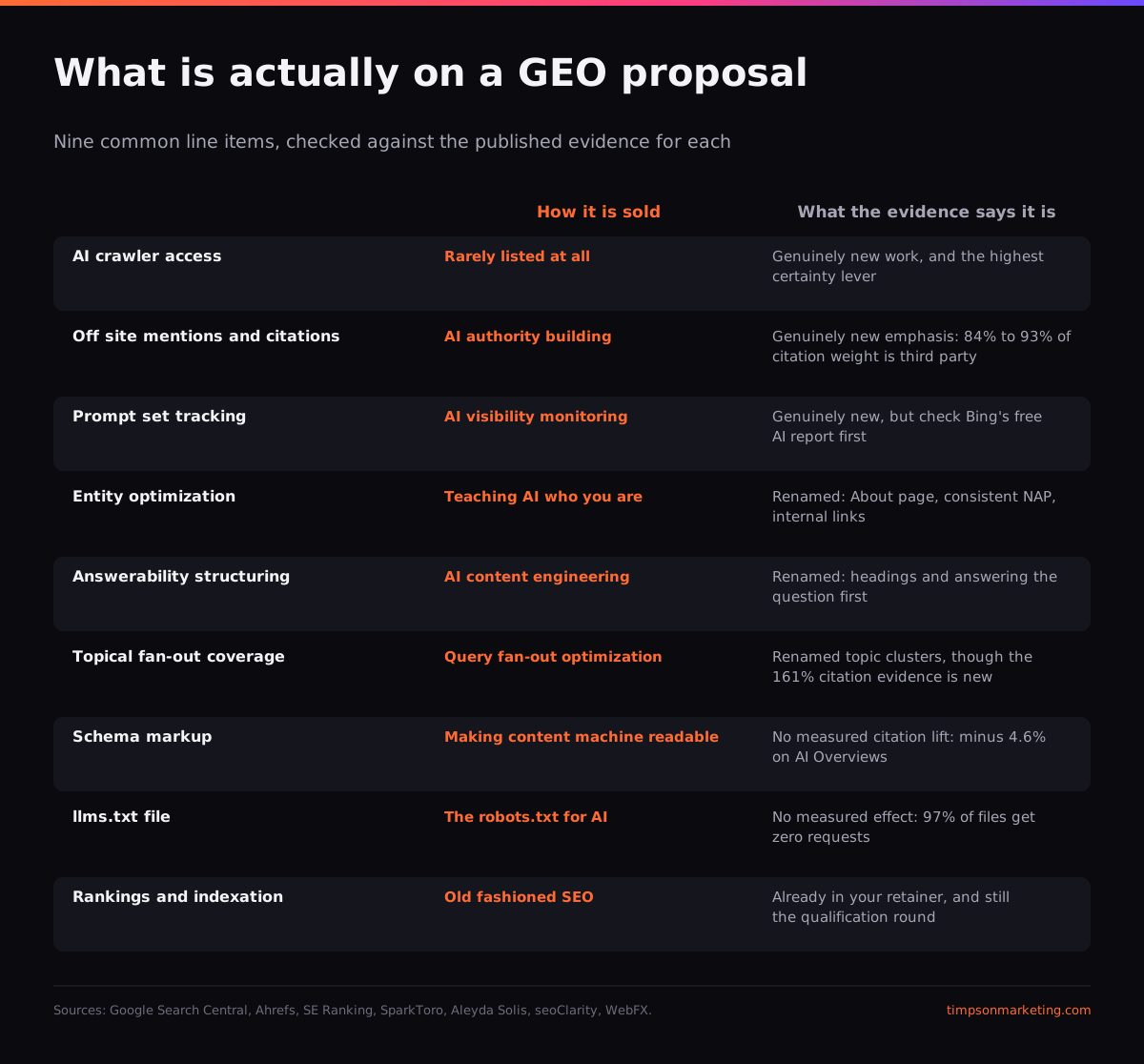
- Three tasks on a GEO proposal are genuinely new work: AI crawler access, earning mentions on third party pages, and measuring by repeated sampling instead of one screenshot.
- Schema markup and llms.txt are two of the most heavily sold GEO deliverables, and the published studies on both show no citation lift.
- Roughly half a typical GEO scope is work your existing SEO retainer already covers, which means the risk is not that GEO is fake, it is that you pay for the same hours twice.
- You almost certainly do not need a second retainer. You need one scope that names the three genuinely new tasks and prices them once.
The one paragraph answer
Of the deliverables on a typical GEO proposal, three are genuinely new work and most of the rest are things a competent SEO retainer already does. The genuinely new three are AI crawler access, earning mentions on third party pages the models actually read, and measuring by repeated sampling instead of one screenshot. Everything else is either renamed SEO or a tactic with no measured effect. You do not need a second retainer. You need one scope that names the new three and prices them once.
WebFX sells generative engine optimization at $1,500 to $50,000 per month and publishes what you get: AI visibility monitoring, updates to priority pages and FAQs, schema markup and crawlability work, competitor prompt tracking, and reporting.
Read that list again. Three of those five are line items on the invoice you are already paying.
That is not an accusation of fraud. It is the actual shape of the work, and the search engine itself says so in writing. Google's documentation states plainly that optimizing for generative AI search is still SEO. The problem is not that GEO is fake. The problem is that a discipline with an eighty percent overlap is being sold as a second product at a second price.
Below is every common line item, sorted into four piles. We are an agency that sells this work, so read the sorting critically. Every claim is linked to the study or the documentation it came from.
of agencies say clients are now asking for AI search optimization, the top new service request of 2026
Pile one: the three tasks that are genuinely new work
These did not exist in a 2019 SEO scope. They are the only part of GEO that deserves its own budget line.
1. AI crawler access. OpenAI documents four separate bots, and they do different jobs. GPTBot collects training data. OAI-SearchBot is the one that decides whether you can appear in ChatGPT search answers. OpenAI states that sites opted out of OAI-SearchBot will not be shown in ChatGPT search answers. Block the wrong one and you have protected nothing while deleting yourself from an answer surface. Anthropic runs three crawlers on the same train, search and user fetch split, and says blocking Claude-SearchBot may reduce your visibility in Claude search results.
This is a ten minute check on a robots.txt file and a firewall rule set. On a local service business site the blocker is rarely a deliberate decision. It is a security plugin default, a CDN bot rule someone switched on after a spam wave, or a staging directive that survived the launch. Nobody signed off on removing the company from ChatGPT. It just happened, quietly, and nothing else in the scope matters until it is undone.
AI crawler access is also the item most often missing from GEO proposals, because it is not billable for very long. It is the highest certainty lever in the category and nobody can sell you twelve months of it.
2. Earning presence on pages you do not own. This is the biggest genuine change. Across fifteen brands measured on ChatGPT and Google AI Mode, Aleyda Solis found that third party sources generate 84% to 93% of citation weight. Ahrefs separately found that only 38% of AI Overview citations come from pages ranking in the top 10, down from roughly 76% in its own July 2025 measurement.
The skill is old. Digital PR, review platforms, industry directories and getting listed in the roundups people actually cite is what good publicists have always done. The weighting is new. If your whole plan is your own website, you are optimizing the smaller half.
3. Measurement by repeated sampling. A single screenshot of ChatGPT naming your competitor proves nothing, and there is now hard data saying so. SparkToro ran 12 prompts through 2,961 combined runs across ChatGPT, Claude and Google's AI with 600 volunteers and found almost no chance of the same brand list appearing twice.
AIs do not give consistent lists of brand or product recommendations. If you don't like an answer, or your brand doesn't show up where you want it to, just ask a few more times.
Ranking the three honestly: access is close to certain, off site presence is strongly evidenced but correlational, and measurement is real work that mostly protects you from being sold noise. If a proposal covers only the third one, you are buying a dashboard.
Pile two: the same work with a new invoice header
None of these are wrong. All of them are old.
- Entity optimization. In practice this is a clear About page, one consistent business name, address and phone across the web, and internal links that connect your service pages. That was local SEO in 2015.
- Answer engine content structuring. Microsoft's own product team wrote that clear headings, tables, and FAQ sections help AI systems reference content accurately. That is on page SEO with a new adjective.
- Topical coverage for query fan-out. Building clusters of related pages instead of one page per keyword. The tactic is old. The evidence behind it is genuinely new: Surfer analyzed 10,000 keywords and 173,902 URLs and found pages ranking for both the main query and its fan-out subqueries were 161% more likely to be cited.
- Content freshness. Seer Interactive looked at 7,683 cited pages and found 75% had been updated within the last year. Updating old posts is not a new service.
The renaming is not automatically dishonest. Language moves. It becomes dishonest at the exact moment it is billed a second time, on a second contract, by the same agency that was already meant to be doing it.
Pile three: the line items with no measured effect
These are the two most heavily sold GEO deliverables in the market, and both have real studies against them.
Schema markup. Ahrefs tracked 1,885 pages that added JSON-LD against 4,000 matched control pages and measured the difference before and after. AI Overview citations fell 4.6%, while AI Mode and ChatGPT moved by amounts indistinguishable from zero.
Adding schema produced no major uplift in citations on any platform.
Google agrees in its own words: structured data is not required for generative AI search, and there is no special schema.org markup you need to add. Schema still earns rich results in classic search, so keep it. Just do not let anyone charge you a GEO premium for it. We went deeper on that trade off in whether schema markup is worth paying for.
llms.txt. SE Ranking checked nearly 300,000 domains and found no relationship between having the file and being cited. Ahrefs then checked server requests across 137,210 domains and found 97% of llms.txt files got zero requests in May 2026. Google's documentation now states that llms.txt files will neither harm nor help your visibility.
Two independent methodologies, one vendor neutral confirmation from the search engine, and a null result each time. If llms.txt is a headline item on your proposal, that tells you what the rest of the proposal was researched to.
Pile four: the invoice you already have
The uncomfortable part for the GEO sales pitch is that the biggest single input to AI visibility is the thing you were already buying.
Google's documentation is explicit: to be eligible for generative AI features, a page must be indexed and eligible to be shown with a snippet. A stray noindex or nosnippet tag zeroes out your AI visibility no matter what else is in the scope.
Ranking still carries weight too. seoClarity analyzed 362,000 US desktop keywords and found 94% of AI Overviews included at least one URL from the top 20 organic results, with position one appearing 43% of the time. That sits alongside the Ahrefs finding that most individual citation slots go to non ranking pages. Both are true because they measure different things: nearly every AI answer contains a ranking page, while most of the citation slots inside it do not.
So like I've said many times, if you drop in Google, you can drop in AI Overviews, AI Mode, and downstream at AI search platforms like ChatGPT.
For a local service business the same logic runs through Google Maps. Sterling Sky analyzed 322 markets and found AI local packs surfaced only 5,943 unique businesses against 18,330 in traditional 3-packs, roughly a third as many winners. Fewer slots, same qualification round. If your profile does not rank now, an AI layer on top of it will not rescue you. That is the same argument we make in how to rank higher on Google Maps.
Why the overlap is this wide
Because the retrieval system underneath is the same system. Google's documentation states that its generative AI features are rooted in its core Search ranking and quality systems, and that they work by pulling from those systems and by firing a set of concurrent related queries it calls query fan-out.
That fan-out step is where the one real structural change hides, and almost nobody explains it properly. Your customer types one question. The model quietly turns it into several narrower questions and retrieves against those. Ahrefs measured this across 1.4 million ChatGPT prompts and found that the titles of cited pages matched ChatGPT's own internally generated subqueries more closely than they matched the user's original prompt, at a cosine similarity of 0.656 against 0.602, while retrieved but uncited pages sat at 0.484.
Read in plain terms: the competition moved down a level. You are no longer competing for "emergency plumber Salt Lake City" alone. You are competing for the four or five narrower questions the model invents on the way to answering it, such as what a burst pipe call costs after hours and who is licensed to do it. Building pages for those subquestions is the same discipline as building topic clusters. The level it happens at is what changed.
Then Google goes further than any agency will. Its guide names the acronyms directly and tells you where to send them:
> If you're considering third-party "AEO" or "GEO" advice or services, review our guidance on evaluating third-party SEO advice.
That guidance on third party SEO tools and services is worth ten minutes of any owner's time. It says Google does not evaluate third party services, that using a tool does not guarantee ranking success, and that good advice either flags its claims as opinion based on data and experience or cites official Google guidance. That is a usable filter for reading any proposal, including ours.
abandoning SEO for GEO is not sophistication. It is usually a failure to understand the machinery.
The honest synthesis is narrower than either sales pitch. GEO is not a replacement discipline and it is not pure marketing either. It is a set of three additions bolted onto a stack that did not change. Anyone telling you the foundation moved has an invoice to justify. We laid out the full version of that argument on our GEO versus SEO service page.
## How to read a GEO proposal in ten minutes Run the scope through these six questions before you sign anything. This is the same list we would want a prospect to run on us.
Get a free AI visibility audit→- Does it name specific AI crawlers, not just "AI bots"? OAI-SearchBot, Claude-SearchBot and PerplexityBot should appear by name.
- Does it separate the new work from work already in my current SEO contract, in writing, line by line?
- Is llms.txt listed as a deliverable? If yes, ask which study supports it.
- Is schema markup priced as an AI citation lever, or correctly as a classic rich result play?
- Does the measurement plan describe repeated runs across a fixed prompt set, or a monthly screenshot?
- Does it include off site work on pages I do not own, given that is where most citation weight sits?
If the answer to question two is a shrug, stop there. You are not evaluating a strategy, you are evaluating a billing structure. The same test applies to your existing provider, which is why we wrote how to tell if your SEO agency is working.
So should you pay for both?
No. You should pay for one scope with the three new tasks named inside it.
Here is the split as we would price it for a local service business doing between one and twenty million a year.
| Sold as GEO | What it really is | |
|---|---|---|
| AI crawler access audit | Premium AI service | New work, one time, small hours |
| Off site citation and mention earning | GEO authority building | New emphasis, old skill, ongoing |
| Prompt set tracking and reporting | AI visibility monitoring | New work, but check for free first party tools first |
| Entity and answerability optimization | AI content engineering | Your existing on page SEO |
| Schema markup | AI readability layer | Classic rich results, no measured citation lift |
| llms.txt implementation | AI access file | No measured effect at all |
| Rankings, indexation and reviews | Rarely mentioned | Still the qualification round |
The reason to care about any of this is not citations. It is calls. An AI answer that names three contractors and not you removes you from consideration before the customer ever opens a browser tab, and no dashboard will show you the job you never heard about. That is the honest argument for the three new tasks, and it is also the reason we refuse to promise a citation count. Nobody can, and anyone who does is selling a number they do not control.
One more thing worth knowing before you negotiate: check the free first party reporting before you buy a dashboard. Microsoft launched an AI Performance report in Bing Webmaster Tools covering Copilot citations. Google gives you less. Its documentation says traffic from AI Overviews and AI Mode is folded into the overall Web search type in Search Console rather than reported separately, so you cannot isolate AI performance there at all. Price any monitoring line item against what those two already give you, not against zero.
If you want the wider picture on what these tools are and where they differ, start with our breakdown of AI Overviews, AI Mode and ChatGPT, then read why AI does not recommend your business. If the number on the proposal is the part bothering you, what local SEO actually costs and how long it takes are the two we send owners most often. Everything else we have published sits in the Timpson Marketing blog.
Frequently asked questions
Is GEO replacing SEO?
No. Google's own documentation says its generative AI features are rooted in its core Search ranking and quality systems, and that a page must be indexed and snippet eligible to appear in them. AI answers are a layer on top of the same retrieval stack, not a replacement for it.
Do I need to pay for GEO on top of my SEO retainer?
Almost never. Three tasks are genuinely new: AI crawler access, off site mention earning, and repeated sampled measurement. Ask your current provider to add those three to the existing scope. A separate contract usually means you are paying twice for the overlapping work.
What is the actual difference between GEO and SEO?
SEO aims to win a clickable position in a results page. GEO aims to be selected as a source inside a generated answer. The retrieval systems underneath are largely shared, which is why most of the tasks are shared too. The genuine differences are crawler access, off site weighting, and measurement.
Does schema markup help me get cited by AI?
The best available evidence says no. Ahrefs compared 1,885 pages that added JSON-LD against 4,000 controls and found AI Overview citations fell 4.6 percent, with other platforms showing effects indistinguishable from zero. Google states structured data is not required for generative AI search. Keep schema for rich results, not for AI.
Should I add an llms.txt file to my website?
There is no evidence it does anything. SE Ranking analyzed nearly 300,000 domains and found no citation relationship, and Ahrefs found 97 percent of llms.txt files received zero requests. Google's documentation says the file will neither harm nor help your visibility. It costs nothing to skip.
How do I check whether AI tools can even reach my website?
Look at your robots.txt and your firewall rules for OAI-SearchBot, Claude-SearchBot and PerplexityBot by name. Blocking GPTBot only stops training collection. Blocking OAI-SearchBot removes you from ChatGPT search answers. Security plugins and CDN bot rules block these more often than site owners realise.
How should a GEO agency prove results?
By running a fixed prompt set repeatedly and reporting the trend, not by sending screenshots. SparkToro found almost no chance of two runs of the same prompt returning the same brand list. Any single screenshot, good or bad, is noise. Ask what the prompt set is and how often it runs.
Does ranking on Google still matter for AI visibility?
Yes, as the qualification round. seoClarity found 94 percent of AI Overviews contain at least one URL from the top 20 organic results, and position one appears 43 percent of the time. Ranking does not guarantee citation, but losing rankings reliably costs you AI presence too.
Sources
- Google Search Central. Optimizing your website for generative AI features on Google Search (2026-07)
- Google Search Central. Google Search's guidance on using third-party SEO tools, services, and advice (2026-06)
- Google Search Central. AI features and your website (2025-12)
- Ahrefs. Does adding schema increase AI citations? We studied 1,885 pages (2026-05)
- Ahrefs. 97% of llms.txt files are never read: a study of 137,210 domains (2026-06)
- Ahrefs. Only 38% of AI Overview citations come from top 10 rankings (2026-03)
- SE Ranking. LLMs.txt study across nearly 300,000 domains (2025-11)
- SparkToro. New research: AIs are highly inconsistent when recommending brands or products (2026-01)
- Aleyda Solis. SaaS AI search optimization: where citation weight actually sits (2026-07)
- Jono Alderson. SEO vs GEO is the wrong question (2026-07)
- WebFX. How much does generative engine optimization cost? (2026)
- AgencyAnalytics. 2026 Marketing Agency Benchmarks Report (2026-04)
- OpenAI. OpenAI bots documentation (2026-07)
- Anthropic. Does Anthropic crawl data from the web, and how can site owners block the crawler? (2026-04)
- seoClarity. AI Overview and organic ranking overlap across 362,000 keywords (2025-10)
- Surfer. The impact of query fan-out on AI Overview citations (2025-12)
- Ahrefs. Why ChatGPT cites the pages it cites: 1.4 million prompts analyzed (2026-04)
- Seer Interactive. Study: content recency's impact on AI visibility in 2026 (2026-07)
- Sterling Sky. The state of local SEO in 2026 (2026-06)
- Microsoft Bing Webmaster Blog. Introducing AI Performance in Bing Webmaster Tools (2026-02)
- G-Squared Interactive. Surging in ChatGPT, dead in Google (2026-06)
Joseph Timpson has worked in search since 2010 and runs Timpson Marketing out of St. George, Utah. He built The Cited Method, a five stage framework for earning and proving real citations in AI answers, and publishes what does not work alongside what does.
Want this done for you, with the receipts to prove it worked?
One call, no pitch deck. We look at what is actually blocking you and tell you the truth about whether we can help.
Book a free consultation →