How Long Does Local SEO Actually Take to Work?
A range cannot be wrong, which is exactly why every agency gives you one. Here are four dated checkpoints you can verify yourself, and what a stalled engagement looks like at each.

- Local SEO does not run on one clock. Google Business Profile edits move Maps rankings in 24 to 72 hours, reviews move in weeks, organic pages rank fast or mostly never, and revenue lags all three.
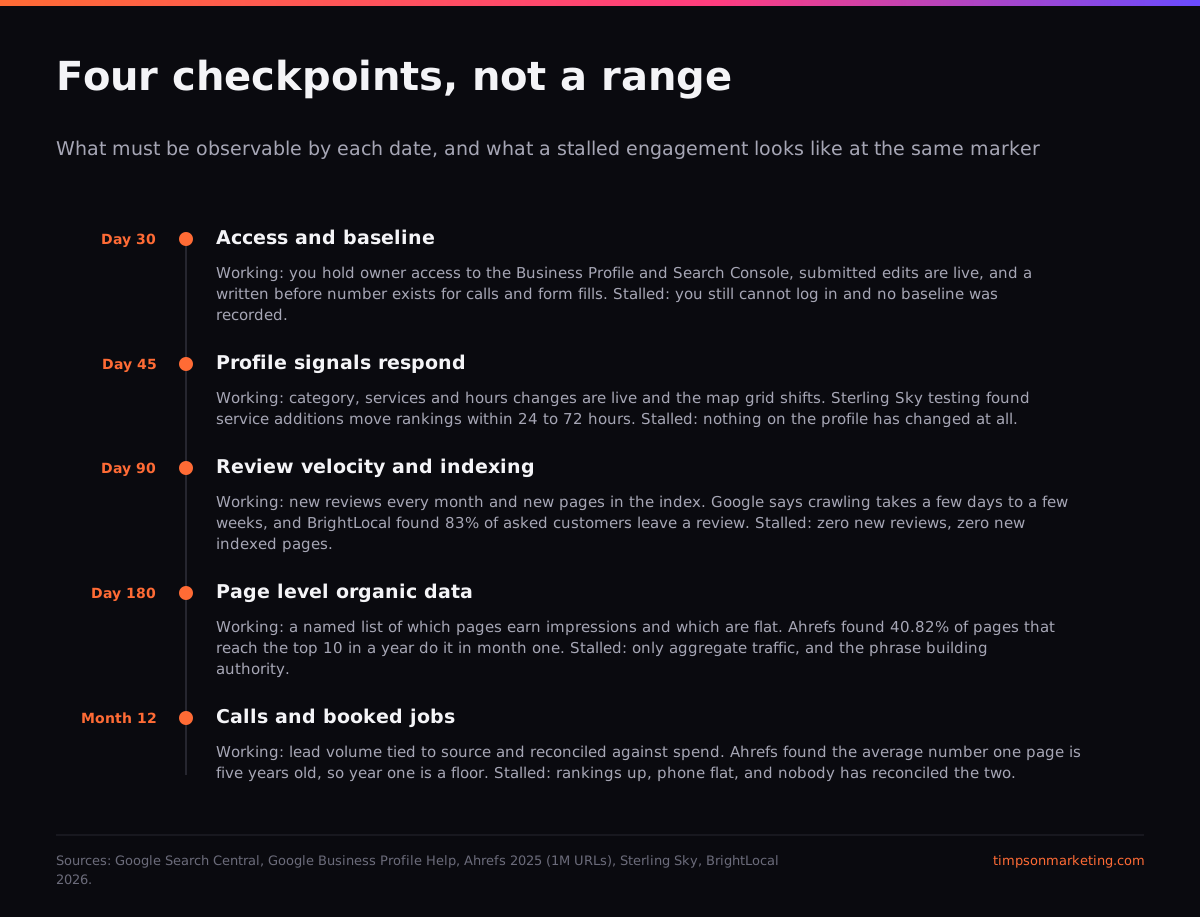
- Day 30 is the only genuinely pass or fail checkpoint: you personally hold the logins, the profile edits are live, and a written before number exists.
- Ahrefs tracked one million URLs and found 40.82% of the pages that reached the top 10 within a year got there in the first month. Ranking is bimodal, not a slow ramp.
- By day 180 your agency should hand you a page by page list of what is climbing and what is dead, not a sentence about building authority.
- Google's own live guidance on hiring an SEO gives no timeframe at all and says plainly that no one can guarantee a number one ranking.
Every answer to this question is a range, and a range cannot be wrong
Ask ten agencies how long local SEO takes and you get ten versions of "three to six months." That answer is built so it cannot fail. At month four with nothing visible it is still technically true. At month eight, someone tells you the market is competitive. An answer that survives every possible outcome tells you nothing about yours.
The most repeated authority on this question is a line from a 2017 Google video: four months to a year. Google's current live guidance on hiring an SEO contains no timeframe at all. It tells you to ask the vendor "What kind of results do you expect to see, and in what timeframe?" and it states flatly that "No one can guarantee a #1 ranking on Google." Google moved the estimate onto the vendor and left you no number to hold anyone to.
So build your own. Four dated checkpoints, each carrying something you can observe yourself without your agency's dashboard. Miss the first one and the timeline stops being a timeline.
Local SEO does not run on one clock. It runs on four, at different speeds. Google Business Profile edits move Maps rankings within 24 to 72 hours. Review velocity moves in weeks. Organic pages are bimodal, they rank fast or they mostly never rank. Revenue lags all three. Judge the engagement at day 30, day 90, day 180 and month 12 against what each clock should have produced by then, not against a range.
Checkpoint one, day 30: you can see the machine without asking
This is the only checkpoint that is genuinely pass or fail, and it is the one nobody publishes.
By day 30 you should personally hold owner access to your Google Business Profile and verified access to Google Search Console. Both are free, both take minutes, and neither depends on a single ranking. Google's documentation says verification review can take up to 5 business days, that postcard codes usually arrive within 14 days, and that codes expire after 30 days. Thirty days is not an aggressive deadline. It is the outer edge of Google's own stated process.
You should also see the profile edits live on the public profile. Google states that edits "usually take up to 10 minutes to review, but sometimes it can take up to 30 days". A changed primary category should therefore be visible inside the month. If it is not, it was either never submitted or it was rejected, and you are entitled to know which. Whitespark's survey of 47 local search experts scored primary category as the single highest impact local pack factor, ahead of proximity. This is not a cosmetic edit.
Last, a written baseline: the exact keywords, the exact pages, and today's raw numbers for calls and form fills. Without a before number, every later report is a claim rather than a measurement. If you are still deciding what to pay for all this, the cost side of the question is a separate post, but the baseline matters more than the price.
Stalled at day 30 looks like this: you do not have the logins, you have never opened the dashboard, someone said "we handle that," and no baseline exists. If day 30 passes in that state, nothing after it can be evaluated. That is precisely why the hardest checkpoint goes first.
Checkpoint two, day 90: the fast surfaces have already moved
Maps is the fastest surface in local search and almost nobody tells buyers that when they sign.
Sterling Sky's testing found that adding services to a Business Profile does move rankings, with changes typically appearing within 24 to 72 hours. Days, not quarters. So if a full quarter has passed and nothing on the map grid has moved anywhere, the profile work is not being done. That is a different diagnosis from "local SEO is slow," and it is the diagnosis most owners never get offered. The mechanics of that surface are covered in more depth in our guide to ranking higher on Google Maps.
Reviews are the second fast lever, and the evidence on velocity is unusually strong for this field. Sterling Sky analyzed 8,186 businesses across 200 cities and found current month review count correlates with local pack ranking more strongly than lifetime count. BrightLocal's 2026 consumer survey found 83% of people who were asked to leave a review went on to leave one. The bottleneck is the ask, not the customer. Review velocity has no legitimate reason to lag by 90 days.
If your business isn't getting new reviews consistently, your competitors will quietly pull ahead of you in the rankings, and you probably won't even notice.
Content is the slow one at this stage, and Google says so directly. Its documentation on requesting a recrawl states that crawling "can take anywhere from a few days to a few weeks". By day 90 you should be able to see new pages indexed in Search Console even if they rank for nothing yet. Indexed and invisible is normal at 90 days. Not indexed at all is not.
Stalled at day 90 looks like: zero new reviews in three months, no map grid ever shown to you, and no new pages in the index.
Checkpoint three, day 180: you know which pages are in the fast bucket
Month six is where the honest version of this question diverges hardest from the sales version.
Ahrefs tracked one million URLs for a year and found only 1.74% of newly published pages reach Google's top 10 within a year. Among the pages that did make it, 40.82% got there within the first month. Ranking is not a slow ramp that eventually pays off for everything you publish. It is closer to a fast resolution on most pages, then a long grind for the handful that landed.
That changes what month six owes you. Not "we are still building authority." It owes you a page by page list: these three pages earn impressions and are climbing, these six are flat, here is what happens to the six. Search Console reports that at page level for free, so there is no tooling excuse.
It likely took a lot of effort for the 1.74% of new pages ranking in the top 10 to get there. Don't expect to put out mediocre content and rank for competitive terms.
Hold the counterweight in view too. The same study found the average number one page is five years old and 72.9% of top 10 pages are more than three years old. Six months of work against a five year old incumbent is not a fair fight. Anyone who promised you otherwise was selling, and if your competitor is beating you with a weaker profile, that gap usually has a structural cause rather than a time based one.
Citations are the slowest lever in the whole set, which is why they are the worst thing to still be waiting on at month six. Whitespark's Darren Shaw describes directory listings that take more than a year to publish after submission, and Google needing months more to notice them. Budget spent there in month one should not be the thing you are still defending in month six.
We've seen emails come in over a year after we created the citations, we submitted them.
Checkpoint four, month 12: the phone, not the position
The twelve month checkpoint is the only one measured in dollars, and it is the one that gets quietly replaced with a rankings screenshot.
By month 12 someone should be able to answer three questions in plain numbers. How many calls came in from the Business Profile and from organic search. How many became booked jobs. What that is worth against what you paid. Google's Business Profile performance report gives you the raw call and direction data, though note the caveat in its own documentation: the searches metric "is updated at the start of each month" and "might take up to 5 days to show up." Your reporting will always be slightly behind reality.
Rankings are a nice byproduct. Leads are the goal.
The failure mode at month 12 is subtle and common: rankings genuinely improved, the phone did not, and nobody reconciled the two. That is a real result and it needs a real explanation, whether it is a conversion problem, a call handling problem, or a keyword set that was never commercial in the first place. Our post on telling whether your SEO agency is working breaks down the reports that hide this, and the case study shows what the reconciled version looks like on one account.
Month 12 is also not the finish line. Given that most top 10 pages are years old, twelve months is where a local SEO program stops being an expense and starts being an asset. Whether it should keep running is a decision, not an assumption, and it should be made against the numbers above rather than against a renewal date.
What these checkpoints cannot tell you
Being honest about the limits is what makes the checkpoints usable.
None of this survives a moved goalpost. Google's official documentation says local results rest on relevance, distance and prominence, and exactly one of those three is under your control. Seasonality moves local demand hard, a competitor can buy their way into the local pack, and Google ships core updates that reshuffle everything. Sterling Sky's own testing has reversed prior findings, which is a healthy sign in a field where certainty is usually a sales posture.
Ranking checks are also sampled and noisy. What you see from your phone at your desk is not what a customer sees three miles away, which is why grid based checks exist and why a single screenshot proves nothing. The same caution applies to AI answers, where measurement is even noisier and no engine publishes a share of voice number.
And expect to be told that reviews stopping is fine. It is not.
We had a dental client who pulled in 60+ reviews a month and absolutely dominated the rankings. Then they stopped. For 18 days. Guess what happened? Their rankings fell off a cliff.
What to do when a checkpoint is missed
A missed checkpoint is information, not automatically a firing.
A missed day 30 is the serious one. Access and baseline do not depend on the algorithm, the market, or your budget. If they are missing, ask for them in writing with a date, and treat a vague answer as the answer. A missed day 90 on reviews or profile edits is an execution problem, and execution problems are fixable inside a month if someone names them. A missed day 180 on page level data usually means the work went into things that cannot be shown, which is a scope conversation.
- Can you send me my own owner access to the Business Profile and Search Console today?
- What were the exact call and form numbers the month before we started?
- Which specific pages are earning impressions right now, and which are flat?
- What changed on the Business Profile in the last 30 days, and is it live?
A twelve month term is not the problem by itself. A twelve month term with no dated checkpoints is, because it converts every month into a request for more patience. If you are choosing between waiting and buying attention right now, paid search for contractors answers a different question with a much shorter feedback loop, and the two are not mutually exclusive.
The rest of this cluster covers what local SEO costs, how to read a Business Profile ranking drop, and how to build location pages that are worth indexing. If you want a second opinion on where your own engagement actually is, our free audit is a fixed scope look at exactly the checkpoints above, and the full archive has the rest.
Frequently asked questions
How long does local SEO take to work?
It depends on the surface. Google Business Profile edits can move Maps rankings within 24 to 72 hours. Review velocity shows up in weeks. Organic pages either rank fast or mostly never rank. Revenue lags all three, typically becoming readable somewhere between month six and month twelve.
Is three to six months a real answer or a sales line?
It is real in the sense that many programs do show movement in that window. It is a poor commitment because it cannot be falsified. Ask instead for dated checkpoints at day 30, day 90, day 180 and month 12, each with something you can verify without the agency's dashboard.
How long until my business shows up on Google Maps?
Google says Business Profile verification review can take up to five business days, postcard codes usually arrive within 14 days, and codes expire after 30 days. Profile edits usually review in about 10 minutes but can take up to 30 days. Appearing is fast. Ranking well is the slow part.
What should I see at month one?
Not rankings. You should hold owner access to your Business Profile and Search Console, see submitted profile edits live on the public profile, and have a written baseline of your current calls, form fills, target keywords and target pages. Missing any of those at day 30 is the real warning sign.
My rankings went up but my phone did not. Is that normal?
It is common and it needs an explanation, not a shrug. Usual causes are keywords with no commercial intent, a landing experience that does not convert, or calls that are not being answered or tracked. Ask for calls and booked jobs alongside positions in every report.
Should I fire my agency if month four shows nothing?
Not automatically. Check which checkpoint was missed. If day 30 access and baseline were missed, that is a serious failure independent of any algorithm. If Maps and reviews have moved but organic is flat at month four, that is normal, because organic is the slowest of the four clocks.
Why do agencies want a twelve month contract?
Some of it is legitimate: early work produces the substrate later months depend on, and staffing needs predictability. The problem is a twelve month term with no dated checkpoints, because it turns every month into a request for more patience. Ask for the term with review points attached.
Does local SEO get faster if I spend more?
Partly. More spend buys more simultaneous work, which shortens the day 30 and day 90 checkpoints. It does not shorten Google's crawl and index cycle, directory moderation queues, or the years of age carried by incumbent pages. Money compresses execution time, not the platform's clocks.
What happens if I stop local SEO after six months?
The fastest signals decay first. Review velocity is a live signal, and Sterling Sky documented a client whose rankings dropped sharply after only 18 days without new reviews. Pages already ranking tend to hold longer, but the profile side degrades quickly once the ongoing work stops.
Sources
- Google Search Central. Do you need an SEO? (2026-06)
- Google Business Profile Help. Verify your Business Profile (2026-07)
- Google Business Profile Help. Understand what happens to your Business Profile edits (2026-07)
- Google Search Central. Ask Google to recrawl your URLs (2026-07)
- Google Business Profile Help. Understand your Business Profile performance and insights (2026-07)
- Google Business Profile Help. Improve your local ranking on Google (2026-07)
- Ahrefs. How Long Does It Take to Rank in Google? (1 million URLs studied) (2025-05)
- Sterling Sky. Do Services in Google Business Profile Impact Ranking? (2026-02)
- Sterling Sky. What Gets You Ranking for Near Me Searches in 2025 (2025-11)
- Sterling Sky. Starting a Local SEO Agency? Read this First (2025-07)
- Whitespark. Local Search Ranking Factors 2026 (2025-11)
- Whitespark. Do Citations Still Matter for Local SEO? (2024-10)
- Whitespark. The Most Underrated Local Ranking Factor in 2025 (2025-05)
- BrightLocal. Local Consumer Review Survey 2026 (2026-02)
- BrightLocal. How long does it take to rank in local search? Expert Survey (undated)
Joseph Timpson has worked in search since 2010 and runs Timpson Marketing out of St. George, Utah. He built The Cited Method, a five stage framework for earning and proving real citations in AI answers, and publishes what does not work alongside what does.
Want this done for you, with the receipts to prove it worked?
One call, no pitch deck. We look at what is actually blocking you and tell you the truth about whether we can help.
Book a free consultation →