How to Tell If Your SEO Agency Is Actually Doing Anything
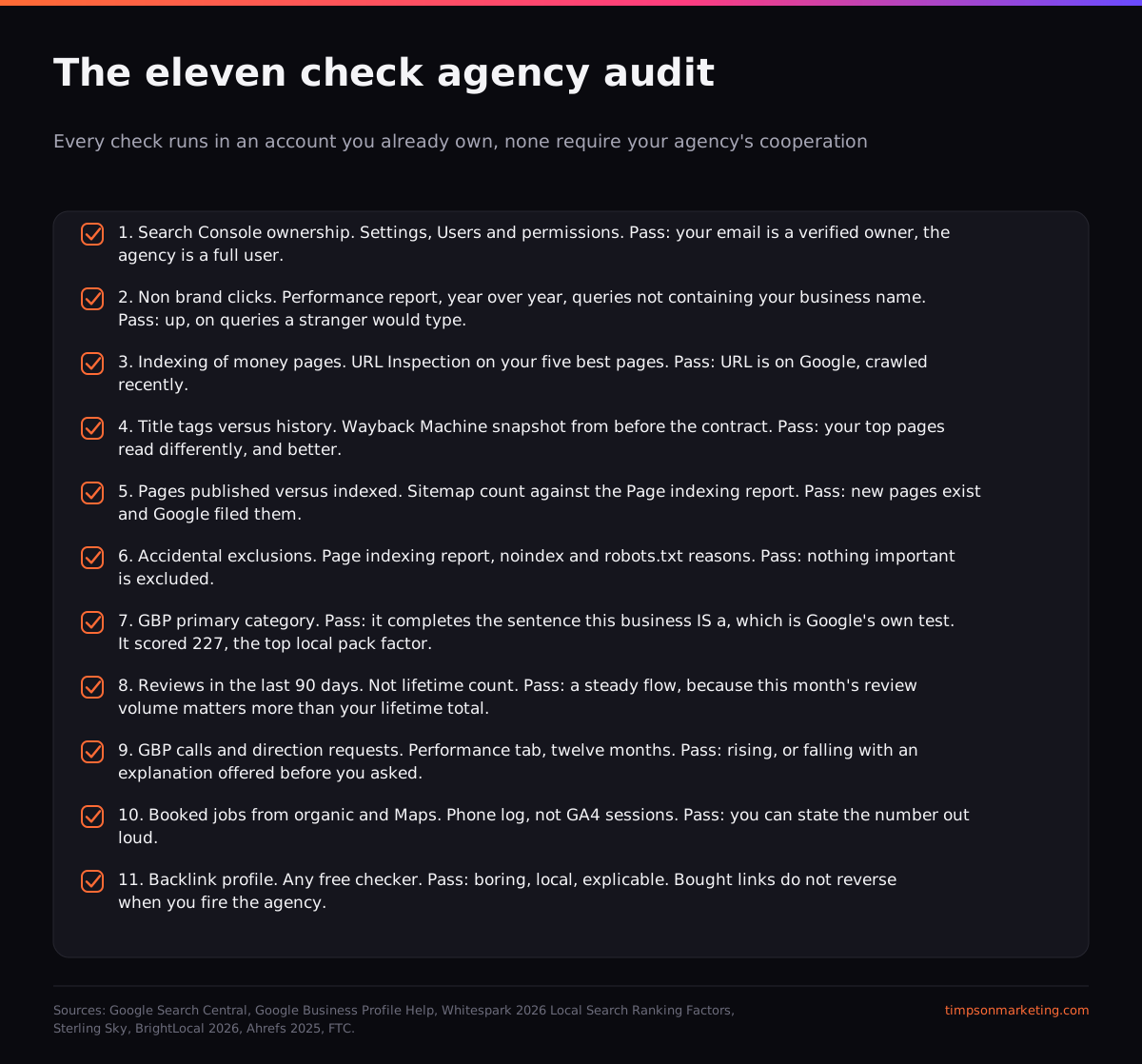
Eleven checks you can run yourself in about ninety minutes, in accounts you already own. None of them require your agency's cooperation, their dashboard, or their permission.

- Every red flag list is useless to you, because you cannot verify a red flag without asking the agency that wrote the report.
- Three numbers settle it: non brand clicks in Search Console, calls and direction requests on your Google Business Profile, and booked jobs. Everything else is diagnostic.
- The single fastest tell is ownership. If your agency is the verified owner of your Search Console property and you are not, you are renting your own data.
- A ranking guarantee is disqualifying on its own. Google's documentation says flatly that no one can guarantee a number one ranking, and its local documentation says there is no way to request or pay for better local ranking.
- Slow is not the same as fake. Only 1.74% of newly published pages reach Google's top 10 within a year, so judge the work, not just the clock.
Stop reading their report. Read the accounts you already own.
Fourteen months at $2,000 a month is $28,000. If you cannot name one page on your website that is different today because of that money, you do not have a reporting problem. You have an evidence problem, and it is fixable in an afternoon.
Every article you have already read on this question is a list of red flags. Red flags are useless to you. You cannot verify a single one without asking the agency, and the agency writes the report. We checked the pages currently ranking for this question: the best of them, a roughly 2,900 word guide, tells you to ask your agency for a dated work list. The second tells you to review your own contract. Useful advice, but every path still runs through the people you are trying to audit.
So here is the other version. Eleven checks you run yourself, in accounts you already own, that your agency cannot edit, delay, or reframe.
Your SEO agency is working if three things moved: non brand clicks in Google Search Console, calls and direction requests on your Google Business Profile, and booked jobs. Everything else on their report is diagnostic, not proof. The eleven checks below verify all three from accounts you control, and not one of them requires your agency's cooperation.
The reason this matters is that the whole industry, agencies included, has quietly substituted tracking for value. The 2026 CMO Survey of 308 US marketing leaders found marketing budgets fell to 9.0% of company revenues, their lowest share in several years, and that when profits miss, marketing is the line that gets cut 45.4% of the time, more often than any other expense category. Your retainer lives in that environment. A colorful dashboard is not a defense.
Rather than investing in deeper customer insights, most marketers focus on developing stronger performance tracking as the primary way to demonstrate value.
Block out ninety minutes. Open these before you start.
- Google Search Console for your domain
- Google Business Profile, Performance tab
- Google Analytics 4, Traffic acquisition report
- Your phone system or call log for the last twelve months
- Your signed agency agreement, the actual PDF, not the proposal
Checks 1 to 3: did they get in, and did anything move
Check 1. Look at who owns your Search Console property
Open Search Console, click Settings, then Users and permissions. Google's documentation defines the levels precisely: an owner has full control and can add and remove other users, a full user has view rights to all data and can take some actions, and a restricted user has simple view rights on most data. Only owners can add or remove users.
If your agency is listed as owner and you are listed as a full user, or worse, you are not listed at all, that is the finding. It means the day you leave, your entire search history leaves with them. Google's own hiring guidance tells business owners to only grant read access to Search Console during an audit and specifically not to grant write access at that stage. Passing result: your email is a verified owner. Fix it today regardless of what the other ten checks say.
Check 2. Pull non brand clicks, three months against the same three months last year
In the Performance report, Google shows the past three months by default, so widen the range yourself and turn on the year over year comparison. Then add a query filter: Queries not containing your business name. That one filter removes the most common way a report gets padded, which is counting people who were already looking for you by name.
Passing result: non brand clicks up year over year, and the queries driving them are things a customer would type before they knew you existed. Not up is not automatically failing, but it moves the burden of proof.
Check 3. Run URL Inspection on your five money pages
Paste each of your five highest value URLs into the search bar at the top of Search Console. The URL Inspection tool tells you whether a page is indexed, when Google last crawled it, and which URL Google chose as canonical. Google's wording is blunt: URL is on Google means indexed and eligible, URL is not on Google means it will not appear at all.
This is the check that catches catastrophes. A service page that is not on Google cannot rank no matter how many hours were billed against it. Look at the last crawl date too. If Google has not crawled your main service page in months, nothing was published that would have prompted a recrawl.
Checks 4 to 6: did the website actually change
Check 4. Diff your title tags against the Wayback Machine
Open the Internet Archive Wayback Machine, enter your homepage and one service page, and pull up a snapshot from the month before your contract started. Compare the browser tab text and the visible headline against today's live page.
This is the single most damning check in the list, because title tags are the first thing any competent SEO changes and the change is permanently timestamped by a third party. If fourteen months of retainers produced identical titles, identical headlines, and identical body copy, you now have proof that does not depend on anyone's report. Passing result: at least your top pages read differently, and better, than they did before.
Check 5. Count pages published, then count pages indexed
Those are two different numbers and only the second one counts. Load your sitemap at yourdomain.com/sitemap.xml and count entries added since the contract started. Then check the Page indexing report, which shows how many URLs on your site have been crawled and indexed, and lists the reasons the rest were not, in Google's own labels: a noindex tag on the page, blocked by robots.txt, Crawled - currently not indexed, Discovered - currently not indexed.
A large pile of published pages sitting under Crawled - currently not indexed is its own verdict. Google is seeing the content and declining to file it. That usually means volume was the strategy. If those pages are near duplicate city pages, read our take on location pages that actually survive review before you defend them, because Google's spam policies specifically name pages targeted at cities that funnel users to one page.
Check 6. Search the Page indexing report for the words noindex and blocked
Same report, different question. A page can be excluded because someone told Google to exclude it. Staging noindex tags left on a live site after a redesign are one of the most expensive and most common unforced errors in this business, and they are invisible from the front end. Passing result: nothing important sits under a noindex or robots.txt exclusion. This takes two minutes and occasionally finds five figures of lost revenue.
Checks 7 to 9: did anyone touch the Google Business Profile
For a local service business this section matters more than the website section, and it is the section most often left untouched under a retainer that is nominally about local search.
Check 7. Read your primary category out loud
Whitespark's 2026 report asked 47 local search experts to score 187 individual ranking factors. Primary Google Business Profile category came out first with a score of 227, ahead of proximity of your address to the searcher at 225. That ordering matters: the highest impact factor in local search is a dropdown you can change in ninety seconds, and it beats the one thing you genuinely cannot control.
So read yours. If you are a plumbing company whose primary category is Contractor, or an HVAC company sitting under Air Conditioning Repair Service when you sell installs, nobody has looked at this. Our guide to choosing the right primary category has the process. Passing result: the primary category completes the sentence "this business IS a," which is Google's own test.
Check 8. Count reviews received in the last 90 days
Not lifetime reviews. The last 90 days. Sterling Sky analyzed 8,186 businesses across 200 cities for five near me service queries and found that the number of reviews you have earned this month matters more for local pack ranking than your total number of reviews. The consumer side agrees: BrightLocal's 2026 survey of 1,002 US adults found 74% of consumers seek reviews written in the last three months.
If your review count has not moved in a quarter, no review program exists, whatever the report says. That is a fixable gap, and we wrote the process out in how to get more Google reviews. It is also why a competitor with fewer reviews can outrank you: they are getting theirs this month.
Check 9. Compare calls and direction requests, not rankings
Open the Performance tab on your Business Profile. Google defines calls as the number of times a customer clicked the call button on your profile, website clicks as clicks on the website link, and directions as how many people asked for directions to your business. Those are behaviors, not impressions, and they are the closest free proxy you have for demand.
Here is the nuance almost no agency will volunteer, and it protects an honest one as much as it exposes a lazy one.
If you have a business profile that ranks really well, even if you don't see a drop in ranking, your calls from the business profile are going down over time.
Hawkins' 2026 analysis of 322 markets found Google's AI local packs surfaced 5,943 unique businesses against 18,330 in traditional 3-packs, and that local pack ads went from about 1% of tracked reports in early 2025 to nearly 22% by December. Flat calls on flat rankings in that environment is not automatically a failure. Falling calls with no explanation offered is. The question to ask is not "why did calls drop," it is "did you know calls dropped before I asked."
Ran the eleven checks and did not like the answers? We will run the same audit properly, in writing, against your live site and profile, and tell you what we find whether or not you ever hire us.
Get an independent audit→Checks 10 and 11: did it turn into money, and did it cost you anything
Check 10. Count booked jobs from organic and Maps, not sessions
In GA4, open Traffic acquisition and look at Organic Search as a channel. Then go get the number that actually matters from your phone system: how many inbound calls turned into booked work in the last twelve months, and how many of those callers found you through a search or a map.
The honest version of this check is uncomfortable for everyone, including us. The confidence gap in small business measurement is documented: LocalImpact's September 2025 survey of 400 US local business owners found 62% describe themselves as very confident in their marketing ROI while 15% simultaneously name tracking ROI as one of their biggest marketing challenges. If you cannot answer the booked jobs question, the agency is not the only thing that needs fixing, and no agency can hand you that number if your intake does not capture it. We put the real numbers behind one engagement in this local SEO case study so you can see what a defensible answer looks like.
Check 11. Look at your backlink profile for links you did not earn
Run your domain through any free backlink checker and scan the referring domains. You are looking for names you have never heard of, foreign language directories, and blog networks. Google's spam policies define link spam as creating links primarily for the purpose of manipulating search rankings and lists exchanging money for links first among the examples.
This check has an ugly asymmetry. If your agency bought links, the damage does not reverse when you fire them. Google states that once a link spam update removes the effects of spammy links, any ranking benefit those links generated is lost and cannot be regained. You inherit the baseline, not the recovery. Passing result: your link profile is boring, local, and explicable.
The ranking guarantee is the one answer that ends the conversation
Most red flags are judgment calls. This one is not, and you can settle it against a primary source in thirty seconds.
Google's own hiring documentation states that no one can guarantee a #1 ranking on Google and tells business owners to beware of SEOs who claim to guarantee rankings, allege a special relationship with Google, or advertise a priority submit. On the local side, Google's Business Profile documentation is even shorter: there is no way to request or pay for a better local ranking on Google.
So a written ranking guarantee is not aggressive salesmanship. It is a promise the platform has publicly said cannot be kept, which means it is either a lie or a description of tactics that will get you demoted. There is no third option. Neither is anyone's private access to the algorithm.
None of the experts have special access to the internal workings of Google's local search algorithm.
Shaw wrote that as a methodology caveat on his own survey of 47 experts, which is the point. The people with the most credibility in local search are the ones who publish their uncertainty. Treat that as the standard. The same test now applies to the AI pitch: if the claim is deterministic placement inside ChatGPT or AI Overviews, read whether AI SEO is worth paying for first, and hold the vendor to the same evidence bar. Google's generative AI guidance warns site owners directly to be wary of third-party tools that promise ranking success or claim to use internal Google metrics, because no third party tool has access to Google's internal ranking or AI systems.
This is not a hypothetical risk to small businesses. The FTC's Pointbreak Media case involved telemarketers falsely claiming to represent Google who charged businesses $300 to $700 to claim and verify their Google listing, then pitched a program falsely guaranteeing top placement for $949.99 plus recurring monthly payments. It ended with more than $700,000 refunded to 4,467 small business owners, an average of $158.32 each. That is what the recovery looks like after the fact, which is why the check happens before.
Score it: eleven checks, three verdicts
Give one point per check that passes. Then use the score the way a mechanic uses a diagnostic, not the way a jury uses a verdict.
| Filler retainer | Real retainer | |
|---|---|---|
| Monthly deliverable | A PDF of graphs and a ranking table | A dated list of URLs changed, with before and after |
| Search Console | Agency is owner, you are not listed | You are verified owner, they are a full user |
| Title tags | Identical to the Wayback snapshot from before the contract | Rewritten, with the reasoning explained |
| GBP primary category | Never mentioned in any report | Named, justified, and revisited when services change |
| Reviews | Lifetime count quoted | Reviews received in the last 30 and 90 days |
| What they report on a bad month | A different metric than last month | The same metric, plus what they are changing |
Nine or more passing: the work is real. If leads are still flat, the conversation is about strategy and budget, not honesty. Ask what they would do with 50% more and 50% less, and judge the answer.
Six to eight: something is being neglected, usually the Google Business Profile or the review program, and usually because the retainer was scoped for a website and your customers live on a map. Fixable, and worth one direct conversation before you move.
Five or fewer, especially if checks 1, 4 and 8 all failed: you are paying for reporting. Ask for owner access to everything in writing, give thirty days, and start looking. Read what local SEO should actually cost before you shop, so the next quote gets judged on scope instead of price, and browse our case studies or what we actually do as one comparison point among several.
Before you fire them, check the clock
The worst outcome here is not keeping a bad agency for another quarter. It is firing a good one at month ten and restarting the clock with someone worse.
Ahrefs tracked 1 million URLs for a year and found only 1.74% of newly published pages reach Google's top 10 within a year, down from 5.7% in a comparable 2017 study. The average number one ranking page is five years old, and 72.9% of top 10 pages are more than three years old. The pattern is bimodal rather than gradual: among pages that did reach the top 10 within a year, 40.82% got there in the first month.
Older content dominates. If you want to rank in Google's top 10, focus on creating evergreen content that can stand the test of time and plan to update it.
That reframes the eleven checks. They do not measure speed. They measure whether the asset is being built at all. A slow climb on real pages that really changed is a working engagement. A fast nothing on pages that are byte for byte identical to last year is not, no matter how green the arrows are. We laid out realistic milestones in how long local SEO takes, and if your rankings genuinely fell rather than stalled, start with diagnosing a Business Profile ranking drop instead of assuming sabotage.
If you want the rest of the picture, the full blog covers the ranking mechanics behind these checks, from how to rank higher on Google Maps to why AI assistants may not recommend your business and whether schema markup is worth the invoice line.
Frequently asked questions
What should my SEO agency be sending me every month?
A dated list of every URL they changed, with before and after values, plus every page published and its indexing status. Then non brand clicks, Business Profile calls and direction requests, and leads. Graphs of rankings alone are not a report, because rankings are the input, not the outcome.
Is a ranking guarantee always a red flag?
Yes, and it is the only item on this list that is disqualifying by itself. Google's hiring documentation states plainly that no one can guarantee a number one ranking, and its Business Profile documentation says there is no way to request or pay for better local ranking. The promise cannot be kept honestly.
How do I check whether my agency actually changed my website?
Open the Internet Archive Wayback Machine, pull a snapshot of your homepage and a service page from the month before your contract started, and compare titles, headlines and body copy against the live page today. It is timestamped by a third party and your agency cannot edit it.
Should my SEO agency own my Google Search Console property?
No. You should be the verified owner and they should be a full user. Only owners can add and remove users, so if the agency owns the property, your entire search history leaves with them when the relationship ends. Fix this before you do anything else.
How long should I give an SEO agency before judging results?
Judge the work at ninety days and the outcome at nine to twelve months. Ahrefs found only 1.74% of new pages reach the top 10 within a year, so slow is normal. What is not normal is ninety days with no page changed, no new indexed content, and no reviews earned.
My rankings went up but my phone did not ring. Is the agency lying?
Not necessarily. Sterling Sky's 2026 research found Business Profiles can hold their rankings while calls decline, because AI local packs surface roughly a third as many businesses and paid placements have expanded sharply. The real test is whether your agency told you before you noticed.
How can I tell if my agency bought links for my site?
Run your domain through a free backlink checker and scan referring domains for names you do not recognize, foreign directories, and blog networks. Google's spam policies name buying links first among link spam examples, and the ranking benefit is not recoverable once it is removed.
What is the fastest single check if I only have ten minutes?
Compare your homepage title tag today against the Wayback Machine snapshot from the month before your contract started. Title tags are the first thing any competent SEO rewrites, and the change is timestamped by a third party. If it is identical after a year of retainers, you have your answer.
Sources
- Google Search Central. Do you need an SEO? (2026-06)
- Google Business Profile Help. How to improve your local ranking on Google (2026-07)
- Google Search Console Help. Manage users and owners of a Search Console property (2026-07)
- Google Search Console Help. Search performance report (2026-07)
- Google Search Console Help. URL Inspection Tool (2026-07)
- Google Search Console Help. Page indexing report (2026-07)
- Google Business Profile Help. Understand your Business Profile performance and insights (2026-07)
- Google Search Central. Google's Guide to Optimizing for Generative AI Features on Google Search (2026-06)
- Google Search Central. Spam policies for Google web search (2026-05)
- Google Search Central. Google Search spam updates and your site (2025-12)
- Whitespark. Local Search Ranking Factors 2026 (2025-11)
- Sterling Sky. What Gets You Ranking for Near Me Searches in 2025 (2025-11)
- Sterling Sky. The State of Local SEO in 2026 (2026-06)
- BrightLocal. Local Consumer Review Survey 2026 (2026-02)
- Ahrefs. How Long Does It Take to Rank in Google? (2025-05)
- Duke Fuqua, Deloitte and the American Marketing Association. The CMO Survey, Highlights and Insights Report, Spring 2026 (2026-04)
- Duke University Fuqua School of Business. CMOs Face Headwinds Even as Marketing Value and AI Impact Grow (2026-03)
- LocalImpact. State of Small Business Marketing (2025-09)
- U.S. Federal Trade Commission. FTC Sends Refund Checks Totaling More Than $700,000 to Small Business Owners Defrauded by Deceptive Robocalls (2020-08)
- U.S. Federal Trade Commission. FTC Action Halts Deceptive Robocalls Aimed at Small Business Owners (2018-05)
- Internet Archive. The Wayback Machine (2026-07)
Joseph Timpson has worked in search since 2010 and runs Timpson Marketing out of St. George, Utah. He built The Cited Method, a five stage framework for earning and proving real citations in AI answers, and publishes what does not work alongside what does.
Want this done for you, with the receipts to prove it worked?
One call, no pitch deck. We look at what is actually blocking you and tell you the truth about whether we can help.
Book a free consultation →