Your Agency Added an AI Line Item. Ask These Nine Questions
A call script, not a category debate. Nine questions in order, what a good answer sounds like, what a dodge sounds like, and a scoring line at the end.

- An AI line item is worth paying for when the agency can name the mechanism, show the measurement, and tell you what you keep if you cancel.
- Crawler access is the highest certainty lever on the whole invoice and it is the one most sellers skip because it is boring.
- If llms.txt or schema markup is the headline reason your bill went up, the published evidence says you are paying consulting rates for a checkbox.
- Google's own AI reporting in Search Console gives you impressions and no clicks, so anyone selling deterministic AI attribution is selling something that does not exist.
- Score the call out of nine. Seven or more, keep paying. Four or fewer, kill the line item and ask them to fold the work into the base retainer.
The line item is real. The work behind it might not be.
Your invoice went up $750 last month and the new row says AI optimization. Nobody walked you through it. Here is the uncomfortable part: the demand behind that row is real. BrightLocal's 2026 Local Consumer Review Survey of 1,002 US consumers found 45% had asked ChatGPT or a similar tool for a local business recommendation, up from 6% a year earlier. We broke that number down in do customers use ChatGPT to find local businesses.
So the category is not invented. The question is narrower and far more useful: is this particular invoice buying any of it.
An AI line item is worth paying for when your agency can name the mechanism, show the measurement, and tell you what you keep if you cancel. If all three answers do not arrive on one phone call, you are paying for a label rather than a service.
Almost everything published on this subject argues about the category, and the few buyer guides that exist are written for procurement teams at software companies. Nobody writes for the person who already signed and is now looking at a bigger number. That is who this is for.
Nine questions, in order, short enough to read off a phone during the call. Under each one: what a good answer sounds like, and what an evasive answer sounds like. A scoring line at the end.
Before you dial, put three numbers on the screen
Do not open with a philosophy question. Open with arithmetic.
- The delta. What you paid before the line item, what you pay now, and the annual difference. $750 a month is $9,000 a year. Say the annual number out loud.
- Booked jobs, last 90 days. Not traffic. Not impressions. Jobs, and roughly where they came from.
- The original promise. Whatever the proposal or email said the AI work would produce. Read it back to them.
The third one matters more than it looks, because rankings and phone calls have been drifting apart in local search for two years. An agency can show you a green chart while your phone gets quieter.
If you have a business profile that ranks really well, even if you don't see a drop in ranking, your calls from the business profile are going down over time.
Sterling Sky's State of Local SEO in 2026 also found Google's AI local packs surfaced 5,943 unique businesses against 18,330 in traditional 3-packs across the same 322 markets, roughly a third as many winners. That compression is the honest reason to care about this line item at all. It is also the reason a vague answer should worry you.
Questions 1 to 3: what am I actually buying
1. Name the three specific things you will do this month that you were not doing before this line appeared.
Good answer: three nouns with owners and dates. We are rewriting your six service pages to answer the question in the first 60 words. We are getting you listed and reviewed on the two directories that keep showing up in AI answers for your trade. We are fixing the four pages that return an error to AI crawlers. You can picture the work.
Bad answer: we optimize your content for AI engines and monitor your visibility across LLMs. That is a description of a category, not a task list. If they cannot name three things, there are not three things.
2. Which of those three would still be worth doing if AI search disappeared tomorrow?
Good answer: most of it. Honest operators say this immediately, because most of the work is classic hygiene applied in an AI-shaped priority order. Google's own AI features documentation states there are no additional requirements to appear in AI Overviews or AI Mode, and that a page only needs to be indexed and eligible to be shown with a snippet.
Bad answer: none, this is entirely new work. That is either a misunderstanding or a markup. The real difference between the surfaces is smaller than the pitch decks suggest, which we walked through in AI Overviews vs AI Mode vs ChatGPT and in GEO versus SEO.
3. Did you check whether AI crawlers can actually reach my site, and what did you find?
Good answer: they name the user agents (GPTBot, OAI-SearchBot, ClaudeBot, PerplexityBot, Google-Extended), tell you the HTTP status each one got, and mention your firewall or bot protection by name.
Bad answer: your site is fine. Access is the highest certainty mechanical lever in this entire field, and it is the one most sellers skip because it is unglamorous and takes an afternoon. Cloudflare's 2025 year in review measured AI bots at an average 4.2% of HTML requests across its network, with crawl-to-refer ratios as extreme as 500,000:1 for Anthropic against 3:1 to 30:1 for Google. Those crawlers are hitting your site constantly. If they get a challenge page instead of your content, nothing further down the invoice matters. That is usually the first thing we find in why AI does not recommend my business.
Questions 4 to 6: make them show the mechanism
4. Is llms.txt or schema markup the reason this costs extra?
Good answer: no, and here is why not. Bad answer: yes, and it is the centerpiece.
SE Ranking analyzed close to 300,000 domains and found llms.txt on 10.13% of them with no measurable relationship to citation. Removing the file from their prediction model made the model more accurate, which is the opposite of what a real signal does.
Our analysis of 300,000 domains shows that LLMs.txt doesn't impact how AI systems see or cite your content today.
Schema is the same story with stronger evidence, because someone ran a control group. Ahrefs tracked 1,885 pages that added JSON-LD against 4,000 matched control pages and measured minus 4.6% in AI Overviews, plus 2.4% in AI Mode and plus 2.2% in ChatGPT.
Adding schema produced no major uplift in citations on any platform.
Neither finding makes schema useless. Both make schema a search hygiene job, priced like one. We took the full swing at that in is schema markup worth it. If a $750 line item is mostly a plugin writing JSON-LD, you are paying consulting rates for a checkbox.
5. For my category, where do the cited answers actually come from?
Good answer: they have looked. They can name the specific pages and platforms that get cited when someone asks an AI for a plumber in your city, and they can tell you which of those you are absent from.
Bad answer: we are building your authority. Ahrefs' March 2026 analysis of 863,000 SERPs and 4 million AI Overview URLs found only 38% of AI Overview citations came from pages ranking in the top 10, down from roughly 76% in July 2025. Ranking well is table stakes now, not the whole game.
Being cited is also not the same as being named. Semrush and Growth Memo found that 62% of AI citations are ghost citations, where your page supplies the source link and the answer never says your business name.
The AI knows the information about the brand came from somewhere, but doesn't feel the need to explicitly say so to users. The brand name carries on its own.
That single finding should change what you accept as a report. A citation count is not a brand count, and an agency that conflates the two is either careless or counting on you not knowing.
6. What are you doing off my website this month?
Good answer: a specific list. Review velocity on the profiles that keep getting cited, a genuine listing cleanup, a supplier or trade association page that mentions you by name, a video, a local news mention you actually earned. If the facts about you are wrong in the first place, fixing that comes before any of it, which is the whole of ChatGPT has wrong information about my business.
Bad answer: anything involving buying reviews or mentions. The FTC's rule on consumer reviews carries civil penalties, and in May 2026 the agency and the state of Illinois sued a company for creating thousands of fake home repair listings with fabricated five star reviews. Buying your way into an answer is the one tactic on this list that can cost you more than the retainer.
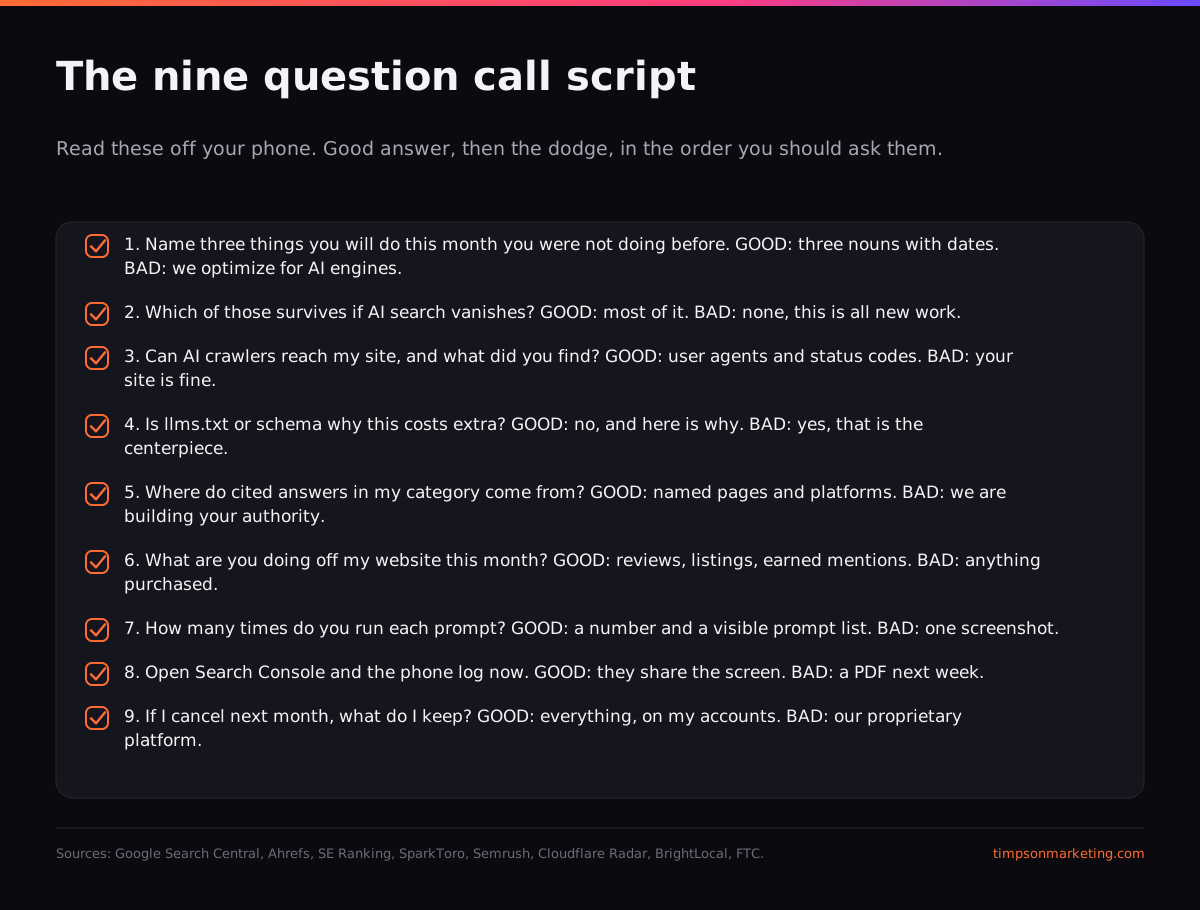
## Questions 7 to 9: proof, and the exit 7. How many times do you run each prompt before you report a number to me? Good answer: a number, plus a prompt list you are allowed to see. Dozens of prompts, run repeatedly, reported as a share of appearances over time. Bad answer: a screenshot of one ChatGPT conversation where you show up. SparkToro and Gumshoe.ai had 600 volunteers run 12 prompts a combined 2,961 times and found less than a 1 in 100 chance that any two runs of the same prompt return the same list of brands.
See what our AI work actually includes→Before you spend a dime tracking AI visibility, make sure your provider answers the questions we've surfaced here and shows their math.
8. Open Search Console and the phone log and walk me through the last 90 days.
Good answer: they share the screen right then, on this call.
Bad answer: a PDF next week. Google shipped a generative AI performance report in Search Console in June 2026, and the fine print matters. It reports impressions, pages, countries, devices and dates. As Search Engine Land's Barry Schwartz wrote when it launched, it does not include click data. Anyone selling you deterministic AI attribution is selling something Google does not provide to itself. The honest method is triangulation: AI impressions, referral sessions from chat tools, branded search volume, and your call log, watched together over months. We laid the full method out in how to tell if your SEO agency is working, and what a real 12 month arc looks like in this local SEO case study.
9. If I cancel next month, what do I keep?
Good answer: everything. Pages on your domain, your Google Business Profile with you as primary owner, your Search Console and analytics properties, your reviews, your content in a file you can download today.
Bad answer: anything hosted on the agency's infrastructure, and any sentence containing the words proprietary platform. Assets you cannot take with you are rented, not built. Ask specifically who holds primary ownership of the Google Business Profile. That one question has ended more agency relationships than any performance dispute we have watched.
Score the call: nine questions, one number
Count the answers you would repeat to your spouse without wincing.
- Name three things you will do this month that you were not doing before this line item.
- Which of those would still be worth doing if AI search vanished tomorrow?
- Did you check whether AI crawlers can reach my site, and what did you find?
- Is llms.txt or schema markup the reason this costs extra?
- For my category, where do the cited answers actually come from?
- What are you doing off my website this month?
- How many times do you run each prompt before reporting a number?
- Can you open Search Console and the phone log right now?
- If I cancel next month, what do I keep?
Seven or more solid answers: keep paying, and book the same call every quarter. Five or six: the work is probably real but the reporting is not, so put the line item on a written 90 day review with a named outcome. Four or fewer: stop the line item, not necessarily the relationship. Ask them to fold the work back into the base retainer and show you a plan.
One caution before you swing the axe. Search work compounds slowly and cancelling in month three guarantees you paid for the setup and left before the return, which is the pattern we mapped in how long local SEO takes. Judge the answers, not the calendar.
What a fair AI line item actually costs
There is no rate card, which is most of the problem. An Ahrefs poll of 439 SEO professionals put the average monthly retainer at $2,917, with $501 to $1,000 the single most common band, though that page is dated August 2024. Backlinko's survey of more than 300 professionals puts typical monthly cost at $1,000 to $2,500. On the AI side published pricing is scarce, and where it exists it is high: WebFX lists GEO services starting at $3,000 a month. We break down the local numbers in how much local SEO costs.
Set against that, only 8% of US local small businesses use a marketing agency at all and roughly 10% of local marketing budget goes to SEO, per LocalImpact's September 2025 survey of 400 owners. You are already an outlier for having an agency. That is not a reason to tolerate an unexplained increase.
Two hard rules to carry into the call. Google states plainly that no one can guarantee a #1 ranking and tells business owners to walk away from anyone who promises one. Guaranteed AI citations are a stronger version of the same lie, because answers are less controllable than rankings. And the FTC has refunded more than $700,000 to 4,467 small business owners taken by a scheme that charged $300 to $700 while falsely claiming to act on Google's behalf and promising their listing would appear prominently. Average refund: $158.32. The money almost never comes back.
If you want a second opinion on the invoice in your hand, that is where our GEO marketing agency engagements start: access first, mechanism second, measurement third. The rest of this series lives on the Timpson Marketing blog.
Frequently asked questions
Is AI SEO worth paying for?
It is worth paying for when the agency can name the mechanism, show the measurement, and tell you what you keep if you cancel. It is not worth paying for when the answer is a category description. Demand is real: BrightLocal found 45% of US consumers used AI for local recommendations in 2026.
How much should an AI SEO line item cost?
There is no published rate card. Ahrefs polled 439 professionals and found a $2,917 average monthly retainer, Backlinko puts typical cost at $1,000 to $2,500, and WebFX lists GEO starting at $3,000 a month. Judge the line by the work named, not by the price alone.
Can an agency guarantee my business will appear in ChatGPT?
No. SparkToro measured less than a 1 in 100 chance that two runs of the same prompt return the same brand list. Google itself says no one can guarantee a number one ranking, and AI answers are less controllable than rankings. Treat any guarantee as a reason to leave.
Is llms.txt worth paying extra for?
The evidence says no. SE Ranking analyzed close to 300,000 domains, found llms.txt on 10.13% of them, and measured no relationship to citation. Removing the file from their prediction model improved accuracy. If it appears as a headline deliverable on your invoice, ask what else is in the line.
Does schema markup get me cited in AI answers?
Not on its own. Ahrefs compared 1,885 pages that added JSON-LD against 4,000 matched controls and found minus 4.6% in AI Overviews, plus 2.4% in AI Mode and plus 2.2% in ChatGPT. Schema is useful search hygiene for rich results. It is not an AI citation lever.
How do I check whether my agency is actually doing AI work?
Ask them to name the AI crawler user agents they tested and the HTTP status each one returned on your site. That answer takes ten seconds if the work happened and cannot be faked. Then ask how many times they run each prompt before reporting a visibility number.
Can I measure AI traffic in Search Console?
Partly. Google's generative AI performance report launched in June 2026 and shows impressions, pages, countries, devices and dates. It does not include click data. Combine it with referral sessions from chat tools, branded search volume and your phone log rather than trusting one dashboard.
What should I do if my agency cannot answer these questions?
Do not cancel the whole relationship on one bad call. Ask them to fold the AI work back into the base retainer, put a written 90 day review on it with a named outcome, and confirm in writing that you own the domain, the Google Business Profile, the analytics and the content.
Sources
- BrightLocal. Local Consumer Review Survey 2026 (2026)
- Sterling Sky. The State of Local SEO in 2026 (2026-06)
- Google Search Central. AI features and your website (2025-12)
- Google Search Central. Do you need an SEO? (2026-06)
- Cloudflare. Cloudflare Radar 2025 Year in Review (2025-12)
- SE Ranking. Does llms.txt affect AI citations? A study of 300,000 domains (2025-11)
- Ahrefs. Does schema markup increase AI citations? (2026-05)
- Ahrefs. Only 38% of AI Overview citations come from the top 10 (2026-03)
- Semrush and Growth Memo. The Ghost Citations Study (2026-06)
- SparkToro and Gumshoe.ai. New research: AIs are highly inconsistent when recommending brands (2026-01)
- Google Search Console Help. Generative AI performance report (Search) (2026-06)
- Search Engine Land (Barry Schwartz). Google Search Console AI performance reports and controls (2026-06)
- Ahrefs. SEO Pricing: How Much Does SEO Cost? (2024-08)
- Backlinko. SEO Pricing: How Much Does SEO Cost in 2026? (2025-12)
- WebFX. How Much Does Generative Engine Optimization Cost? (2026-05)
- LocalImpact. The State of Small Business Marketing (2025-09)
- U.S. Federal Trade Commission. FTC sends refund checks totaling more than $700,000 to small business owners (2020-08)
- U.S. Federal Trade Commission. FTC and Illinois act to stop company that created thousands of fake business listings (2026-05)
Joseph Timpson has worked in search since 2010 and runs Timpson Marketing out of St. George, Utah. He built The Cited Method, a five stage framework for earning and proving real citations in AI answers, and publishes what does not work alongside what does.
Want this done for you, with the receipts to prove it worked?
One call, no pitch deck. We look at what is actually blocking you and tell you the truth about whether we can help.
Book a free consultation →