How Much Does Local SEO Actually Cost?
Four published surveys of SEO providers disagree with each other by a factor of six. That is not a data problem. It is proof that the price of local SEO is decided on your side of the table, not theirs.

- There is no market price for local SEO. Four separate surveys of providers put the typical monthly retainer anywhere from under $500 to $2,917, and all four are polls of practitioners rather than samples of the market.
- What you can afford is set by three numbers only you have: average job value, gross margin on that job, and close rate on inbound leads. Retainer divided by gross profit per job equals the extra jobs per month the retainer must produce.
- At the $98.90 average agency hourly rate, a $900 monthly retainer buys about nine hours of work. A $2,400 retainer buys about 24. Compare hours, not adjectives.
- The cheap proposal is not automatically bad and the expensive one is not automatically better. The tell is whether either one will commit to a lead number and a review date in writing.
- Google's own documentation says no one can guarantee a number one ranking. Any proposal that does is disqualified before you compare prices.
Four surveys asked what local SEO costs and gave four different answers
Three proposals are on the desk. One is $900 a month, one is $2,400, one is $6,500. All three describe roughly the same nouns: Google Business Profile optimization, content, citations, reporting, a monthly call. Nothing in any of them tells you whether the cheap one is a bargain or a bot, or whether the expensive one buys anything the middle one does not.
A price range will not tell you either. The industry publishes a lot of them.
There is no market price for local SEO, and the published ranges cannot make this decision for you. What you can afford is set by three numbers only you have: your average job value, your gross margin on that job, and your close rate on inbound leads. Multiply the first two to get gross profit per job, divide the monthly retainer by that number, and you have the extra jobs per month the retainer has to produce just to break even. If that number looks impossible in your market, the price is wrong no matter what the range says.
Here is what the four largest published surveys of SEO providers actually found.
| Survey | Sample | Headline finding |
|---|---|---|
| Ahrefs, updated August 2024 | 439 SEO professionals | $2,917 average monthly retainer, $3,209 for agencies. Most common band is $501 to $1,000 at 20.4% of respondents. |
| SE Ranking with Duda | 260 agencies, 78% under 10 people | 30% charge under $500 a month, 34% charge $500 to $1,000, only 2% charge over $5,000. |
| Backlinko, updated December 2025 | 300+ SEO professionals | Typical monthly cost of $1,000 to $2,500. |
| Sitechecker, March 2026 | 73 SEO agencies | 42.5% under $1,000, 12.3% at $5,000 to $10,000, 8.2% above $10,000, and 56.2% raising rates in 2026. |
Read those four rows together and the useful finding is not a number. It is the spread. Two of the four say most providers charge under $1,000 a month. One says the average is close to $3,000. All four are polls of practitioners who chose to answer, not random samples of the market, so the mix of who responded drives the headline more than the market does.
We went looking for something better and could not find it. There is no government or academic dataset on local SEO pricing, and the two top-ranking pages for this exact query publish ranges with no linked source at all, then suggest you allocate 1% to 10% of a marketing budget you may not have. That is a circular answer. It tells you to know your budget in order to set your budget.
The question is not what local SEO costs. It is what a given retainer has to produce for you, specifically. That is arithmetic, and you already own the inputs.
The three numbers, and the one almost nobody has calculated
Every credible version of this decision runs off three figures.
Average job value
The revenue on a typical job of the kind search actually brings you. Not your best job. Not your revenue divided by jobs across every line of business. The specific job type a stranger searching your service in your city ends up buying.
Gross margin on that job
What is left of that revenue after materials, subcontractors and the labor that touched the job. Not net profit. Not what hits your bank account. This is the number almost nobody has actually calculated.
Gross profit per job
Multiply the first two. A $9,500 system replacement at 28% gross margin is $2,660 of gross profit, not $9,500.
Breakeven jobs
Divide the monthly retainer by gross profit per job. That is how many extra jobs a month the retainer has to produce before it has paid for itself.
Close rate on inbound leads
Divide breakeven jobs by your close rate to get the extra leads per month required. If you have never measured this, that gap is a bigger problem than the price of the proposal.
The second number is where most of these conversations go wrong. Owners answer the average job value question instantly and confidently. Ask for gross margin on that same job and the room goes quiet, or the answer is a company-wide percentage from a tax return that mixes maintenance agreements, warranty work and new construction into one blended figure that describes no actual job.
That matters because the entire decision is divided by that number. Get it wrong by ten points and your breakeven job count moves by a third.
Small business owners aren't failing at marketing because they don't work hard enough
Hollman said that on the back of a survey of 245 small business owners across 40 states in which only 20% rated their marketing as very or extremely effective. It is a self-selected vendor panel, so treat the percentage loosely, but the underlying point holds. The failure is not effort. It is that the decision is being made on adjectives instead of on the owner's own numbers.
The third number, close rate on inbound leads, is the one that quietly decides whether any of this works. Nielsen's 2025 survey of 1,400 marketers found 85% were extremely or very confident in their ability to measure return, while only 32% actually measured spending holistically. On the small business side, LocalImpact's 2025 survey of 400 local owners found 62% very confident in their marketing return and, in the same survey, 15% naming tracking that return as their single biggest challenge. Confidence is not measurement.
Three worked examples, using numbers you would supply
The inputs below are illustrations, not benchmarks. We looked hard for a credible published average job value by trade and there is not one. Every figure circulating online traces back to a vendor marketing page with no stated method. Do not borrow ours. Replace all three columns with your own.
| Drain and sewer plumber | Residential HVAC replacement | Commercial concrete | |
|---|---|---|---|
| Average job value | $650 | $9,500 | $42,000 |
| Gross margin | 45% | 28% | 18% |
| Gross profit per job | $293 | $2,660 | $7,560 |
| Retainer under consideration | $900 | $2,400 | $6,500 |
| Breakeven jobs per month | 4 | 1 | 1 |
| Close rate on inbound leads | 40% | 25% | 15% |
| Breakeven leads per month | 10 | 4 | 6 |
Now look at what the arithmetic did to the question.
The plumber needs ten extra inbound leads a month to justify $900. That is a real target and a demanding one. The HVAC contractor needs four extra leads to justify $2,400, and the concrete contractor needs six real bid opportunities to justify $6,500. The most expensive proposal on the table has the easiest breakeven of the three.
That inverts how most owners read a price list. Above roughly $5,000 in gross profit per job, the retainer amount stops being the important variable and the agency's competence becomes almost the only variable. Below roughly $300 in gross profit per job, the retainer amount is genuinely decisive, and a cheap provider who produces nothing is not a small loss. It is the whole budget.
Breakeven is also the floor, not the goal. Our own rule, and it is a judgment rather than a published finding, is that a retainer should be sized to produce three times its cost in gross profit within twelve months of steady work. Multiply the breakeven job count by three and see whether the number still looks reachable. If the plumber above needs thirty extra leads a month for a real return, $900 may not be cheap. It may be unaffordable.
What the retainer actually buys, in hours
Agencies sell scope. Scope is unfalsifiable. Hours are not.
The Ahrefs poll of 439 SEO professionals put the average agency hourly rate at $98.90. Divide any retainer by that and you get an honest, if rough, upper bound on the labor inside it.
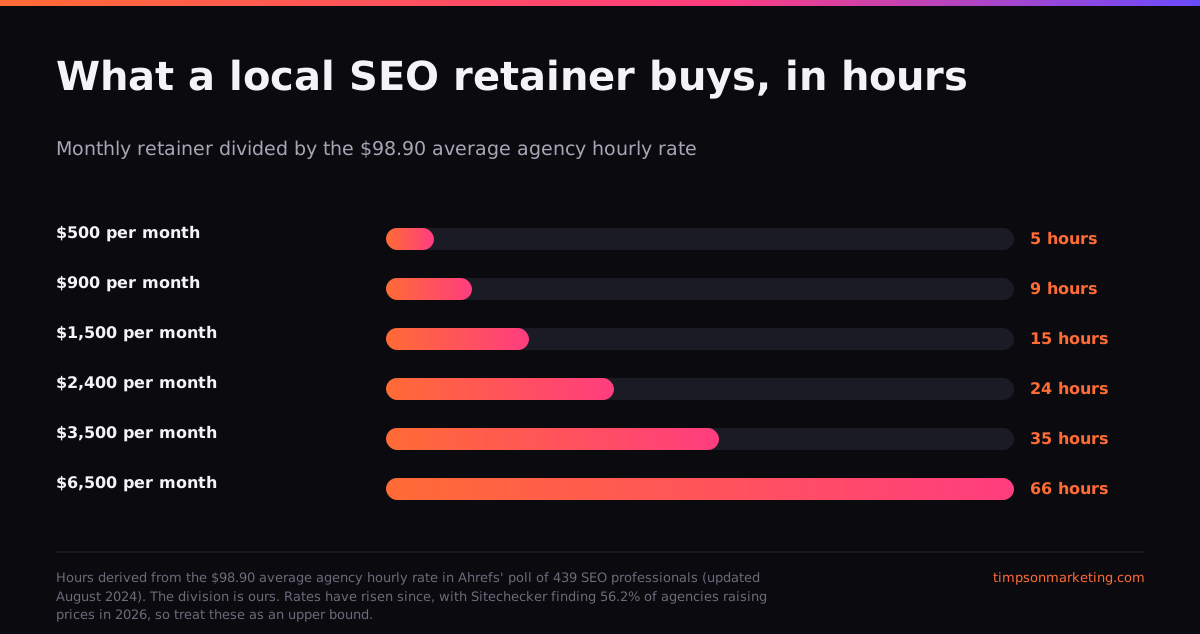
A $900 retainer buys about nine hours a month. That is one working day plus an hour, for everything: profile management, review response, content, technical fixes, reporting and the monthly call. The call alone can eat 10% of it.
A $2,400 retainer buys about 24 hours, roughly three working days. A $6,500 retainer buys about 66, or eight working days, which is the first tier at which a genuinely multi-person team can touch the account without the math collapsing.
Two caveats keep this honest. The Ahrefs figure is from August 2024 and rates have risen since, with Sitechecker finding 56.2% of agencies raising prices in 2026, so real hours are probably fewer than these. And any agency running good process, templates and tooling delivers more per hour than the rate implies. Treat the hour count as a ceiling and a conversation starter, not a verdict.
The question to ask each of your three proposals is simply this: how many hours a month, by whom, and on what. An agency that will not answer is telling you the answer.
What each tier can and cannot realistically do
| $900 per month, about 9 hours | $6,500 per month, about 66 hours | |
|---|---|---|
| Google Business Profile | Categories, services and hours kept correct. Reviews responded to. | All of that plus proactive category testing, service expansion and monthly geo-grid rank checks. |
| Content | One page a month at best, often a rewrite rather than a new asset. | Four to eight new pages a month plus scheduled refreshes of existing ones. |
| Technical work | Reactive only. Something breaks, it gets fixed. | Ongoing crawl monitoring, site speed, internal linking and structured data maintenance. |
| Off-site and PR | Almost none. Citation cleanup at most. | Real outreach for mentions, best-of list placement and partnership links. |
| Reporting | An automated dashboard. | An analyst who reads the dashboard and changes the plan. |
| Who touches the account | One generalist, often junior. | A specialist per discipline. |
The honest read on that table is that the $900 tier is not a smaller version of the $6,500 tier. It is a different product. It is maintenance. Maintenance is a legitimate purchase for a business that already ranks and simply needs its assets kept current, and it is close to worthless for a business trying to break into a market it has never ranked in.
That distinction is missing from every price-range article we read, and it is the single most useful thing to know before you compare the three PDFs on your desk. If you are not sure which situation you are in, our guide to what a local SEO engagement actually produces walks through both.
The cheap proposal: bargain or bot?
A $900 proposal is not disqualified by its price. It is disqualified by six specific things, all of which you can check in an afternoon.
- Ask who does the work and where they sit. Backlinko found entry-level offerings represent 7% of US, UK and Australian providers versus 42% in India and Latin America. Offshore is not automatically bad. Undisclosed offshore is.
- Ask for two client references in a comparable trade and call them. Google's own hiring documentation tells you to ask for examples of previous work and success stories.
- Search the proposal's exact sentences. If they appear on other agency sites, the strategy is a template and the price reflects it.
- Check whether they will name a lead target. Not a ranking target. If they will only commit to positions, read our piece on how to tell whether your SEO agency is working before signing.
- Ask what happens to the assets if you leave. Content, profile access and site changes should be yours.
- Count the hours. If the deliverable list would take twenty hours and the price implies nine, one of the two is fiction.
The reason to be this careful is documented in federal court, not in agency blog posts. In FTC v. Pointbreak Media, telemarketers falsely claiming to represent Google charged small businesses $300 to $700 to claim and verify a Google listing, then pitched guaranteed top placement for $949.99 plus $169.99 or $99.99 a month. The FTC ultimately mailed more than $700,000 in refunds to 4,467 small business owners, an average of $158.32 each. In May 2026 the FTC and the state of Illinois sued a company for creating thousands of fake home repair listings with fabricated five-star reviews.
The scam pattern is not a low price. It is a low price attached to a guarantee.
If you want to compare a proposal against a scope written in hours and lead targets instead of adjectives, our service pages spell out exactly what is inside each tier.
See what our engagements include→The expensive proposal: what does the extra $4,000 buy?
Sometimes a great deal. Sometimes nothing. Three things genuinely justify the gap, and everything else is packaging.
Market difficulty. A single-location plumber in a town of 40,000 and a personal injury firm in Phoenix are not buying the same product. LocaliQ's 2026 benchmarks put the average Google Ads cost per lead in Home and Home Improvement at $90.92 off an $8.33 cost per click, and legal at $131.63. Paid cost per lead is the cleanest available proxy for how contested a market is, and it varies by more than 40% between those two categories alone.
Scope that actually scales. Multiple locations, multiple service lines, or a service area you are trying to expand into all multiply the page count and the profile count. If a proposal is expensive because it covers four cities, check our take on ranking in a city you are not physically in and on how to build location pages that are not thin duplicates before you assume it is padded.
Senior attention. At 66 hours a month you can afford a specialist per discipline instead of one generalist. Whether that is worth $4,000 to you depends entirely on the gross profit per job number from the worksheet above.
What does not justify the gap: line items that sound technical and move nothing. A separate AI search retainer bolted on top is the current favorite. Sitechecker's 2026 survey found that agencies raising prices most often cited AI-related services. Some of that work is real. Much of it is not, and we have written honestly about which parts of AI search optimization are worth paying for and why schema markup is a hygiene item rather than a growth lever.
What no honest agency can promise you
This is the section that should make you trust the rest of the post, because it is the section most pricing articles omit.
None of the experts have special access to the internal workings of Google's local search algorithm.
Shaw wrote that as the methodology caveat on the 2026 Local Search Ranking Factors report, in which 47 local search specialists scored 187 ranking factors. It is the most-cited study in local SEO, and its own author opens by saying nobody involved knows the algorithm. Anyone selling you certainty is selling you something they do not have.
Google says the same thing in its own documentation on hiring an SEO: "No one can guarantee a #1 ranking on Google." The same page tells you to be wary of anyone claiming a special relationship with Google, sending unsolicited email about search optimization, or refusing to explain clearly what they intend to do.
Rankings are also the wrong thing to buy even when you get them.
If you have a business profile that ranks really well, even if you don't see a drop in ranking, your calls from the business profile are going down over time.
Hawkins published that alongside a finding that AI local packs surfaced 5,943 unique businesses across 322 markets against 18,330 in traditional three-packs, roughly a third as many winners. A contract written around ranking positions can be fully satisfied while your phone gets quieter. Write it around calls and booked jobs instead. Our guide to Google Maps ranking covers what actually moves those positions, and the piece on Business Profile categories covers the single highest-scoring lever in Whitespark's data.
Older content dominates. If you want to rank in Google's top 10, focus on creating evergreen content that can stand the test of time and plan to update it.
Two cheaper things to try before you sign anything
Both of these change the arithmetic in your favor, and both are close to free.
Reviews. BrightLocal's 2026 survey of 1,002 US consumers found 47% will not use a business with fewer than 20 reviews, and 83% of people who were asked to leave a review went ahead and left one. The ask is the bottleneck, not customer willingness. Fixing that raises your close rate, which lowers every breakeven number in the worksheet. Start with our review generation guide.
Answering the phone. Google's Local Services Ads documentation states that missed calls may negatively affect your responsiveness score, which affects ad rank. Speed of response is literally priced into a Google ad product. It is also the cheapest close-rate lever in the business, and it costs nothing.
If you are weighing search against paid instead, our analysis of whether Google Ads are worth it for contractors runs the same style of arithmetic on the paid side. Worth knowing for comparison: Angi's audited 10-K reports $587.1 million of US lead revenue on 20.195 million leads in 2025, an implied average near $29 a lead, and the filing states pros pay for a match "regardless of whether the Pro ultimately provides the requested service."
The number to put in the contract
Stop negotiating the price. Negotiate the review date.
Take the breakeven lead number from your worksheet, add a realistic ramp, and write it into the agreement as a checkpoint. Something like: by month six we expect to see qualified inbound leads running at X per month, measured by tracked calls and form submissions, and at month six either party can end this without penalty.
That single clause does more than any amount of price shopping. It forces the agency to tell you, before you sign, whether they believe the number is reachable. An agency that will not put a lead figure on paper has told you what they think of their own plan. An agency that argues the number down to something honest before signing is the one to hire.
The CMO Survey's 2026 breakout found firms under $10 million in revenue spend a mean 13.34% of revenue on marketing, though on a cell size of only 20 respondents. Meanwhile the 2022 Economic Census shows plumbing and HVAC contractors purchased advertising equal to 0.62% of revenue, roofing 0.73% and electrical 0.25%. Those two figures measure different things, self-reported total marketing expense against purchased advertising only, but the gap is wide enough to make the point: the trades sit far below cross-industry marketing norms.
Which is either a warning or an opportunity, depending on whether your competitors read this post first. If you want the arithmetic run against your own numbers before you sign anything, tell us what you are looking at, or browse the rest of the hiring and proof series for the timeline and measurement pieces that pair with this one.
Frequently asked questions
How much does local SEO cost per month?
Published surveys disagree sharply. Ahrefs put the average agency retainer at $2,917, SE Ranking found 64% of agencies charge under $1,000, and Backlinko put the typical range at $1,000 to $2,500. Use your own gross profit per job to decide, not these ranges.
Is $500 a month enough for local SEO?
At the $98.90 average agency hourly rate, $500 buys about five hours a month. That is enough to maintain a Google Business Profile and respond to reviews. It is not enough to break into a market where you currently do not rank at all.
How do I calculate whether a local SEO retainer is worth it?
Multiply your average job value by your gross margin to get gross profit per job. Divide the monthly retainer by that figure. The result is how many extra jobs per month the retainer must produce to break even. Aim for three times that for a real return.
Why do local SEO prices vary so much between agencies?
Three reasons dominate: market difficulty, scope, and who does the work. Backlinko found entry-level offerings make up 7% of US, UK and Australian providers versus 42% in India and Latin America. Price often reflects labor location and seniority more than method.
Should I pay for a guaranteed number one ranking?
No. Google's own documentation states plainly that no one can guarantee a number one ranking, and advises walking away from anyone who promises it. The FTC has prosecuted multiple companies for selling guaranteed placement to small businesses, with refunds mailed to thousands of owners.
How long before local SEO pays for itself?
Ahrefs tracked one million new pages and found only 1.74% reached the top ten within a year, but 40.82% of those that did got there within one month. Results tend to be fast or never. Set a six month checkpoint with a lead target, not a ranking target.
Is local SEO cheaper than Google Ads?
Different cost shape. LocaliQ's 2026 benchmarks put the average cost per lead in Home and Home Improvement at $90.92, paid every month you run ads. SEO costs more up front and compounds. Most local businesses under $5M end up running both.
What should be included in a local SEO retainer?
At minimum: Google Business Profile management with category and service work, review response, service and location page content, technical maintenance, and reporting tied to calls and form submissions rather than rankings. Ask how many hours each line item takes every month, and who does them.
Can I do local SEO myself instead of hiring someone?
Partly. Reviews, categories, hours, services and answering the phone quickly are all owner-controllable and account for a large share of local pack performance. LocalImpact found 59% of local businesses already run marketing in-house. Content and technical work is where outside help earns its fee.
What is a fair contract length for local SEO?
Six to twelve months is reasonable given how long content takes to mature, but only with a written checkpoint. Put a lead target and a no-penalty exit at month six. A thirty day guarantee is a warning sign, not a benefit.
Sources
- Ahrefs. SEO Pricing: How Much Does SEO Cost? (2024-08)
- SE Ranking with Duda. SEO Pricing: How Much Does SEO Cost (Agency Survey) (2025)
- Backlinko. SEO Pricing: How Much Does SEO Cost (New Data) (2025-12)
- Sitechecker. The 2026 SEO Agency Growth Data Study (2026-03)
- Google Search Central. Do you need an SEO? Tips for hiring an SEO (2026-06)
- Ahrefs. How Long Does It Take to Rank in Google? (2025-05)
- LocaliQ / WordStream. Search Advertising Benchmarks (2026-06)
- Whitespark. Local Search Ranking Factors 2026 (2025-11)
- Sterling Sky. The State of Local SEO in 2026 (2026-06)
- BrightLocal. Local Consumer Review Survey 2026 (2026-02)
- U.S. Federal Trade Commission. FTC Action Halts Deceptive Robocalls Aimed at Small Business Owners (2018-05)
- U.S. Federal Trade Commission. FTC Sends Refund Checks Totaling More Than $700,000 to Small Business Owners (2020-08)
- U.S. Federal Trade Commission. FTC and Illinois Take Action to Stop Company That Created Thousands of Business Listings with Fake Reviews (2026-05)
- Duke Fuqua, Deloitte, American Marketing Association. The CMO Survey Firm and Industry Breakout Report 2026 (2026-03)
- U.S. Census Bureau. 2022 Economic Census, Construction sector basic file (2022)
- LocalImpact. State of Small Business Marketing (2025-09)
- Nielsen. 2025 Annual Marketing Report, ROI (2025)
- Enji, State of Small Business 2025. 4 in 5 Small Business Owners Say Their Marketing Barely Works (2026-04)
- WebFX. Local SEO Pricing (2026)
- Google Local Services Help. About ad rankings, Local Services Ads (2026)
Joseph Timpson has worked in search since 2010 and runs Timpson Marketing out of St. George, Utah. He built The Cited Method, a five stage framework for earning and proving real citations in AI answers, and publishes what does not work alongside what does.
Want this done for you, with the receipts to prove it worked?
One call, no pitch deck. We look at what is actually blocking you and tell you the truth about whether we can help.
Book a free consultation →