You Were Quoted for Schema Markup. What Are You Buying?
Every schema proposal describes a benefit. Almost none describe a deliverable. This is the version that tells you what arrives, how to check it, and what it should cost.

- What you buy is blocks of JSON-LD code added to your page templates. You can see it yourself by pressing Ctrl+U and searching for application/ld+json.
- Google's structured data gallery lists 33 rich result features. A local service business is realistically eligible for about seven of them.
- Google states in its own policy documentation that a structured data penalty costs rich result eligibility and does not affect how the page ranks.
- Schema is priced per template, not per page, because the code is generated by the template. A per-page quote on a 60 page site deserves a hard question.
- For a five template local service site, six to twelve focused hours at published agency rates lands roughly between $500 and $1,800.
The line on the proposal
"Schema markup implementation, $1,800."
Google's own structured data gallery lists 33 rich result features. A plumbing company is realistically eligible for about seven of them. Nearly every schema quote is sold inside that gap, and almost none of them name which seven.
This post is not an argument about whether schema is good. It is a purchase decision. What physically arrives, how you check it without a developer, what it plausibly moves, and what a fair number looks like for a site your size.
A schema markup engagement delivers one visible thing: blocks of JSON-LD code added to your page templates that describe your business, locations, services and content in a format search engines parse. You can confirm it exists in about two minutes using your browser's View Page Source and Google's Rich Results Test. It makes pages eligible for richer search listings. It does not lift rankings by itself, and Google says so in its own policy documentation.
What physically gets delivered
Strip the language off the proposal and a schema engagement produces four artifacts. Only one of them is code.
The first is an audit of what is already there. This matters more than agencies admit, because a large share of sites already have markup they never bought. JSON-LD appears on 36.6% of desktop home pages according to the HTTP Archive's 2025 Web Almanac, and most of it arrived by plugin default, not decision. If your site runs Yoast, Rank Math or Squarespace, you almost certainly have Organization and WebPage markup right now.
The second is a map: which page template gets which schema type. Home page gets Organization. Service pages get Service. Location pages get LocalBusiness. That map is the actual thinking in the engagement.
The third is the code itself. Google recommends JSON-LD over the older Microdata and RDFa formats, calling it the easiest solution to implement and maintain at scale. It is a script block in the page head. It is invisible to visitors.
The fourth is evidence that it works, which is the artifact most often missing.
Expect an audit of your current markup and gaps, a map tying each page type to specific schema types, validation evidence from Google's Rich Results Test, Search Console monitoring of valid items, and documentation of how the markup is deployed so future developers do not accidentally break it.
That list is the right one, and we would add one item to it: ask where the code physically lives. Markup buried inside a proprietary plugin leaves with the agency. Markup in your theme or tag manager stays with you.
Verify it yourself in two minutes
You do not need a developer to find out whether you got what you paid for. You need a browser and two free tools, both of which Google names in its own documentation.
View the source
Open the page in Chrome and press Ctrl+U (Cmd+Option+U on Mac). Then press Ctrl+F and search for application/ld+json. Every hit is one JSON-LD block. Zero hits means nothing is in the raw HTML.
Run the Rich Results Test
Paste the URL into Google's Rich Results Test. It reports only the types Google supports for rich results, which makes it the eligibility answer, not the inventory.
Run the Schema Markup Validator
Paste the same URL into validator.schema.org. It reports every schema.org type on the page, including the ones Google never renders. The gap between these two tools is the point.
Check Search Console
Open the rich result status reports. This is the only view that shows valid items across your whole site over time rather than one page at a time.
Compare against the invoice
Line up the types you found against the types you were quoted. Anything on the invoice that is missing from the output was either not delivered or deployed broken.
The step most people skip is the third one, and it is the one that catches overselling. The Rich Results Test only knows about features Google renders. The Schema Markup Validator knows about everything. If your agency deployed nine schema types and Google only recognizes three of them, both tools are telling the truth and only one of them is telling you what you bought.
The 33 features Google renders, and the seven you can get
Schema.org's vocabulary contains 823 types and 1,529 properties. Google renders 33 of them as rich results. A local service business qualifies for a much smaller set than either number suggests.
| Feature | What it can change | Who it applies to |
|---|---|---|
| Organization | How Google resolves your business as an entity: name, logo, contact points | Every business |
| Local business | Address, hours and phone tied to the page | Anyone with a service address |
| Breadcrumb | The breadcrumb trail shown on desktop results | Sites with real hierarchy |
| Article | Eligibility for article treatment on published content | Businesses that blog |
| Review snippet | Star ratings in the listing, with a large caveat below | Almost nobody, see below |
| Video | Thumbnails and key moments for embedded video | Businesses with real video |
| Job posting | Placement inside Google's jobs experience | Businesses actively hiring |
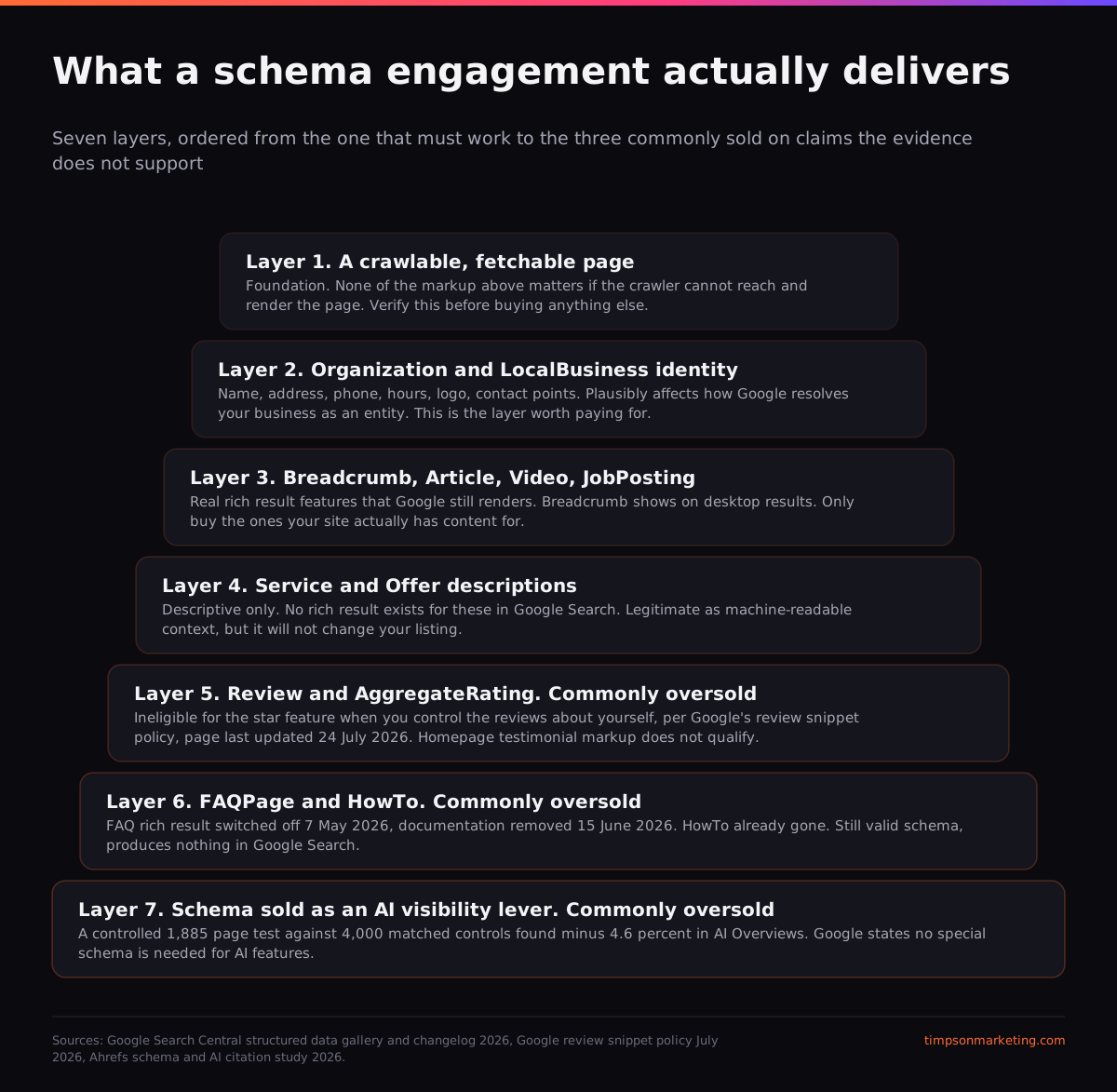
The review row is where quotes go wrong most often. Google's review snippet documentation, last updated 24 July 2026, states that if the entity being reviewed controls the reviews about itself, pages using LocalBusiness or any Organization structured data are ineligible for the star review feature. That kills the single most commonly sold schema deliverable in local SEO: the homepage testimonial widget marked up with AggregateRating. It is ineligible by policy, not by accident, and no amount of clean code changes that.
If a proposal promises stars in your search listing from testimonials on your own site, that is the line to strike. Genuine review visibility comes from the profiles themselves, which is a different job covered in how to get more Google reviews.
What you are not buying
The honest boundaries are all documented, and Google publishes every one of them.
Schema is not a ranking input. Google's general structured data guidelines state that using structured data enables a feature to be present and does not guarantee it will be present. The sharper evidence is in the penalty language on the same page: a structured data manual action costs a page its rich result eligibility and does not affect how the page ranks in Google web search. If schema were a ranking lever, the penalty would touch rankings. It does not touch rankings, which tells you which layer of the system it lives on.
FAQ schema is not a SERP play anymore. Google's documentation changelog records the FAQ rich result being switched off on 7 May 2026 and the documentation removed on 15 June 2026. FAQPage is still valid schema.org and keeping it causes no harm. It just produces nothing in Google Search, so it is not a deliverable worth paying for.
And it is not an AI lever. Ahrefs ran a rare controlled design here, tracking 1,885 pages that added JSON-LD against 4,000 matched control pages and finding no meaningful lift: minus 4.6 percent in AI Overviews, plus 2.4 percent in AI Mode, plus 2.2 percent in ChatGPT. Google's AI features documentation says the same thing in plainer terms, that there is no special schema.org structured data you need to add to appear in AI Overviews or AI Mode.
Adding schema produced no major uplift in citations on any platform.
We are not relitigating that here. The full evidence review lives in is AI SEO worth paying for and the mechanics of how the engines actually choose sources are in where AI chatbots get their data. For a purchase decision, one sentence is enough: do not pay a premium for the AI line on a schema quote.
There is a legitimate long game, and it is worth stating fairly rather than dismissing.
Building a knowledge graph to manage how your website/content is understood with schema, and then asking it questions will be more important than optimizing for Rich Results or for Google.
That is a real position from someone who has built this for a living, stated in 2024 and still the strongest case for descriptive markup. It is also an argument about future optionality, not about leads this quarter. Price it accordingly.
What a fair price actually looks like
Schema pricing is not mysterious once you convert it into hours, because that is all it is.
Two independent surveys give you the rate. Ahrefs polled 439 SEO professionals and found agencies averaging $98.90 an hour at the top of their quoted tiers, with $75 to $100 the most common band. Backlinko surveyed more than 300 professionals and put typical monthly SEO cost at $1,000 to $2,500. Both are practitioner polls rather than random market samples, and both are directionally consistent with the technical specialist range published elsewhere.
Specialist technical SEO work commonly runs $80 to $150 per hour, with a mid-sized site's implementation taking a handful of focused hours.
Now the hours. This estimate is ours, built on those published rates, and you should treat it as a benchmark to argue with rather than a quote.
A typical local service site has about five page templates: home, service, location, about, and blog post. JSON-LD is generated by the template, so 60 location pages built from one template are one unit of work, not sixty. Audit runs one to two hours. Template mapping, one to two. Writing and deploying across five templates, three to six. Validation and Search Console setup, one to two. Call it six to twelve focused hours, which at $80 to $150 lands roughly between $500 and $1,800.
| A $99 plugin install | A $1,200 engagement | |
|---|---|---|
| Audit of existing markup | None | Written, including the duplicate blocks found |
| Template mapping | Plugin defaults | Each template mapped to a named type |
| Types deployed | Whatever the plugin ships | Chosen against what your site is eligible for |
| Validation evidence | None | Rich Results Test output per template |
| Search Console monitoring | None | Rich result status reports connected and read |
| Who can fix it in 2028 | Nobody, it is inside the plugin | Documented, portable JSON-LD you own |
So the $1,800 line item is not automatically wrong. It is at the top of a defensible band, and it is only worth it if the audit, the map, the validation evidence and the documentation all arrive with it. Paid as pure code delivery it is roughly double the market.
Watch the two ends. At the bottom, plugin installs sold around $99 are real and are sometimes the correct purchase for a five page site. At the top, enterprise platforms like Schema App do not publish a price at all, requiring a custom quote, a one time setup fee and a 12 month minimum term. That is a legitimate product for a 10,000 page catalog. A 40 page HVAC site does not need a knowledge graph platform, and quoting one is a scoping failure.
If your quote is priced per page, ask why. If the answer is that each page is hand coded, you are paying for a method nobody should be using in 2026. Wider context on where this fits in a real budget is in how much local SEO costs.
We publish the deliverable list, the validation evidence and the price band before you sign. No stars promised, no AI claims attached.
See what our schema work includes→Five questions that separate an engagement from a line item
Ask these before you sign. The answers take a competent provider ninety seconds and expose an incompetent one immediately.
- Which specific schema types are you deploying, and which rich result feature does each one target?
- Is this priced per page or per template, and how many templates does my site actually have?
- Will you send me Rich Results Test output for every template after deployment?
- Where does the code live: theme files, a plugin, or Google Tag Manager? What happens to it if we part ways?
- What is the monthly fee paying for once the markup is deployed and validated?
Question five is the one that saves the most money. Schema is largely a one time build with occasional maintenance when your services or locations change. A recurring fee is defensible when it covers monitoring, new page types and fixing what your page builder breaks on update. It is not defensible as rent on code that was written once.
Question four matters more than it looks. We have inherited sites where every schema block vanished the day a plugin license lapsed, and the owner had paid four figures for markup he never owned.
And if a proposal guarantees rankings or guaranteed rich results, that is the end of the conversation. Google's own guidance for hiring an SEO says plainly that nobody can guarantee a number one ranking. The same logic applies to rich results, which Google explicitly declines to guarantee even with correct markup.
When schema is genuinely worth paying for
Here is the ranking we would actually give an owner.
Buy it when your business has real structure to describe: multiple locations, multiple services, staff with credentials, events, jobs, or video. Markup earns its keep by removing ambiguity, and a business with genuine complexity has more ambiguity to remove. Multi-location businesses get the most out of it, which connects directly to building location pages properly.
Buy it as part of technical cleanup, not as a standalone product. Correct Organization and LocalBusiness markup belongs in the same work order as your titles, canonicals and internal links. Sold alone at a premium it is usually margin.
Do not buy it expecting a ranking change. If Google Maps visibility is the goal, the Whitespark survey of 47 local search experts put primary Google Business Profile category at the top of the local pack factors, and schema is not near it. That work is covered in ranking higher on Google Maps.
The honest summary: schema markup is worth it as cheap, durable search hygiene that makes your pages eligible for better listings and easier for machines to parse correctly. It is not worth a premium, it is not a ranking lever, and it is not the thing standing between you and the phone ringing. Judge the invoice by the artifacts, not by the adjectives, and use the two minute check on whatever you already paid for before you buy any more. If you want to know whether the rest of your retainer is producing anything, how to tell if your SEO agency is working applies the same test to everything else.
Frequently asked questions
How do I know if my website already has schema markup?
Open the page in Chrome, press Ctrl+U to view the source, then press Ctrl+F and search for application/ld+json. Each hit is one JSON-LD block. For a clearer read, paste the URL into Google's Rich Results Test, which names every type it detects.
Is schema markup a ranking factor?
No. Google's structured data guidelines state that a structured data manual action costs a page its rich result eligibility and does not affect how the page ranks in web search. Schema affects how your listing can appear, not where it appears.
How much should schema markup cost for a small business website?
Converted to hours, a five template local service site is roughly six to twelve hours of work. At published agency rates of $80 to $150 an hour, that lands between about $500 and $1,800. Above that band, ask what else is included.
Should schema markup be priced per page or per template?
Per template. JSON-LD is generated by the page template, so 60 location pages built from one template are one unit of work. A per-page quote on a large site either reflects hand coding, which nobody should be doing, or padding.
Do I need to pay a monthly fee for schema markup?
Only if the fee buys something ongoing: monitoring in Search Console, markup for new page types, or repairs when your page builder breaks it on update. A recurring charge for code that was written once and never touched again is rent, not service.
Is FAQ schema still worth adding in 2026?
Not as a search visibility play. Google switched off the FAQ rich result on 7 May 2026 and removed the documentation on 15 June 2026. FAQPage remains valid schema.org and causes no harm, but it produces nothing in Google Search now.
Can I just add schema markup myself with a plugin?
Often yes. Yoast, Rank Math and most modern platforms output Organization and WebPage markup by default, which covers the basics for a small brochure site at no extra cost. Paid work earns its money on multi-location, multi-service sites where mapping templates to types needs real judgment.
Why does the Rich Results Test show nothing when my agency says schema is installed?
The Rich Results Test only reports the types Google supports for rich results, so markup can be present and perfectly valid yet show up as nothing there. Run the same URL through validator.schema.org, which reports every schema.org type on the page, before assuming nothing was delivered.
Will schema markup get my business star ratings in Google?
Almost certainly not from testimonials on your own website. Google's review snippet policy, last updated 24 July 2026, makes pages using LocalBusiness or Organization markup ineligible for the star feature when the entity controls the reviews about itself. Homepage testimonial widgets do not qualify.
Sources
- Google Search Central. Structured Data Markup that Google Search Supports (2026-06)
- Google Search Central. General Structured Data Guidelines (2026-07)
- Google Search Central. Intro to How Structured Data Markup Works (2025-12)
- Google Search Central. Structured Data and testing tools overview (2026-06)
- Google Search Central. Review Snippet (Review, AggregateRating) Structured Data (2026-07)
- Google Search Central. AI Features and Your Website (2025-12)
- Google Search Central. Search Central Documentation Updates changelog (2026-06)
- Google Search Central. Do You Need an SEO? (2026-06)
- Google Search Console. Rich Results Test (2026-07)
- Schema.org. Schema Markup Validator (2026-07)
- Schema.org. Schema.org vocabulary version 30.0 (2026-03)
- Ahrefs (Louise Linehan and Xibeijia Guan). Does Schema Markup Improve AI Citations? We Studied 1,885 Pages (2026-05)
- Ahrefs. SEO Pricing: How Much Does SEO Cost? (2024-08)
- Backlinko. SEO Pricing: How Much Does SEO Cost in 2026? (2025-12)
- eSEOspace (Irina Shvaya). How to Choose a Schema Markup Service: What to Look For and Red Flags to Avoid (2026)
- Schema App. Schema App Pricing (2026-07)
- Search Engine Journal (Roger Montti). Digital Marketers See Schema Structured Data Shifting Beyond SEO (2024-11)
- HTTP Archive. Web Almanac 2025, SEO chapter (2026-01)
- Whitespark (Darren Shaw). Local Search Ranking Factors 2026 (2025-11)
Joseph Timpson has worked in search since 2010 and runs Timpson Marketing out of St. George, Utah. He built The Cited Method, a five stage framework for earning and proving real citations in AI answers, and publishes what does not work alongside what does.
Want this done for you, with the receipts to prove it worked?
One call, no pitch deck. We look at what is actually blocking you and tell you the truth about whether we can help.
Book a free consultation →