How to Respond to a Bad Google Review
The review went up ninety minutes ago and you have already written three replies you did not send. Good. The reply you send depends entirely on which of four situations you are in, and only one of them can end in removal.

- A bad Google review is one of four things, and the four need genuinely different replies: an accurate complaint, a misunderstanding, an unsatisfiable customer, or a fake.
- Google will not remove a review for being negative. It removes reviews that break a named content policy, which in practice means the fake and off-topic ones.
- BrightLocal's 2026 survey found generic or templated replies put off 50% of consumers, which means copying a stock apology from a listicle is an active cost, not a neutral one.
- Never write "we have no record of you as a customer." If you are wrong, they post the invoice, and a public false accusation about a review is conduct the FTC rule on consumer reviews specifically names.
- Responding is a conversion lever, not a ranking lever. Whitespark's 47-expert panel scored owner responses as the 122nd strongest local pack factor out of 187.
Four situations, not one template
Every post that ranks for this query hands you a single apology and tells you to paste it everywhere. Then BrightLocal's 2026 Local Consumer Review Survey found that generic or templated replies put off 50% of consumers, who may see them as a sign of subpar customer care.
The template is not the fix. The template is half the problem.
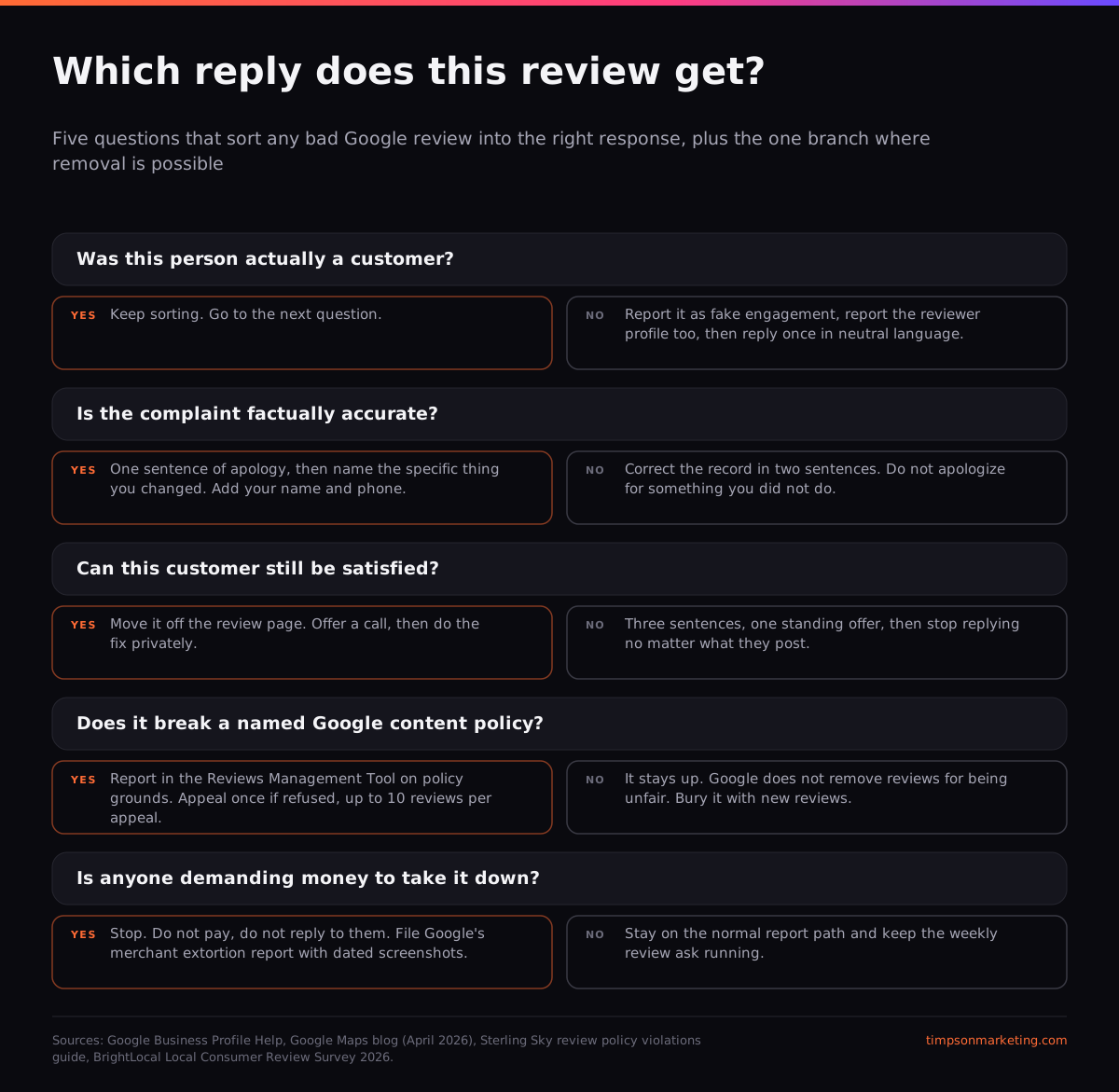
Sort the review before you write a word. If the complaint is accurate, apologize once and name the specific thing you changed. If it is a misunderstanding, correct the record in two sentences and do not apologize. If the customer cannot be satisfied, write three sentences and stop replying. If the person was never a customer, report it under Google's content policy first and reply second, because that is the only one of the four situations where removal is even possible.
The first two numbers pull against each other, and that tension is the whole job. Silence costs you. A stock paragraph costs you differently. The same survey found 19% expect a reply the same day and 81% inside a week, so you have hours, not minutes.
Sort first. Write second.
Situation one: the complaint is accurate
You already know. The truck was four hours late. The estimate moved after the deposit. The job needed a callback and nobody called.
This is the only one of the four that gets a real apology, and it should be one sentence long. Then name the specific thing you changed. Vague regret reads as a template. A named change reads as a business.
Template:
Ron, you are right and I am sorry. We had two trucks down that Thursday and nobody called you to reset the window, which is on us. We now call every customer the moment a window slips. I am Joe, the owner, at 555-0142 if you want the rest of it made right.
That template does three things a stock apology does not. It uses the first name. It concedes one specific fact. It puts a named human and a live phone number on a public page.
What it does not do is negotiate money in writing. Make the refund offer on the phone, where the next customer cannot see it and decide a one star review is the fastest route to a discount. This is also the review most worth answering well, because dispatch failures are exactly what people screen for when they are searching for emergency service at 9pm.
Situation two: it is a misunderstanding, or it is not even your business
This is the most commonly mishandled case, because owners apologize reflexively for things they did not do. Do not. A public apology is a public admission, and the next reader takes it at face value.
Correct the record in two sentences, neutrally, and move on. No sarcasm, no timeline, no invoice numbers.
Template:
Thanks for flagging this. Our records show the $400 charge you mention was the county permit fee, which is listed on line 3 of the estimate and paid straight to the city, not to us. Call me at 555-0142 and I will walk you through it line by line.
If the review is actually for a different company with a similar name, that is not a judgment call, it is a policy violation. Google's prohibited and restricted content policy tells contributors to "Only post content that is based on your experience or questions about experiences at a specific location." A review about somebody else's location is off topic. Report it, then reply once so the next reader sees the correction while the report sits in the queue.
Situation three: the customer cannot be satisfied
Some people are not looking for a resolution. They are looking for a second round. Long replies also quietly legitimize the complaint by making it look like it needed defending.
Write for the audience, not the reviewer. The person you are actually talking to is the homeowner reading your profile next Tuesday, and she is scanning for whether you sound stable.
Three sentences. One offer. Then stop.
Template:
I am sorry we could not get to an agreement here. We offered to return and reset the unit at no charge, and that offer is still open. You can reach me directly at 555-0142.
Then do not reply again, whatever they post underneath. One calm reply beside an escalating rant is the most persuasive thing on the page. A second reply turns it into an argument with two participants.
Situation four: the review is fake, and this is the only removal path
Google does not remove reviews for being unfair. It removes reviews that break a named policy. In 2025 Google says it blocked or removed over 292 million policy-violating reviews and took down more than 13 million fake Business Profiles, so the machinery works. It just works on policy grounds only.
Sterling Sky's Joy Hawkins maintains the most complete public list of what Google actually removes: current or former employee reviews, incentivized reviews, competitor and peer reviews, non-customers with no firsthand experience, reviews dated before the business opened, stolen images, hate speech, and coordinated attacks. Her page is equally clear about what stays up, including the category that hurts most: "One-Star Reviews with No Text: These are frustrating - but they don't break any rules."
Run the escalation in this order, using Google's own removal documentation as the map, and stop when it ends.
Report the review
In the Reviews Management Tool, select Report next to the review and pick the policy it breaks, not "I disagree." Google says "Review evaluation typically takes several days."
Report the reviewer profile
In the Google Maps app, tap the reviewer's name, then the three dots, then Report profile. A profile with reviews for unrelated businesses in five states is stronger evidence than the review itself.
Appeal once, with evidence
If the status returns "Report reviewed - no policy violation," Google gives you one appeal, and you can attach up to 10 reviews to a single submission. There is no second appeal.
Escalate only for extortion
If anyone demands money to take reviews down, use Google's merchant extortion report instead. Google's instruction is blunt: "Do not engage with or pay the malicious individuals."
Stop and outrank it
After the appeal, Google's internal path is finished. From here the only lever is burying it under new reviews.
The extortion branch is worth knowing before you need it. Google describes the pattern as "a sudden increase in 1-star and 2-star reviews on your Google Business Profile, followed by someone demanding money, goods, or services in exchange for removing the negative reviews," and it runs a dedicated extortion report form that asks for dated screenshots of the demands, links to the reviews, and any usernames or phone numbers the extortionist used. Sterling Sky, which has walked multiple businesses through this exact queue, reports that owners who flagged the reviews, reported the profiles, and filed the form got the fraudulent reviews removed. Collect the evidence before you file, because a thin submission is what gets closed.
One warning on the reputation vendors who promise removal for a fee. Hawkins documented how those companies actually do it, and the leading method is fraud: "One common trick is abusing DMCA takedown notices with false claims, which Google often approves automatically." Her verdict on the practice is one line: "While these tactics may seem tempting, let me be clear: This is lying."
One common trick is abusing DMCA takedown notices with false claims, which Google often approves automatically.
The one sentence you must never write
In any of the four situations, do not write this:
"We have no record of you as a customer."
It feels like the strongest sentence available. It is the weakest, for three reasons that compound.
First, it hands the reviewer a second post. If they booked under a spouse's name, a maiden name, or a pseudonym, their reply is a photo of the invoice, and the top of your profile becomes a public correction of the owner.
Second, it does nothing for removal. Google decides on policy grounds inside the Reviews Management Tool, and the team evaluating your report never reads your public reply.
Third, it is legally loaded. The FTC rule on consumer reviews and testimonials, effective October 21, 2024, treats review suppression by "unfounded or groundless legal threat, a physical threat, intimidation, or a public false accusation" as a violation, and Alston & Bird put the exposure at up to $51,744 per violation. A public accusation that a real customer's review is fabricated sits uncomfortably close to that language.
The correct move is silent and split. Report the review privately on policy grounds. Reply publicly with something neutral that does not accuse anyone of anything: We could not locate a job matching these details, and we would genuinely like to. Call me at 555-0142 and I will look into it.
Review response is a weekly operating habit, not a crisis project. If nobody at your shop owns it, that is what we do.
See how we handle reviews→What responding actually buys you, and what it does not
Here is the claim the reputation software vendors make and the evidence does not support: that replying to reviews is a ranking lever. In Whitespark's 2026 Local Search Ranking Factors report, built from 47 local search experts scoring 187 factors, "Presence of Owner Responses to Most Reviews" ranks 122nd for the local pack with a score of 70. For AI search visibility it ranks 149th.
The review factors that do rank are different ones. Quantity of native Google reviews with text sits at #9 with a score of 170. Recency of reviews sits at #11 with a score of 164. Your replies are not what moves you in the map pack. Your review flow is.
That distinction matters when you are diagnosing something. Google's own local ranking documentation says local results run on relevance, distance and prominence, and that "More reviews and positive ratings can help your business's local ranking." It says nothing about replies. So if positions moved this month, look at the usual causes of a profile ranking drop before you blame one angry customer.
| Replying to reviews | Earning new reviews | |
|---|---|---|
| Local pack ranking | Weak. #122 of 187 in Whitespark 2026 | Strong. Text review quantity #9, recency #11 |
| Conversion | Strong. 80% are likely to use a business that replies to all | Strong. 47% will not use a business under 20 reviews |
| Speed of effect | Immediate on the page | Sterling Sky measured current-month review count outranking lifetime count |
| Who can do it | The owner, in ten minutes a week | Requires a standing ask process across the whole crew |
That is not an argument against replying. It is an argument for putting it in the right column of the budget. Replying is customer service that happens to be public. Getting the reviews in the first place is the ranking work, and it is why a competitor with fewer total reviews can still outrank you when their current-month count is higher than yours.
The number of reviews you've gotten this month matters more than your total number of reviews.
One small comfort from the same 8,186-business study across 200 cities: Sterling Sky notes that "1-star ratings without text don't even show up on the Google Maps app." The silent one star eating you alive is invisible to a large share of the people you are worried about.
The reviews with text are a different matter, and not only on Google. They are the raw material assistants read when someone asks for a recommendation, which is one route to an AI answer carrying wrong information about your business and part of why AI does not recommend you even when your ratings look fine.
Three legal tripwires before you hit send
Most review advice skips this entirely, and it is the part that turns a bad afternoon into a bad year.
Confirming someone was a patient or client. In 2022 the HHS Office for Civil Rights imposed a $50,000 civil monetary penalty on a dental practice that answered a Google review by naming the patient and describing the treatment, closing with "Get a life." If you are a medical practice, a law firm, or anyone with a confidentiality duty, the reply cannot confirm the relationship existed.
Contract clauses that gag reviewers. The Consumer Review Fairness Act of 2016 makes non-disparagement clauses in form contracts unenforceable, and the FTC has enforced it. A clause in your service agreement barring negative reviews is exposure, not protection.
Incentives and gating. Google's fake engagement policy bans offering incentives "such as payment, discounts, free goods and/or services" in exchange for posting, revising, or removing a review. The penalty is a public warning banner on your profile telling shoppers fake reviews were removed, which is worse than the one star you were trying to bury.
If your business isn't getting new reviews consistently, your competitors will quietly pull ahead of you in the rankings, and you probably won't even notice.
What to do in the next ten minutes
The reply matters less than the system behind it. One bad review inside forty recent good ones is noise. One bad review inside nine reviews from 2023 is your profile.
- Sort the review into one of the four situations before writing anything.
- Write the matching reply, under sixty words, first name used, one phone number, no invoice numbers.
- If it is fake or off topic, report it in the Reviews Management Tool on policy grounds, and report the reviewer profile in the Maps app too.
- If money is being demanded, stop and file Google's merchant extortion report with dated screenshots.
- Text your last ten completed jobs and ask for a review, because 83% of people who are asked leave one.
- Put a recurring fifteen minute block on Friday to reply to everything from that week, positive included.
Google's own reply documentation adds one rule worth repeating, since it covers every situation above: "Do not share any private or confidential personal or business-related information in this public forum." The reviewer chose what to make public. You do not get to expand that list.
If your review flow has been flat for a year and one bad review can still move your average, the review is not the problem. The ask process is, and that is fixable in a week.
If somebody is already being paid to handle this and it is not happening, that is worth checking against what a working engagement should look like. The rest of our guides for local owners sit here, and if you would rather hand the whole thing off, that is what we do.
Frequently asked questions
Should I respond to a bad Google review at all?
Yes, once. BrightLocal's 2026 survey found 80% of consumers are likely to use a business that responds to all of its reviews, and only 47% say the same about a business that replies only to negative reviews. Reply once, calmly, then stop. A single measured reply next to an escalating rant is persuasive. A second reply turns it into a public argument.
How fast do I need to reply?
Faster than you think but slower than your first draft. BrightLocal found 19% of consumers expect a reply the same day they post and 81% expect one within a week. Same-day is the target. That still leaves you hours to cool off, check the job file, and confirm which of the four situations you are actually in.
Can I get a negative Google review removed?
Only if it breaks a specific Google content policy. Google removes fake, off-topic, incentivized, employee, competitor, and abusive reviews. It does not remove reviews for being unfair, harsh, or one star with no text. Report it in the Reviews Management Tool, choose the policy it violates, and expect evaluation to take several days.
What if the reviewer was never a customer?
Report it under Google's fake engagement policy, which covers content not based on a real experience, and report the reviewer's profile in the Maps app as well. Then reply publicly in neutral language. Do not write that you have no record of them, because if you are wrong they will post the invoice underneath your reply.
How many times can I appeal a rejected review report?
Once. If Google returns the status "Report reviewed - no policy violation," you get a single appeal and can include up to 10 reviews in it. If the appeal fails, Google's internal path is finished. After that the only remaining lever is pushing new reviews in fast enough that the old one stops setting your average.
Someone is demanding money to remove reviews. What do I do?
Do not pay and do not reply to them. Google runs a dedicated merchant extortion report form for exactly this pattern, a burst of one and two star reviews followed by a payment demand. Gather dated screenshots of every message, links to each review, and any usernames or phone numbers, then file. Google's own guidance says not to engage.
Does replying to reviews help my Google Maps ranking?
Barely. Whitespark's 2026 report, built from 47 experts scoring 187 factors, ranks owner responses 122nd for the local pack with a score of 70. Review quantity with text ranks 9th and recency ranks 11th. Replying is a conversion lever and a customer service habit. New reviews are the ranking lever.
Should I offer a refund in the review reply?
No. Put your name and a phone number in the reply and make the offer on the call. A refund promised in public teaches the next unhappy customer that a one star review is the fastest route to money back, and it gives you no chance to understand the complaint before committing.
Can I ask a customer to take down their review?
You can ask politely after you have genuinely fixed the problem, and many people will. What you cannot do is pressure them. Google's fake engagement policy bans offering payment, discounts, or free goods for removing a review, and the FTC rule effective October 21, 2024 treats groundless legal threats and intimidation as review suppression.
What if I run a medical or legal practice?
Your reply cannot confirm the person was ever a patient or client. In 2022 the HHS Office for Civil Rights imposed a $50,000 penalty on a dental practice that answered a Google review by naming the patient and describing treatment. Reply generically about your standards and invite offline contact through your office.
Sources
- BrightLocal. Local Consumer Review Survey 2026 (2026-02)
- Google. New ways we're protecting businesses on Maps (2026-04)
- Google. Prohibited and restricted content for Maps user contributions (2026-07)
- Google Business Profile Help. Remove reviews from your Business Profile on Google (2026-07)
- Google Business Profile Help. Report negative review extortion scams on your Business Profile (2026-07)
- Google Business Profile Help. Reply to Google reviews (2026-07)
- Sterling Sky (Joy Hawkins). Google Review Violations: What They DON'T Tell You (2026)
- Sterling Sky (Joy Hawkins). How Shady Companies Remove Bad Reviews from Google (and Why You Shouldn't Do It) (2026)
- Sterling Sky (Joy Hawkins). What Gets You Ranking for Near Me Searches in 2025 (2025-11)
- Whitespark (Darren Shaw). 2026 Local Search Ranking Factors (2025-11)
- Whitespark (Darren Shaw). The Most Underrated Local Ranking Factor (2025-05)
- Goodwin. FTC Finalizes Long-Awaited Rule on Use of Consumer Reviews and Testimonials (2024-09)
- Alston & Bird. FTC Issues Final Rule on Fake Reviews and Testimonials (2024-10)
- Jackson Lewis, Workplace Privacy Report. Another Dentist Responds to Patient's Online Review, This Time Faces a $50,000 OCR Penalty (2022-03)
- Google Business Profile Help. How Google's local search results work (relevance, distance, prominence) (2026-07)
- Sterling Sky. The Google Business Review Extortion Scam: How to Fight Back (2026)
Joseph Timpson has worked in search since 2010 and runs Timpson Marketing out of St. George, Utah. He built The Cited Method, a five stage framework for earning and proving real citations in AI answers, and publishes what does not work alongside what does.
Want this done for you, with the receipts to prove it worked?
One call, no pitch deck. We look at what is actually blocking you and tell you the truth about whether we can help.
Book a free consultation →