How to Get More Google Reviews Without Breaking Policy
Four out of five customers who get asked leave a review. Your problem is not the customer. It is that the ask lives in somebody's memory instead of in the job.

- 83% of consumers who were asked to leave a review went on to leave one, so willingness is not the constraint. The ask is.
- A reminder sent the day after slightly reduces the review rate. A reminder sent one to two weeks later raises it by 63.6%. Most advice has this backwards.
- Review gating (screening customers before you send the link) violates Google policy, and Google has stripped over 80% of a 400-review profile for it.
- Offering anything in exchange for a review is banned by Google and is a violation of federal law under 16 CFR 465.4.
- Across 8,186 businesses, reviews received this month correlated with local pack ranking more strongly than lifetime review count, so a burst followed by silence loses to a steady trickle.
The customer is not the bottleneck. The ask is.
BrightLocal surveyed 1,002 US adults for its 2026 Local Consumer Review Survey and found that 83% of people who were asked to leave a review went on to leave one. Sixty-nine percent wrote a business review in the last twelve months.
Four out of five people say yes. So if you have nineteen reviews and the shop across town has four hundred, the gap is almost never that your customers like you less. It is that their ask is a step in the job and yours is a thing somebody remembers to do when the week is slow.
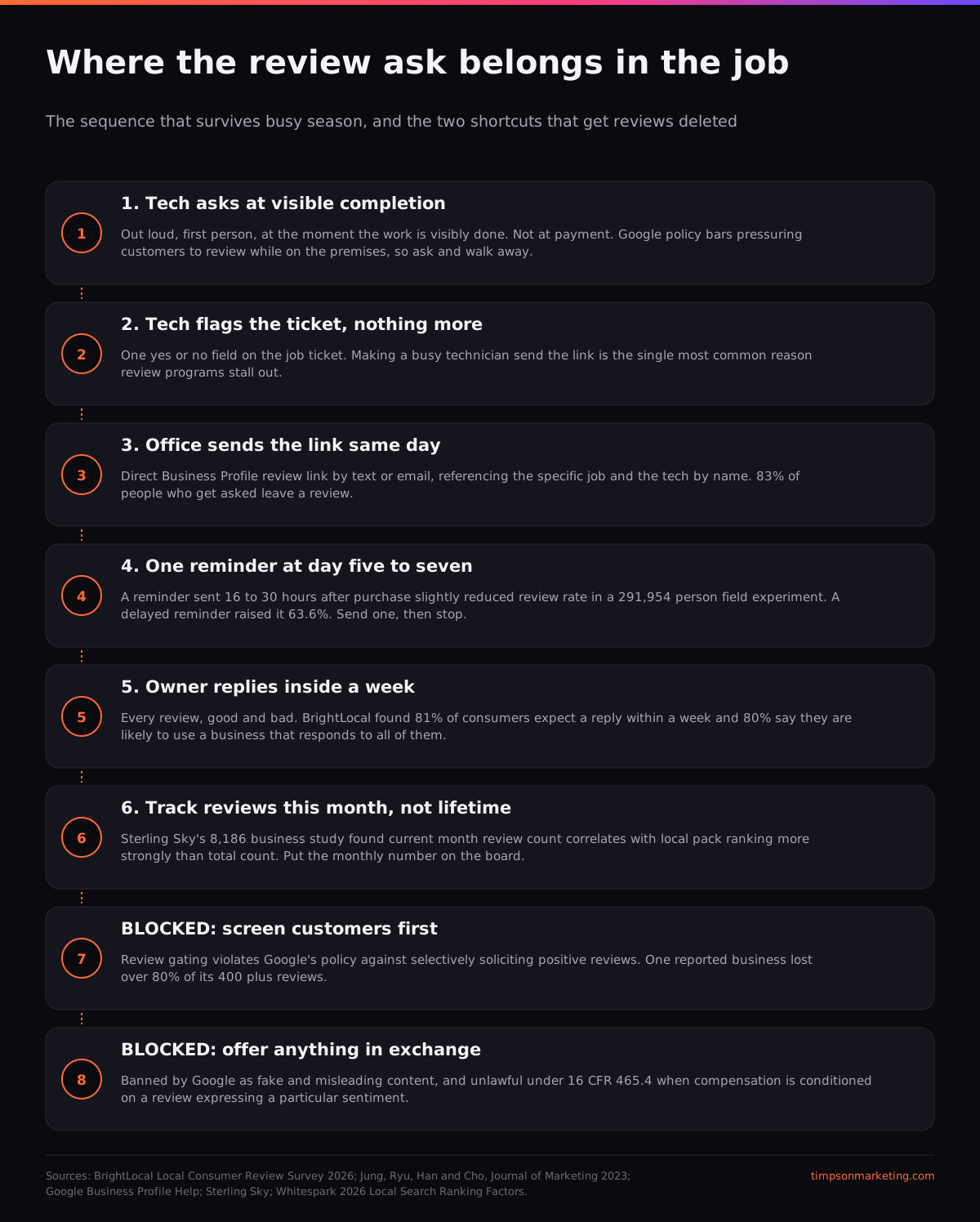
To get more Google reviews, move the ask out of memory and into the job. The technician asks out loud at the moment the work is visibly finished, the office sends the direct review link the same day, and one reminder goes out several days later, not several hours later. Never screen customers before you send the link and never offer anything in exchange. The first is against Google policy. The second is against Google policy and federal law.
The rest of this is the operating version of that paragraph: who asks, when, in what words, and what to do when the customer says yes and then never writes it.
The follow up timing almost everyone gets backwards
Every guide tells you to send the request within 24 hours. Half of that is right. The half nobody checks is wrong, and it is costing you reviews.
Four researchers ran two randomized field experiments on review reminder timing and published the result in the Journal of Marketing. Miyeon Jung, Sunghan Ryu, Sang Pil Han and Daegon Cho tested 8,123 consumers in the first experiment and 291,954 in the second, firing reminders at four different intervals against randomized control groups who received no reminder at all.
The findings show that immediate reminders reduce the chance of review postings relative to a randomized immediate control group who did not receive a reminder, consistent with the notion that the reactance induced by the violation of freedom due to instant review reminders outweighs the benefit of memory recall.
The numbers, broken out by Baylor University's Keller Center, are blunt. In the earliest cohort, 7.78% left a review with no reminder at all. Send that same cohort a reminder and the rate dropped to 7.31%. In the latest cohort, 1.32% left a review unprompted, and a reminder lifted that to 2.16%, a 63.6% increase.
Here is the read nobody publishes. The absolute review rate is still highest right after the job, so the first ask belongs there. But the reminder is a different instrument with a different clock. Fired the day after the first ask, it reads as pressure and slightly suppresses the review. Fired a week or two later, it works as memory recall and lifts the rate by more than half. The suppressed cohort in the fashion experiment was reminded 16 to 30 hours after the purchase, so check what your review software has set as its default reminder delay before you trust it.
Where in the job the ask actually goes
The ask has one natural home: the moment the customer can see the outcome and has not yet moved on to the next thing. For a plumber that is when the drain runs clear. For a concrete crew it is the walkthrough, not the invoice. For a self storage manager it is at the unit door, not at the counter. Anchor it to a visible result, not to a payment event, and it stops feeling like a transaction.
One constraint that most review vendors will not mention: Google's prohibited content policy says merchants "should not require or pressure users to leave ratings or write reviews while on the premises." So the tech asks. The tech does not hand over a tablet and wait. That distinction is the difference between a compliant program and a tablet in the lobby that quietly poisons your whole profile, for reasons covered further down.
Tech asks out loud
At visible completion, not at payment. One sentence, first person, no script recitation. "If we did right by you today, would you mind leaving us a Google review? It genuinely helps."
Tech flags the job
The crew's only paperwork obligation is a yes or no field on the job ticket. That is it. Do not make a busy tech responsible for sending anything.
Office sends the link same day
Whoever closes out jobs sends the direct review link by text or email to every customer flagged yes, referencing the specific work and the tech by name.
One reminder at day five to seven
A single short follow up, not a drip. Same link. If nothing lands, stop. A second reminder buys almost nothing and burns goodwill.
Owner reads the ledger weekly
Reviews received this month is the only number on the board. Not lifetime count. Not star average.
Owner replies within a week
Every review, positive and negative. BrightLocal found 81% of consumers expect a response within a week.
The single most common failure in this whole sequence is step two. Owners try to make the technician send the link. Techs are covered in grease with a phone in a truck cup holder and a next job to get to. Split the ask from the send and the program survives busy season, which is the only test that matters.
Step six carries more weight than owners expect. BrightLocal found 80% of consumers say they are likely to use a business that responds to all of its reviews, and the negative ones are where the leverage sits, because the way you answer a bad Google review gets read by far more prospects than the complaint itself.
The two shortcuts that get your reviews deleted
Both of these are sold as best practice by review software vendors. Both will cost you more than they earn.
Review gating means screening customers before you send the review link. A survey goes out asking how things went. Happy answers get the Google link. Unhappy answers get routed to a private feedback form. Joy Hawkins at Sterling Sky has documented the enforcement since Google added the rule in 2018.
In the first case, the business was review gating on a widget on their website. The business had over 400 reviews and when they were reported, over 80% of them were removed.
Google's fake engagement policy states the rule in seven words that leave no room: businesses must not "Discourage or prohibit negative reviews, or selectively solicit positive reviews from customers." Note that a competitor can report you. Nobody has to catch you organically.
Incentives are the second shortcut, and this one is not just a platform rule. Google's own tips page says that "Offering incentives, like free or discounted goods or services, in exchange for customers to post reviews, change reviews, or remove negative reviews is considered fake & misleading content and is strictly prohibited." Federal law goes further. 16 CFR 465.4, published in the Federal Register on August 22, 2024 and now in force, reads:
> It is an unfair or deceptive act or practice and a violation of this part for a business to provide compensation or other incentives in exchange for, or conditioned expressly or by implication on, the writing or creation of consumer reviews expressing a particular sentiment, whether positive or negative, regarding the product, service, or business that is the subject of the review.
Read "or by implication" twice. A raffle entry for anyone who leaves a five star review is squarely inside it. A raffle entry for anyone who leaves feedback, positive or negative, is a much narrower question you should put to an attorney rather than to a blog post.
| Gated (what vendors sell) | Compliant (what survives) | |
|---|---|---|
| Who gets the link | Only customers who pre-screen happy | Every customer, no filter |
| What happens to unhappy customers | Routed to a private form, silenced | Get the link too, and a phone call from the owner first |
| Short term result | Star average looks perfect | A few 3s and 4s appear |
| What Google can do | Strip reviews, block new ones, post a public warning banner | Nothing |
| What the FTC can do | Pursue it as a deceptive practice | Nothing |
When a profile does get caught, Google's documented enforcement actions are worse than most owners expect: the profile stops receiving new reviews for a set period, existing reviews get unpublished, and the profile displays a public warning telling consumers that fake reviews were removed. That banner is visible to every prospect who looks you up.
We build the ask into the job for HVAC, plumbing, concrete, storage and legal clients, then run the reply cadence so it does not die in busy season.
See how we build the review engine→What the message actually says
Three things kill review request messages: they are too long, they are obviously automated, and they do not contain a working link.
Start with the link, because this is where the internet is most out of date. Dozens of guides still tell you to create a custom short name at g.page/YourBusinessName. Google killed that feature. The help page now says plainly: "You can no longer create or edit short names. Short names and URLs that already exist will still work but will no longer be shown on the Business Profile to customers." Use the link behind the Ask for reviews button inside your Business Profile instead. Google's own guidance is to have customers "visit a Google link or scan a QR code."
Darren Shaw of Whitespark has published the template most local businesses should copy: name the work you did together, thank them, explain that reviews help the business grow, then ask for sixty seconds and hand over a direct link. Sixty seconds is doing real work in that sentence. It converts an open ended favor into a bounded one.
A text that works looks like this:
> Hi Dana, Mike here from Cascade Plumbing. Glad we got the water heater sorted this morning. If you have 60 seconds, a quick Google review helps other folks in Hurricane find us: [link]. Thanks either way.
What is deliberately absent: no star rating menu, no "we are aiming for five stars," no survey step, no attachment, no logo header. Google's policy also bars requesting that specific content be included, so do not tell them what to write.
Why the review you earned never showed up
The customer says yes, writes it, screenshots it to you, and it is nowhere on your profile. This is not rare and it is usually not Google punishing you. It is the automated filter.
Joy Hawkins at Sterling Sky documented the three most common causes, and the first one is the reason that lobby tablet is a bad idea:
If Google sees connections between the IP address that you manage your Google listing from and the IP addresses your guests have connected to, it often causes reviews to not show up.
That single mechanism explains most of the "we asked everyone in the waiting room and got four reviews" stories. Customers on your guest Wi-Fi, leaving reviews from the same network you administer the profile from, look like coordinated activity to a machine. Send the link to their own phone on their own cell connection instead, and the problem mostly disappears.
The second cause Hawkins flags is reviewer location: profiles reviewed by people who are not near the business, or who have not been there recently, get filtered more aggressively. That is a real constraint on any "ask your friends and family to get started" advice, which is bad advice for a second reason anyway.
The number to manage is per month, not lifetime
Owners track lifetime review count because it is the number on the profile. Google appears to care more about the last thirty days.
Sterling Sky analyzed 8,186 businesses across 200 cities for five "near me" service queries and found that reviews received in the current month correlate with local pack ranking more strongly than lifetime count.
The number of reviews you've gotten this month matters more than your total number of reviews.
The expert panel agrees. In Whitespark's 2026 Local Search Ranking Factors report, built from 47 local search experts scoring 187 factors, recency of reviews ranks #11 and sustained influx of reviews over time ranks #14 for local pack visibility. Elizabeth Rule, a Local SEO Analyst at Sterling Sky and a Google Business Profile Product Expert, reached the same conclusion independently in a Search Engine Land audit walkthrough.
The consumer side points the same direction, which is rare. BrightLocal found 74% of consumers actively seek reviews written in the last three months. So a profile with 400 reviews and nothing since March reads as stale to both the algorithm and the buyer. Forty steady reviews beats a 200 review blitz followed by silence, every time.
The best strategy is making review requests part of your ongoing daily local SEO work, so that you get new reviews coming in on a regular basis.
That also reframes what a good month looks like. Set the target in reviews per month, put it on the same whiteboard as jobs completed, and the crew will hit it the way they hit any other number you actually look at. It is one of the few inputs to ranking higher on Google Maps that your own crew controls week to week. We use the same logic when we tell clients how to judge whether their agency is working: pick the number that moves the outcome, then watch it weekly.
What reviews will not fix
Honesty is more useful here than enthusiasm, so: reviews are not the top of the ranking stack, and if you just lost the map pack, reviews are probably not why.
In the same Whitespark study, primary Google Business Profile category scored 227 as the single strongest local pack factor and proximity of address to the searcher scored 225. The first review factor, high numerical ratings, sits at #6 with 181. Reviews are top ten. They are not top two. If your rankings fell off, check the category and the profile edits first, and understand why a competitor with fewer reviews can outrank you before you blame the review count.
Reviews also will not manufacture a service area you do not have. No volume of five star reviews will put you in the pack in a city you have no address in. And they will not shorten the timeline: local SEO still takes months, reviews included.
What reviews genuinely do is three things. They lift click through inside a result you already rank for. They give the AI assistants something concrete to summarize when customers ask ChatGPT for a recommendation. And they are the deciding factor between two businesses a buyer is already choosing between, which is why 47% of consumers told BrightLocal they will not use a business with fewer than 20 reviews.
Build the ask into the job. Send the link the same day. Wait five days before you nudge. Reply to all of them. Never screen and never pay. That is the entire program. It looks slower than a gated funnel in month one, and it is the version nobody can take away from you.
If you would rather it ran without anyone having to remember it, building that engine is part of what we do for clients. We also publish what local SEO actually costs so you can price the alternative honestly, and the rest of this series is on the blog.
Frequently asked questions
How many Google reviews do I need?
Twenty is the practical floor. BrightLocal's 2026 survey found 47% of consumers will not use a business with fewer than 20 reviews. Above that number, the count matters far less than how recently the last few arrived, so aim for a steady monthly rate rather than a target total.
Is it against the rules to ask customers for Google reviews?
No. Google explicitly encourages it and tells businesses to have customers visit a Google link or scan a QR code. What is banned is screening customers first, offering anything in exchange, telling them what to write, and pressuring them to review while they are on your premises.
What is review gating and why does it matter?
Review gating means surveying customers first and only sending the Google review link to the ones who answer happy. Google's policy bars selectively soliciting positive reviews. Sterling Sky documented a business that lost over 80% of its 400 plus reviews after a gating widget was reported.
Can I offer a discount or a raffle entry for a Google review?
No. Google calls incentivized reviews fake and misleading content. Federal rule 16 CFR 465.4 also makes it unlawful to provide compensation conditioned, expressly or by implication, on a review expressing a particular sentiment. The rule was published in August 2024 and is now in force.
When should I send the review request?
Ask in person at visible job completion, then send the link the same day. Hold the single follow up reminder for five to seven days. Journal of Marketing field experiments found immediate reminders slightly reduce review posting while delayed reminders raised it 63.6%.
Why do my Google reviews disappear after customers post them?
Usually the automated filter, not manual removal. Sterling Sky identified shared IP addresses as a top cause: reviews left on your guest Wi-Fi from a network you also administer the profile from look coordinated. Send the link to the customer's own phone on their own connection.
Should I use a review request software or do it manually?
Either works if the ask is built into the job. Software helps at volume but ships with reminder defaults set far too early and often includes a gating workflow you must turn off. Automated marketing texts also require prior express written consent under FCC rules.
Do more Google reviews improve my map pack ranking?
They contribute but they are not the top lever. In Whitespark's 2026 survey of 47 local search experts, primary category scored 227 and proximity 225, while the strongest review factor scored 181 at rank six. Review recency and velocity outperform lifetime review count.
Sources
- BrightLocal. Local Consumer Review Survey 2026 (2026-02)
- Journal of Marketing (Jung, Ryu, Han, Cho). Ask for Reviews at the Right Time: Evidence from Two Field Experiments (2023-07)
- Keller Center for Research, Baylor University. Wait Just a Minute: When to Ask for Online Reviews (2024)
- Google Business Profile Help. Prohibited and restricted content: fake engagement (2026-07)
- Google Business Profile Help. Tips to get more reviews (2026-07)
- Google Business Profile Help. Manage your business short name and URL (2026-07)
- Google Business Profile Help. Business Profile restrictions for policy violations (2026-07)
- Cornell Legal Information Institute. 16 CFR 465.4, Buying Positive or Negative Consumer Reviews (2024-10)
- Sterling Sky (Joy Hawkins). Review Gating is Against the Google Business Profile Guidelines (2018-04)
- Sterling Sky (Joy Hawkins). Why Are My Google Reviews Not Publishing? (2024-05)
- Sterling Sky (Joy Hawkins). What Gets You Ranking for Near Me Searches in 2025 (2025-11)
- Whitespark (Darren Shaw). Local Search Ranking Factors 2026 (2025-11)
- Whitespark (Darren Shaw). What's the Best Way to Ask For a Review? (2025)
- Whitespark (Darren Shaw). The Most Underrated Local Ranking Factor in 2025 (2025-05)
- Search Engine Land (Elizabeth Rule). Google Business Profile audit for local rankings (2026-03)
- Nelson Mullins (Jack Pringle, Josh Myers). The FCC's Prior Express Written Consent Rule is Changing This Month (2025-01)
- Google Business Profile Help. How Google local ranking works: relevance, distance, prominence (2026-07)
Joseph Timpson has worked in search since 2010 and runs Timpson Marketing out of St. George, Utah. He built The Cited Method, a five stage framework for earning and proving real citations in AI answers, and publishes what does not work alongside what does.
Want this done for you, with the receipts to prove it worked?
One call, no pitch deck. We look at what is actually blocking you and tell you the truth about whether we can help.
Book a free consultation →