How to Capture Emergency and Seasonal Demand
Three worked demand spikes: a lockout on a Sunday night, a nine day freeze, and the first 100 degree week in July. Every item that had to be finished before the trigger, with the published lead time attached.

- Google publishes the lead times itself. Local Services Ads screening averages 3 to 4 weeks, Business Profile verification review takes up to 5 business days, and crawling a new page can take a few days to a few weeks. None of that compresses because the forecast changed.
- Hours are the only local ranking factor that changes by the hour. Whitespark's 2026 expert survey puts 'business is open at time of search' at #5 in the local pack, which means a profile that says closed at 2am is invisible at 2am.
- Missed calls are an auction input, not a service failure. Google's Local Services documentation states that missed calls may negatively affect your responsiveness, and responsiveness feeds ad rank.
- Google Ads seasonality adjustments are built for events of 1 to 7 days and degrade past 14 days, which is the exact shape of a cold snap and the exact opposite of how most contractors budget.
- We could not verify a single published statistic on emergency call volume by hour. Every figure in circulation traces to vendor blogs citing each other, so we cut them all.
The forecast is not the starting gun
Three weeks a year pay for the slow season. A hard freeze, a first heat wave, a holiday weekend of lockouts. Owners treat those weeks as something to react to. The problem is arithmetic.
Google publishes the lead times on the three things that decide who gets the calls, and every one of them is longer than the event. Local Services Ads screening averages 3 to 4 weeks after you submit documents. Business Profile verification review can take up to 5 business days. And Google Search Central says plainly that crawling can take anywhere from a few days to a few weeks.
Add those up. The work that wins a January freeze starts in October.
Emergency and seasonal demand goes to whoever finished the setup before the weather changed. The four items with real lead time are Local Services Ads screening (3 to 4 weeks), Business Profile verification (up to 5 business days), a crawled and indexed emergency service page (days to weeks), and a phone path that a human actually answers at 2am. Nothing on that list can be built during the event. Everything else, ad budget, bid adjustments, a Business Profile post, can be changed the same day.
This post is not a calendar of blog topics. Publishing "5 Winter Plumbing Tips" in November is not the same thing as being findable at 2am in a cold snap. What follows is the operational side, worked through three real trigger events.
Worked example one: the Sunday night lockout
A woman locks her keys in the car outside a grocery store at 9:40pm on a Sunday. She searches "locksmith near me" on her phone. She will not read a blog post. She will look at the map results, glance at two or three profiles, and dial.
BrightLocal's panel of 1,227 recent local searchers found that 72% look at three or fewer businesses before deciding. In a companion release from the same panel, 75% decided in under 30 minutes and 28% decided in under five.
Consumers are not hanging around. It's clear from the data that most consumers want to make quick decisions on the businesses they use.
Here is what decides that lockout, and it is not your website. It is whether your Business Profile says you are open at 9:40pm on a Sunday.
Google's own local ranking documentation says results are based on relevance, distance and prominence, and it never mentions hours. That omission is the reason almost nobody audits them.
Whitespark's 2026 Local Search Ranking Factors report, built from 47 local search experts scoring 187 factors, ranks "business is open at time of search" as the #5 local pack factor with a score of 189. That puts it above high star ratings, above review count, above almost everything an agency will sell you a retainer for.
You can watch it happen in real time. When your business is open you can be sitting pretty at #1 in the local results, and then 60 minutes before you close you'll start to drop off, and then when you're actually closed you'll be displaced by businesses that are open.
Sterling Sky's Joy Hawkins documented the same behavior in December 2023, showing a lawyer who ranked fine at 7am while closed in October and no longer did weeks later. BrightLocal ran its own coverage of the discovery a week after, and the practitioner reaction was immediate and identical: do not react by setting every profile to 24/7.
That is the honest tension in this post, so here it is with both sides. Google's guidelines tell you to provide your regular customer-facing hours of operation. Whitespark's panel says being open is the #5 factor. Shaw resolves it without hedging.
Do NOT list your hours other than what they actually are for any brick and mortar businesses where people might actually show up during your stated opening hours.
The distinction that matters for the trades: a locksmith with a genuine 24 hour dispatch rota is not gaming anything by listing 24 hours. A locksmith who lists 24 hours and lets it ring to voicemail is lying, will collect the review that says so, and has traded a ranking point for a reputation problem. The rule is not "set it wide." The rule is "make the hours true, then make them accurate on the profile."
One more locksmith-specific detail worth knowing before you plan an ad budget. Google's screening documentation notes that locksmiths, plumbers and electricians carry additional service professional background checks on top of the standard license and insurance requirements. That is a longer runway than the 3 to 4 week average, not a shorter one.
Worked example two: the nine day freeze
State Farm's own claims data shows more than 20,000 frozen pipe and winter water damage claims from 2024 through June 2025, totaling over $628 million in paid losses, with an average claim payment above $30,000. Those claims are your calls. They arrive in a cluster measured in days.
Here is the counterintuitive part, and it changes the whole strategy.
Federal employment data shows plumbing and HVAC contractor employment swings only about 3.2% peak to trough across a year, while site preparation swings 13.2% and roofing 9.8%, based on the 2025 not-seasonally-adjusted series from the BLS Current Employment Statistics program. Most people read the plumbing number as "plumbing is not seasonal." That reading is wrong.
Excavation and roofing swing because their season is months long, so contractors staff up for it. Plumbing barely swings because its spikes are too short to staff into. Nobody hires a crew for a nine day freeze. You capture exactly what your existing systems can absorb, which is why every lever in a freeze is a pre-built one.
| Prepared in October | Started on day one | |
|---|---|---|
| Emergency page in the index | Live and crawled weeks earlier | Google says crawling takes days to weeks, so possibly not until the freeze is over |
| Local Services Ads running | Screened and approved | Screening averages 3 to 4 weeks, so not this event |
| Profile shows open at 2am | Special hours already set and true | Shows closed, and drops out of the pack exactly when calls happen |
| Seasonality adjustment | Scheduled against the forecast window | Set on day four, after the peak |
| Phone at 2am | Rota booked in advance | Voicemail, plus a responsiveness hit on ad rank |
| Reviews from the event | Requested within days, while it is fresh | Requested in March, if at all |
The one lever you genuinely can pull during a freeze is the bid side, and Google built a tool for exactly this shape of event. Seasonality adjustments let you tell Smart Bidding to expect a conversion rate change for a date range. Google's own guidance says they are ideal for short events of about a week and work poorly beyond two weeks, and that you should only use them when you expect major conversion rate changes, because Smart Bidding already handles ordinary seasonality.
A nine day freeze is precisely the event that documentation describes. A flat "winter budget" is precisely the event it says not to use it for. Most contractors we look at run the second and never touch the first. If you want the fuller argument on when paid search earns its keep for a trade, we wrote that up in are Google Ads worth it for contractors.
One caveat that keeps people honest. Google's documentation on how its bidding algorithms learn says to allow at least one conversion cycle before judging performance. In a nine day event, your conversion cycle and your event are roughly the same length. You will not get a clean read on whether the adjustment worked. Set it, run it, and judge the campaign across seasons rather than across days.
Worked example three: the first 100 degree week
Summer peaking in the trades is not folklore. ServiceTitan's audited 10-K states in its seasonality section that demand for its customers' services rises during seasonally hot summer months across landscaping, pool, pest, HVAC and roofing. That is an SEC filing, not a vendor blog, and the same filing reports $82.1 billion of gross transaction volume processed in fiscal 2026.
The first 100 degree week differs from a freeze in one important way: it is predictable to the month, if not the day. That makes it the easiest of the three to prepare for and the one contractors most often waste.
The waste has a pattern. The ad budget goes up in July, when every competitor's budget also goes up. The maintenance email that would have filled the calendar in May never goes out. And the "AC not cooling" page gets published in July, which is the one month Google's crawl delay costs you the most.
For scale on what that auction costs before any seasonal pressure, LocaliQ's benchmark set puts the blended Home and Home Improvement cost per click at $8.33 and cost per lead at $90.92. Treat that as a directional vendor benchmark rather than a measurement. LocaliQ describes its methodology only as thousands of customer campaigns, with no account count, no data window and no separate HVAC breakout. It is still the closest thing to a public anchor that exists, and no government or academic source publishes home services CPC at all.
Here is the ranking we would give the summer prep list, in order of how much it moves money:
- Confirm hours and after hours dispatch are true and accurate on the profile. Costs nothing, moves the #5 local pack factor.
- Publish and get the emergency page indexed by May. Free, and it expires as an option once the heat arrives.
- Email your existing maintenance list before the first hot week. The cheapest jobs you will book all year.
- Then spend on ads, into an auction where you have already taken the free positions.
That order is close to the reverse of how the work is usually sold. Ads are billable and visible, so they go first. Hours accuracy is unbillable and invisible, so it never gets audited. For a broader version of that argument, see how to tell if your SEO agency is working.
The emergency page has to exist before the emergency
One page per service is the top local organic ranking factor in Whitespark's 2026 report, scoring 210. An emergency service page is a service page, and it needs to be treated like one rather than like a blog post.
What it needs, in the order a panicked person on a phone reads it:
- The phone number as the first thing on screen, tappable, not in an image
- The actual hours you answer, written in words, matching the Business Profile exactly
- The response window you will really hit, stated as a number of minutes or hours
- The specific emergencies you handle, named the way a customer would say them
- The towns you will actually drive to at 2am, which may be smaller than your daytime service area
- After hours pricing, or at least how after hours pricing works
- A form of three or four fields maximum, if you have a form at all
BrightLocal's decision study found the top factor in choosing which local business to contact was clear and complete information such as hours, address and phone at 32%, ahead of best reviews at 30% and clear pricing at 29%. Read that as a ranking of what to fix, because it is one. Complete basic information beat both reviews and price.
The part people skip: the emergency page and the profile have to agree. If the page says 24/7 and the profile says closes at 5pm, you have built a contradiction that costs you in both places. Our write up on location pages for local SEO covers the same consistency problem across service areas.
Send us your trade and your two biggest trigger months. We will tell you which items are still buildable and which ones are already too late for this season. No ranking promises.
Get your pre-season checklist reviewed→After hours call handling is an ad rank input
This is the one most owners genuinely do not know, and it is written in Google's documentation.
Google's Local Services Ads help page on ad rankings states that the auction weighs bid and overall profile quality, defines profile quality to include your rating, number of reviews, average response time, and use of high quality images, and then says directly that missed calls may negatively affect your responsiveness.
So the sequence is: you miss a 2am call, your responsiveness drops, your ad rank drops, and you pay more or show less for the rest of the event. Answering the phone stopped being customer service and became an auction input. Google also says higher quality profiles may pay lower costs, which means the answering rota is a cost lever as well as a lead lever.
We want to be precise about what Google does not say. It does not publish how much a missed call weighs, over what window, or how quickly responsiveness recovers. Anyone who tells you "one missed call costs you X" is inventing it.
The lead time table, and what is already too late
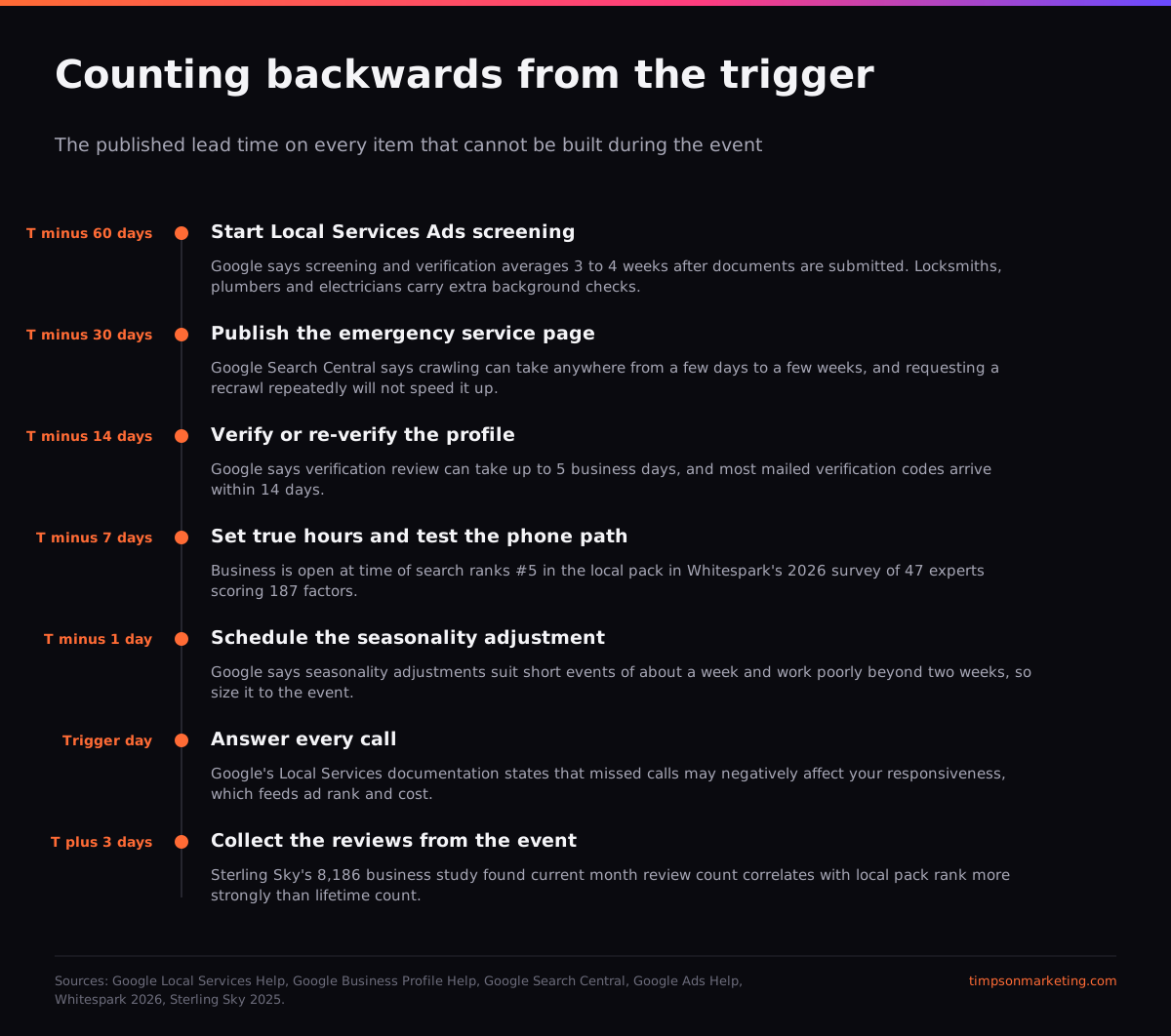
The practical value of knowing the published lead times is that it tells you what to stop trying to do. On day one of a freeze, the LSA application is not a plan, it is a wish. The list below sorts by when work has to be finished, counting backwards from the trigger.
T minus 60 days
Start Local Services Ads screening. Google averages 3 to 4 weeks after documents are submitted, and gathering license and insurance paperwork takes longer than owners expect. Locksmiths, plumbers and electricians face extra background checks.
T minus 30 days
Publish the emergency service page and confirm it is indexed. Google says crawling can take days to weeks. A page published during the event may not be crawled until after it ends.
T minus 14 days
Verify or re-verify the Business Profile if ownership or access is shaky. Verification review takes up to 5 business days and mailed codes arrive within 14.
T minus 7 days
Set special hours, confirm the after hours phone path, and test it by calling your own number at midnight from a phone that is not yours.
T minus 1 day
Schedule the seasonality adjustment against the forecast window, sized to the event and not to the season.
Trigger day
Answer everything. Do not change the ad structure mid event. Log which calls you could not take, because that number is your capacity plan for next year.
T plus 3 days
Ask every customer from the event for a review, while the rescue is still fresh in their memory.
That last step is not a nicety. Sterling Sky studied 8,186 businesses across 200 cities on five "near me" service queries, including plumber, HVAC and locksmith, and found that current month review count correlates with local pack ranking more strongly than lifetime review count.
The number of reviews you've gotten this month matters more than your total number of reviews.
Put those two facts together and a demand spike is worth more than the invoices. A freeze that produces forty rescues in nine days is also the single best review acquisition window you will get all year, and it feeds the ranking factor that decides the next one. Most contractors bank the revenue and skip the reviews. Our guide to getting more Google reviews covers the ask mechanics.
The annual calendar, honestly bounded
Build the calendar backwards from your two or three real triggers, not forwards from a content plan. For most trades in most markets that means a heating trigger, a cooling trigger, and a holiday or weekend trigger. Fill in the dates from your own dispatch history rather than from a national average.
Then accept the limits. We cannot prove a seasonality adjustment caused a given lift, because Google does not expose the counterfactual. Whitespark's factor scores are aggregated expert opinion, not measurement, and the report says so. Sterling Sky's review finding is correlation across a large sample, not a controlled test. And no one, including us, can guarantee you a ranking or a citation in any surface at any hour.
What we can say is narrower and more useful. The lead times are published by Google, they are not negotiable, and they are the reason the same contractors win the same weeks every year. If you want the timeline view of how the slower work compounds, how long local SEO takes sets realistic expectations, and why your Google Business Profile ranking dropped covers what to check when visibility falls off in the middle of an event.
The rest of this cluster, including the HVAC specific AI visibility playbook and how to get more construction leads, sits in our blog. If you want us to look at your own pre-season setup before the next trigger, that is what our services are for.
Frequently asked questions
How long before a cold snap should I start preparing my marketing?
Sixty days for anything involving Local Services Ads, because Google says screening averages 3 to 4 weeks after documents are submitted and gathering license and insurance paperwork takes longer than owners expect. Thirty days for a new emergency page, since Google says crawling can take days to weeks.
Should I set my Google Business Profile to open 24 hours?
Only if you genuinely answer at those hours. Whitespark's 2026 report ranks being open at time of search as the #5 local pack factor, so listing real 24 hour dispatch helps. Listing hours you do not actually staff violates Google's guidelines and earns reviews saying nobody answered.
Do missed calls hurt my Google Ads performance?
For Local Services Ads, yes. Google's own ad rankings documentation states that missed calls may negatively affect your responsiveness, and responsiveness is part of the profile quality that feeds the auction. Google does not publish how heavily it weighs a missed call or how fast the score recovers.
What is a seasonality adjustment and when should I use one?
It tells Google Smart Bidding to expect a conversion rate change over a specific date range. Google says these work best for short events of roughly a week and degrade past two weeks, which fits a cold snap or heat wave but not a whole winter budget.
Can I publish an emergency service page once the emergency starts?
You can publish it, but Google Search Central says crawling can take anywhere from a few days to a few weeks, and repeatedly requesting a recrawl will not speed it up. A page published on day one of a nine day event may not be indexed until the event is over.
What should a 24 hour locksmith prioritise before a holiday weekend?
Hours accuracy on the Business Profile first, because it is free and moves a top five ranking factor. Then the after hours phone path, tested by calling your own number at midnight. Then the emergency page. Ads last, once the free positions are taken.
How many businesses does someone actually call in an emergency?
Very few. BrightLocal's panel of 1,227 recent local searchers found 72% look at three or fewer businesses before deciding, and a companion release from the same panel found 75% decided in under thirty minutes. Being outside the visible top three is close to being invisible.
Is it worth chasing reviews right after a big weather event?
It is the best window you get. Sterling Sky's study of 8,186 businesses found current month review count correlates with local pack ranking more strongly than lifetime count, so the reviews you collect during a spike help you win the next one.
Why does my HVAC company have almost no seasonal hiring swing if demand is so seasonal?
Because the spikes are too short to staff into. Federal employment data shows plumbing and HVAC contractor employment swings only about 3.2% across a year while excavation swings 13.2%. Nobody hires a crew for nine days, so you only capture what existing systems absorb.
What is the single cheapest thing I can fix before the next trigger?
Your hours. It costs nothing, takes ten minutes, and it is the only ranking factor that changes hour by hour. A profile showing closed at 2am is invisible at 2am, which is exactly when emergency searches happen and exactly when the jobs pay the most.
Sources
- Google Local Services Help. Business screening and verification requirements (2026)
- Google Local Services Help. About ad rankings (2026)
- Google Business Profile Help. Verify your Business Profile (2026)
- Google Business Profile Help. Guidelines for representing your business on Google (2026)
- Google Business Profile Help. How Google's local search results work (2026)
- Google Search Central. Ask Google to recrawl your URLs (2026)
- Google Ads Help. About seasonality adjustments (2026)
- Google Ads Help. How our bidding algorithms learn (2026)
- Whitespark. Local Search Ranking Factors 2026 (2025-11)
- Sterling Sky. What Gets You Ranking for Near Me Searches (2025-11)
- Sterling Sky. Google Just Added Business Hours As A New Local Pack Ranking Factor (2023-12)
- BrightLocal. Are Opening Hours a Local Ranking Factor? (2023-12)
- BrightLocal. Consumer Search Behavior: How Consumers Decide (2026-07)
- BrightLocal. Consumer Search Behavior: Speed of Decision (2026-06)
- State Farm. Frozen Pipes? Not So Nice! Beat Winter Water Woes Before They Strike (2025)
- ServiceTitan, Inc.. Form 10-K for fiscal year ended January 31, 2026 (seasonality section) (2026-03)
- U.S. Bureau of Labor Statistics. Current Employment Statistics, plumbing, heating and air-conditioning contractors, not seasonally adjusted (CEU2023822001) (2026-06)
- LocaliQ / WordStream. Search Advertising Benchmarks (2026-06)
Joseph Timpson has worked in search since 2010 and runs Timpson Marketing out of St. George, Utah. He built The Cited Method, a five stage framework for earning and proving real citations in AI answers, and publishes what does not work alongside what does.
Want this done for you, with the receipts to prove it worked?
One call, no pitch deck. We look at what is actually blocking you and tell you the truth about whether we can help.
Book a free consultation →