A Competitor With Fewer Reviews Beats You in the Map Pack
You have 212 reviews at 4.9. The shop that beats you every time has 38 at 4.4. Put the two profiles side by side on eleven fields and the real gap is almost never the review count.

- In BrightLocal's 2018 study of 93,845 businesses, those in the top three local pack spots averaged 47 Google reviews and those in positions 7 to 10 averaged 38. A nine review gap.
- One in five businesses holding a top three local pack spot in that study had no Google reviews at all.
- Review quantity is the ninth strongest local pack factor in Whitespark's 2026 expert survey. Primary category, proximity, business name keywords and city of address all score higher.
- The four fields that explain most head to head gaps are primary category, address geography, the page the profile links to, and how many reviews arrived this month.
- Sometimes the gap is not a ranking gap at all. Two businesses sharing a primary category within about 200 feet of each other get filtered, and one of them disappears.
First, decide which problem you actually have
Two very different problems wear the same shirt.
If you were in the pack for years and fell out in the last few weeks, that is a change event. Something moved. Go read what to do when your Google Business Profile ranking drops instead, because the diagnosis for a drop is a timeline, not a comparison.
This post is for the other problem. You have never beaten them. You have more reviews, better reviews, a longer history, and you still sit at position four while they sit at position one. That is not a change event. That is a standing gap, and standing gaps are diagnosable.
A competitor with fewer reviews outranks you because review quantity is the ninth strongest local pack factor in Whitespark's 2026 expert survey, not the first. Primary category, proximity to the searcher, keywords in the business name, and having an address in the city being searched all score higher. Put the two profiles side by side on eleven specific fields and the real difference is usually visible in under ten minutes.
The two numbers that should end the argument
BrightLocal pulled anonymous data on 93,845 local businesses across 26 industries, identified more than 10,000 local keywords, and matched the review profiles of the top ten ranking businesses against their positions.
Businesses in the top three positions averaged 47 Google reviews. Businesses in positions 7 to 10 averaged 38.
Nine reviews. That is the entire measured distance between the top of the map pack and the bottom of page one.
Then there is the number that actually settles it. Twenty percent of the businesses holding a top three local spot had no Google reviews at all.
of top three local pack businesses had zero Google reviews
Here is the synthesis nobody publishes. If review count were the ladder that owners treat it as, one fifth of the map pack could not be standing on it with zero rungs. The 47 versus 38 finding is not evidence that reviews lift you. It is evidence that businesses which collect reviews also tend to do the other twenty things correctly.
Where review count actually sits in the stack
Once a year, Whitespark surveys local search practitioners and asks them to score ranking factors. The 2026 Local Search Ranking Factors report was built from 47 experts scoring 187 individual factors, each on a zero to five scale, across roughly two hours of survey work per person.
In the local pack column, quantity of native Google reviews ranks ninth with a score of 170. Recency of reviews ranks eleventh at 164. Sustained influx of reviews over time ranks fourteenth at 154.
Above all three sit four factors that have nothing to do with reviews:
Google's own documentation says local results are based on relevance, distance and prominence, and that "More reviews and positive ratings can help your business's local ranking." Read that sentence precisely. Google says reviews can help. It does not say reviews can help you overtake a business that beats you on category, on geography, and on the words in its name. Those are the three inputs that outscore yours.
And the survey itself is honest about what it is:
None of the experts have special access to the internal workings of Google's local search algorithm.
That caveat is why we use the survey to rank your attention, not to promise outcomes. It tells you where to look first. It does not tell you what Google will do.
What your 212 reviews already bought you
Reviews do real work. They just do most of it after the ranking, not before it.
BrightLocal's 2026 Local Consumer Review Survey of 1,002 US adults found that 47 percent will not use a business with fewer than 20 reviews, and 31 percent will only use a business rated 4.5 stars or higher. It also found that 97 percent of consumers read reviews for local businesses at all.
At 212 reviews and 4.9 stars you cleared every published consumer threshold that exists, roughly ten times over. Review number 213 does not buy you anything the first 212 did not already buy.
The one review dimension still open to you is recency, and it is the only one worth spending money on:
The number of reviews you've gotten this month matters more than your total number of reviews.
That conclusion came out of a correlation study covering 8,186 businesses across 200 cities and five service queries. Elizabeth Rule, a Google Business Profile Product Expert and Sterling Sky analyst, put the same finding into a Search Engine Land audit walkthrough. Same firm, so count it as one body of evidence rather than two.
So the honest reframe is this. A competitor with 38 reviews who got 6 of them in the last 30 days is out-signaling your 212 reviews if 200 of yours are three years old. If you want to spend effort on reviews, spend it on a repeatable monthly ask and on answering the bad ones properly, not on chasing a bigger total.
The eleven field teardown
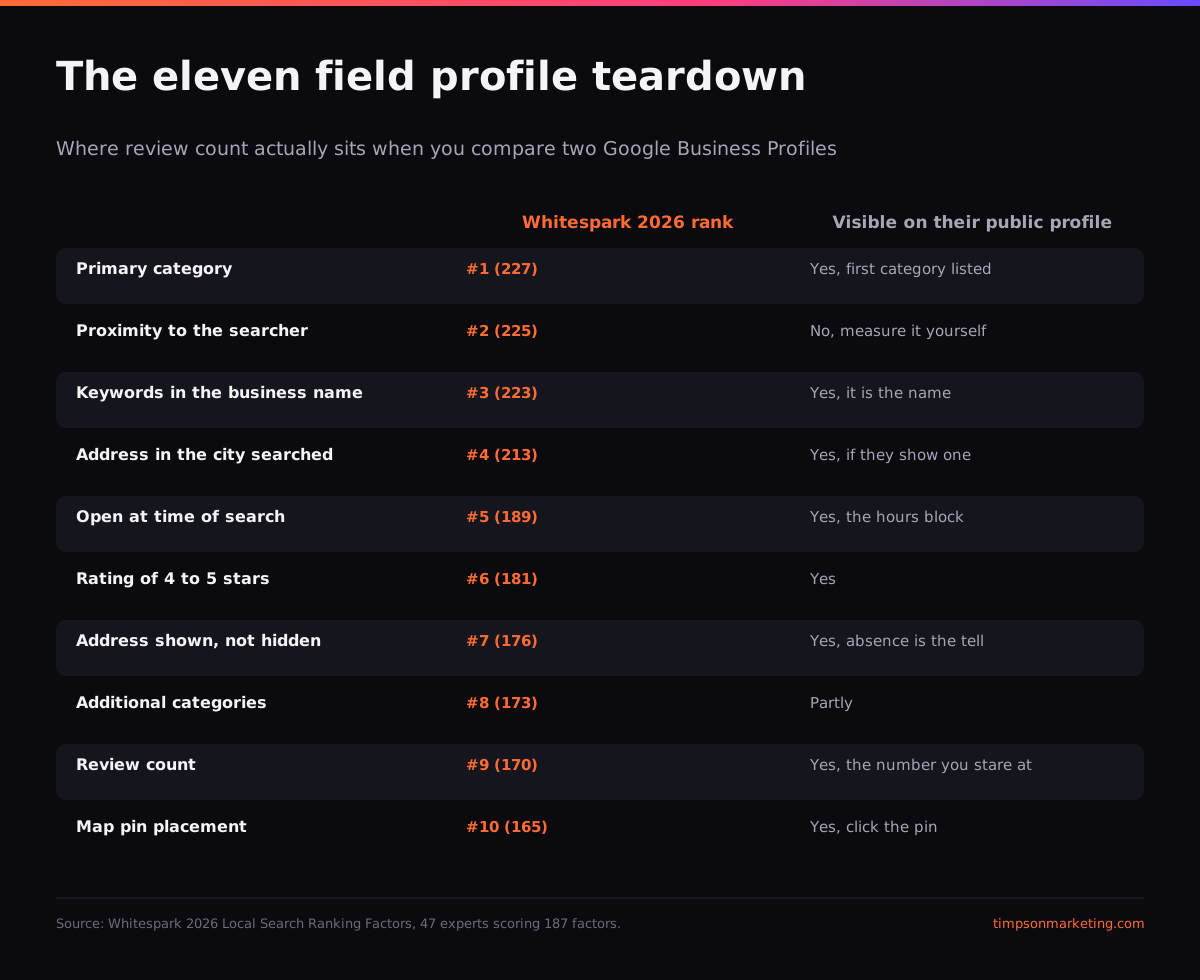
Open their profile and yours in two browser tabs. Work down this list. The ranks are Whitespark's 2026 local pack scores, so the order is the order you should care in.
| # | Field | Whitespark rank | How to check it on their profile |
|---|---|---|---|
| 1 | Primary category | #1 (227) | Scroll their profile. The first category listed under the business name is the primary. |
| 2 | Proximity to the searcher | #2 (225) | Drop both addresses in Maps. Measure to the spot you search from. |
| 3 | Keywords in the business name | #3 (223) | Read their name. Does it say more than the sign on their door? |
| 4 | Physical address in the city searched | #4 (213) | Their listed street address, city line only. |
| 5 | Open at the time of search | #5 (189) | Compare hours blocks. Check evenings and Saturdays. |
| 6 | Rating of 4 to 5 stars | #6 (181) | The star average. Both of you almost certainly pass. |
| 7 | Address shown, not hidden | #7 (176) | If no street address appears, they are a service area business. |
| 8 | Additional categories | #8 (173) | Partly visible. The "in" line and the services block hint at these. |
| 9 | Review count | #9 (170) | The number you have been staring at. |
| 10 | Map pin placement | #10 (165) | Click their pin. Does it land on the building or in a field? |
| 11 | Review recency | #11 (164) | Sort their reviews by newest. Count the last 30 days. |
Run that in ten minutes and one of two things happens. Either a row jumps out, or nothing does. If nothing does, skip to the filtering section, because you may not have a ranking problem at all.
The four rows that explain almost every gap
Across the profiles we tear down, four of those eleven rows account for most standing gaps. In rough order of how often they are the culprit:
One: the primary category is wrong. This is the most common finding and the cheapest fix. Google's guidelines tell you to pick categories that complete the statement "This business IS a" rather than "this business HAS a". Owners routinely set a primary of "Contractor" when the query is "plumber," then wonder why the plumber beats them. Your primary category decides which searches you are even eligible for. Everything else decides your order inside that pool. We cover the selection logic in how to choose your Google Business Profile categories.
Two: the geography does not match the search. Three separate rows in the teardown are really one problem. Address in the city searched (#4), address shown rather than hidden (#7), and map pin placement (#10). Sterling Sky's 8,186 business study found that being configured as a service area business with a hidden address showed a negative correlation with local pack rankings. And a common belief about service areas turns out to be wrong:
The only impact that the service area has is visual.
That single sentence kills a whole category of busywork. Adding cities to your service area list does not make you rank in them. Your verified address does.
Three: the profile points at the wrong page. This is the row almost nobody checks. Joy Hawkins tested changing a law firm practitioner listing's linked URL from the homepage to a specific practice area page, then repeated it with a second page, and both listings began ranking for their niche keywords within weeks.
The content on the specific URL you link to is important and impacts ranking in the local results.
If your profile points at a homepage that says "family owned since 1998" and theirs points at a page titled for the exact service being searched, that is a relevance gap you can close this afternoon. It is also why real service and location pages matter more than most owners assume.
Four: their review clock is running and yours stopped. Covered above. Count their last 30 days, not their lifetime total.
One more worth a look while you are in there. Sterling Sky's testing found that adding services to a profile does move rankings, with changes typically appearing within 24 to 72 hours, reversing their own 2019 finding that services did nothing. Whitespark scores predefined services at #22. It is a twenty minute job with a same week feedback loop, which makes it the best effort to signal ratio on the entire profile.
We run this eleven field comparison against your three closest competitors, then fix what it finds. No contracts, no ranking promises.
See how we run this teardown→The gap that is not a gap: local filtering
Sometimes you run the whole teardown and the two profiles are near identical. That is the tell for filtering, and it is the most misdiagnosed situation in local search.
When two businesses with the same primary category are located within approximately 200 feet of each other, one business will typically be filtered out for certain queries.
Google suppresses one of two near identical, near adjacent businesses rather than showing both. You are not ranked below them. You are hidden behind them for that query, at that spot, in that moment.
The way you spot it is a grid. Run a geographic grid scan instead of a single search and a filtered profile produces a distinctive pattern. Nielsen describes it plainly on the Sterling Sky geogrid guide: "It almost has a Swiss-cheese look to it." Strong positions, then dead pins, then strong positions again, with no geographic logic.
If that is what you have, more reviews will not fix it. Differentiating the primary category, the linked page, and the on page content is what fixes it, because you are trying to stop looking like a duplicate rather than trying to outrank one.
When the honest answer is that they are cheating
Sometimes you run the teardown and row three lights up. Their business name is not their business name. It is a keyword.
Keywords in the business title score 223 in Whitespark's 2026 report, third out of 187 factors. It works, which is exactly why it is everywhere. Google's guidelines require you to represent your business as it is consistently represented in the real world across signage and stationery, without added descriptive terms.
Colan Nielsen documented 50 cases of keyword stuffed profiles and tracked what happened after the keywords were removed. Google sent a warning with no punishment 60 percent of the time. Twenty percent got a soft suspension. Twenty percent got a hard suspension. One business added the keywords back eight times.
His finding on the fix mechanism is the practical part: "Suggesting an edit on the listing never stopped keyword stuffing from coming back on verified listings." Owners restored the keywords 100 percent of the time. The channel that carries weight is Google's Business Redressal Complaint Form, which accepts batches of ten or more profiles or a spreadsheet of URLs.
Set your expectations low. Google publishes no success rate and no turnaround time for these submissions, and Nielsen's own data shows enforcement is manual and inconsistent. Report it, then go back to fixing your own eleven rows.
What you must not do is buy reviews. Google's fake engagement policy prohibits offering payment, discounts, free goods or services in exchange for a review, and prohibits reviews posted from multiple accounts at one person's request. The enforcement is three specific things: your profile stops accepting new reviews for a period, existing reviews get unpublished for a period, and your profile displays a public warning telling customers that fake reviews were removed.
Read that last one again. The penalty for buying reviews is a banner on your profile telling every future customer you bought reviews. You would be trading a ranking position you do not have for a reputation you do.
Your next thirty days
Run the eleven field comparison
Two tabs, their profile and yours, ten minutes. Write down every row where you differ. Do this against your three closest competitors, not one.
Fix the primary category
If your primary does not literally name the service being searched, change it. This is the single highest scoring controllable factor in the survey.
Repoint your profile URL
Send it to the page that matches the query you want to win, not the homepage, and make sure that page actually covers the service.
Fill the services section
Predefined services first, then custom. Expect any movement inside 24 to 72 hours, which makes it your fastest feedback loop.
Start a monthly review ask
Target a steady number every month rather than a burst. Recency is the only review dimension you have not already maxed out.
Re-measure with a grid, not a search
Your own searches are personalized and are not evidence. Grid scans at least monthly, same keyword, same grid.
The uncomfortable part of this teardown is that it usually finds something small. A category set five years ago by whoever claimed the listing. A profile pointed at a homepage. An address hidden because someone read a blog post about service area businesses in 2019.
None of that feels proportionate to how much the losing hurts. It is still what the evidence says. And if you want to know whether the work is landing, the honest answer to how long local SEO takes and how to tell whether your agency is working is measured in months of grid data, not in a screenshot of a good day.
There is also a deadline forming. Sterling Sky compared AI generated local packs against traditional 3-packs across 322 markets and found AI packs surfaced 5,943 unique businesses where regular 3-packs surfaced 18,330, with 88 percent of markets showing fewer unique winners. AI packs also often show one or two businesses instead of three. The gap between position one and position four is about to get more expensive, which is the argument for fixing your four rows now rather than next spring. We cover that shift in how local businesses rank in AI Overviews.
More of the map pack material is in our blog, and the mechanics of moving up generally are in how to rank higher on Google Maps. If you would rather we ran the comparison for you, that is what we do.
Frequently asked questions
Do reviews affect map pack ranking at all?
Yes, but less than owners assume. Google states that more reviews and positive ratings can help local ranking. Whitespark's 2026 expert survey puts review quantity ninth out of 187 factors, behind primary category, proximity, business name keywords and city of address. Reviews contribute. They do not decide.
How many Google reviews do I need to rank in the local pack?
There is no threshold. In BrightLocal's 2018 study of 93,845 businesses, 20 percent of top three local pack holders had zero reviews, and the average gap between top three and positions 7 to 10 was nine reviews. Consumer thresholds matter more: 47 percent avoid businesses with under 20 reviews.
Why does a worse business rank higher than mine on Google Maps?
Usually because ranking measures signal match, not service quality. The most common causes are a primary category that matches the query better, a verified address closer to the searcher, keywords inside their business name, and a profile pointing at a relevant service page instead of a homepage.
Does adding more cities to my service area help me rank in them?
No. Sterling Sky's testing concluded the only impact a service area has is visual. Ranking follows the address where the profile was verified. Google separately advises keeping the overall service area within about two hours of driving time from your base.
What is local filtering and how do I know if it is happening to me?
Filtering is Google suppressing one of two near identical businesses rather than showing both. Sterling Sky reports it typically happens when two businesses share a primary category within roughly 200 feet. The signature is a scattered geographic grid: strong pins, dead pins, strong pins, with no geographic pattern.
Should I report a competitor with a keyword stuffed business name?
Yes, through Google's Business Redressal Complaint Form rather than a Maps suggested edit. Sterling Sky's 50 case study found suggested edits never stopped the behavior and owners restored keywords 100 percent of the time. Expect inconsistent enforcement and no published turnaround time.
Will buying reviews help me catch up?
No, and the downside is public. Google prohibits incentivized reviews and reviews from multiple accounts at one person's request. Enforcement includes blocking new reviews for a period, unpublishing existing reviews, and displaying a warning on your profile telling customers that fake reviews were removed.
What is the fastest change I can make to close the gap?
Fill out the services section. Sterling Sky's testing found service additions move rankings within 24 to 72 hours, and Whitespark scores predefined services at rank 22. It takes about twenty minutes and gives you a same week read on whether the profile responds at all.
Sources
- BrightLocal. Google Reviews Study: How Many Reviews Do Businesses Need? (2018-10)
- Whitespark. Local Search Ranking Factors 2026 (2025-11)
- Google Business Profile Help. How local search results are determined (2026-07)
- Google Business Profile Help. Guidelines for representing your business on Google (2026-07)
- BrightLocal. Local Consumer Review Survey 2026 (2026-02)
- Sterling Sky. What Gets You Ranking for Near Me Searches in 2025 (2025-11)
- Sterling Sky. Uncovering Filtering Issues: A Guide to Using Geogrid Rank Trackers Effectively (2026-07)
- Sterling Sky. Does the URL You Link to in Google My Business Impact Ranking in the Local Pack? (2025-02)
- Sterling Sky. Does the Service Area in Your Google Business Profile Impact Ranking? (2023)
- Sterling Sky. How Does Google My Business Penalize Keyword Stuffing: 50 Examples (2026-07)
- Sterling Sky. Do Services in Google Business Profiles Impact Ranking? (2026-02)
- Google Maps Help. Report a business on Google Maps (Business Redressal Complaint Form) (2026-07)
- Google Business Profile Help. Prohibited and restricted content: fake engagement (2026-07)
- Google Business Profile Help. Business Profile restrictions for policy violations (2026-07)
- Search Engine Land. A 5-step Google Business Profile audit to improve local rankings (2026-03)
- Sterling Sky. The State of Local SEO in 2026 (2026-06)
Joseph Timpson has worked in search since 2010 and runs Timpson Marketing out of St. George, Utah. He built The Cited Method, a five stage framework for earning and proving real citations in AI answers, and publishes what does not work alongside what does.
Want this done for you, with the receipts to prove it worked?
One call, no pitch deck. We look at what is actually blocking you and tell you the truth about whether we can help.
Book a free consultation →