Should an HVAC Company Spend Money on AI Search This Year?
Two vendors pitched you an AI package this quarter. Neither one showed you the number that decides it. This is the arithmetic, run against your books, not theirs.

- For most residential HVAC companies this is a hedge year, not an invest year: fund AI search visibility as a small capped slice, and do not move money off whatever is currently booking jobs.
- The decision flips to invest only when three things are true at once: replacement work drives most of your revenue, you already hold a top three map pack seat, and you are not renting lead flow from a marketplace.
- US plumbing and HVAC contractors spend 0.62 percent of revenue on purchased advertising, so the real risk for most shops is underspending on everything, not misallocating between search and AI.
- The two things AI vendors sell hardest, llms.txt files and schema markup, both have published null results, and Google's own documentation says neither is required.
- Nobody can sell you a reliable AI share of voice number. Repeat runs of the same prompt return the same brand list less than one time in a hundred.
The verdict, before the arithmetic
For most residential HVAC companies, this is a hedge year. Fund AI search visibility with a small capped slice of the marketing budget, and do not move a dollar off the channel currently filling the install schedule.
Hedge, not invest. AI search deserves a defined minority slice of an HVAC marketing budget in 2026, not a reallocation. It moves to invest only when three conditions hold at once: system replacement drives most of your revenue, you already own a top three map pack position for your core service, and you are not dependent on a lead marketplace. Miss any one of the three and the spend is early.
Two numbers explain the verdict, and most vendor decks show you exactly one of them.
The first is real and the vendor is right to point at it. 45 percent of consumers now use ChatGPT or another generative AI tool for local business recommendations, up from 6 percent a year earlier, on a representative panel of 1,002 US adults.
The second is the one that never makes the deck. AI systems accounted for 0.14 percent of total website traffic in 2025 against 16.04 percent from organic search, across more than 50,000 sites in Semrush's channel study. Cloudflare's own network data still puts Google at roughly 88 percent of referral traffic.
Both numbers are correct, and they measure different things. A fast growing share of consideration now starts inside an assistant, while almost all of the clicking still happens on Google. The expensive mistake is treating a discovery shift as if it were a traffic shift and funding it like one.
BrightLocal's follow-up closes the loop. Among consumers who used AI during their most recent local search, only 18 percent felt ready to contact the business the AI recommended, and 43 percent of those who started on AI checked Google anyway (n=1,227 recent local searchers). AI is adding a step in front of search, not replacing it. That step is cheap to be present in and expensive to be measured in, which is exactly backwards from how it is priced.
Condition one: are you renting your leads?
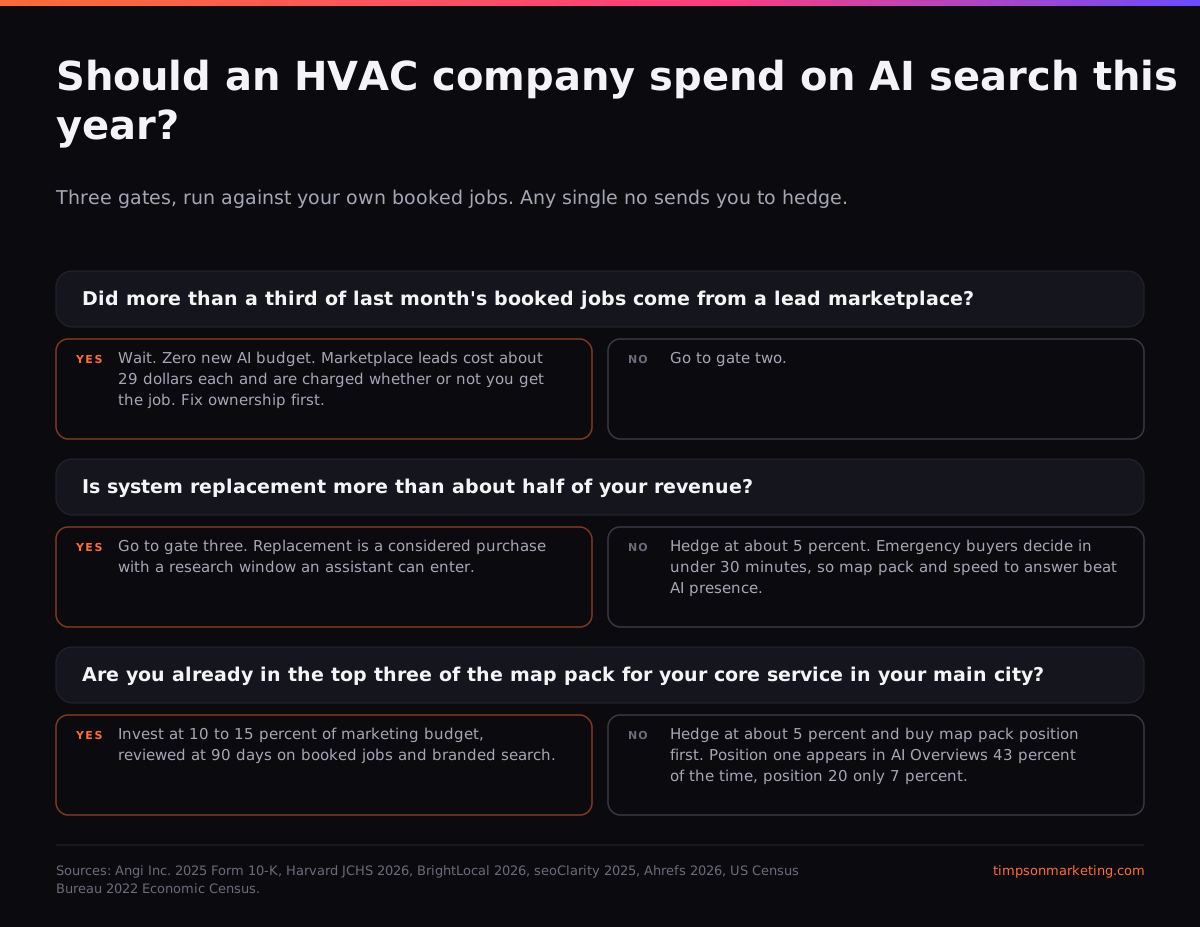
Run this before anything else. Pull last month's booked jobs and mark the origin of each one. If more than about a third came through a lead marketplace, you do not have an AI visibility problem. You have an ownership problem, and it is worth more money than AI search will be worth for years.
The numbers here are unusually solid because they come from an audited filing rather than a contractor forum. Angi's 2025 Form 10-K reports $587.1 million in US lead revenue on 20.195 million leads, which works out to about $29 per lead across all categories. The same filing defines that revenue as fees paid by pros for consumer matches "regardless of whether the Pro ultimately provides the requested service." You pay for the introduction, not the job.
The filing also shows the pro side contracting hard. Average Monthly Active Pros fell 19 percent to 122,000 and newly acquired pros fell 36 percent to 90,000. Contractors are voting with their feet.
There is a regulatory record too. The FTC ordered HomeAdvisor to pay up to $7.2 million for deceptively marketing home improvement leads, and later mailed 110,372 refund checks totalling more than $3 million to affected service providers.
Today's order requires HomeAdvisor to refund home service providers millions of dollars and stop misleading them about the quality of its leads. Even as the nature of work and the economy change, the FTC will continue to combat dishonest commercial practices aimed at consumers, workers, and small businesses.
Here is the part the AI pitch gets structurally wrong. Marketplace dependence is a channel concentration risk with a known price and a known fix. AI visibility is a diffuse brand play with no reliable measurement. Spending on the second while the first is unresolved is buying insurance on the garage while the kitchen burns. If this is you, the higher return move is owning your lead flow through the map pack and a review engine that keeps producing, not an AI retainer.
Condition two: replacement revenue versus emergency revenue
This is the split that decides whether AI search can touch your business at all this year, and no generic AI article makes it.
An emergency call has no research window. 75 percent of consumers decide which local business to use in under 30 minutes and 28 percent decide in under five, on a 1,227 person panel of recent local searchers. Nobody whose furnace died at 11pm is comparison shopping inside a chatbot. That job is won by map pack position, a phone that gets answered and a truck that can be there tomorrow. If emergency and maintenance work is most of your revenue, your money belongs in getting more emergency service calls, full stop.
A system replacement is the opposite: a five figure considered purchase with a multi week research window, and that window is exactly where an assistant gets consulted.
The housing data points the same way. Harvard's Joint Center for Housing Studies finds replacement projects such as roofing, siding, windows, insulation and HVAC make up 39 percent of improvement spending on homes built before 1960, against 24 percent for homes built in 2010 or later, with the US housing stock at a record median age of 44 years. Spending is also sharply income stratified: among owners of pre-1960 homes, the top income quintile spent an average of $12,700 in 2023 versus $3,400 for the bottom quintile.
The demand backdrop argues for efficiency, not expansion. JCHS projects annual improvement and repair spending of $519 billion through mid-2027 with growth slowing to 0.5 percent.
Annual spending on home improvements and repairs is expected to continue losing momentum through mid-2027, according to our latest Leading Indicator of Remodeling Activity (LIRA). Year-over-year growth in renovation and repair spending is expected to slow to just 0.5 percent in the second quarter of 2027.
The practical rule: weight your AI search budget to the share of revenue that comes from considered replacement work. A shop that is 70 percent replacement has a real case. A shop that is 70 percent service agreements and no-heat calls has a 2027 case.
Condition three: is your map pack seat already secure?
Rank is table stakes, not a win condition, and the evidence cuts both ways.
Position still matters for AI exposure. seoClarity's analysis of 362,000 US desktop keywords found position one URLs appear in AI Overviews 43 percent of the time, falling to 7 percent by position 20, and 94 percent of AI Overviews contained at least one URL that also ranked in the top 20.
But ranking is no longer sufficient. Ahrefs' March 2026 update across 863,000 SERPs found only 38 percent of AI Overview citations come from pages ranking in the top 10, down from roughly 76 percent in July 2025. Any vendor still quoting 76 percent is quoting a number the publisher itself has halved.
Those two findings are not in conflict, and the reconciliation is the part most posts miss. Nearly every AI answer contains some ranking page, while most individual citation slots go to pages that do not rank. Ranking buys you a seat at the table and nothing more.
The consumer ceiling is tighter still. 72 percent of consumers look at three or fewer businesses before deciding and only 6 percent just click the top result. At position nine in the map pack, AI spend is buying the second floor of a house with no first floor. Fix the floor. Our breakdown of why local businesses do not get recommended by AI starts in the same place.
What the money actually buys, ranked by strength of evidence
This is the list in the order the published evidence supports, not the order it gets sold in.
- Crawler access. The highest certainty mechanical lever and the one most sellers skip entirely. OpenAI's own documentation states that sites opted out of OAI-SearchBot will not be shown in ChatGPT search answers. Not GPTBot. OAI-SearchBot. A single robots.txt line written by a well meaning developer can zero you out.
- Being indexed and snippet eligible. Google's documentation states plainly that generative AI features are rooted in core Search ranking and quality systems and that a page must be indexed and eligible to show with a snippet. A stray nosnippet tag is a silent AI kill switch.
- Real statistics, named quotes and cited sources in your content. The original GEO paper accepted to KDD 2024 scored Quotation Addition at 27.2 and Statistics Addition at 25.2 against a 19.3 unoptimized baseline on its visibility metric. The same table scored keyword stuffing at 17.7, below doing nothing.
- Subtopic coverage rather than page length. Surfer's study of 10,000 keywords and 33,000 fan-out queries found pages ranking for both the main query and its fan-outs were 161 percent more likely to be cited. This is a topical authority argument, not a word count argument.
- Off-site brand mentions. Across 75,000 brands, Ahrefs measured branded web mentions correlating with AI Overview visibility at 0.664 against 0.218 for backlinks. The authors state explicitly that correlation is not causation, and so do we. Earn mentions. Never buy them.
Now the two items that are missing from that list, which happen to be the two things sold hardest into this trade.
An llms.txt file does nothing. Ahrefs checked 137,210 domains and found 97 percent of published llms.txt files received zero requests in May 2026. Google's documentation says outright that you do not need to create new machine readable files, AI text files, markup or Markdown to appear in Search including its generative capabilities.
If your goal is showing up in ChatGPT, Perplexity, or AI Overviews, an llms.txt file is largely decoration.
Schema markup does not causally lift AI citations either. Ahrefs tracked 1,885 pages that added JSON-LD against 4,000 matched control pages in a difference in differences design and measured minus 4.6 percent in AI Overviews, plus 2.4 percent in AI Mode and plus 2.2 percent in ChatGPT. Google's documentation independently states that structured data is not required for generative AI search. Schema still earns its place as classic search hygiene, which is the honest case we make in whether schema markup is worth it.
The pattern worth noticing before you sign anything: the two levers with the strongest evidence are free and take an afternoon, and the two with published null results are the ones that come with a monthly line item.
## The budget number, and the one the industry made up Search "HVAC marketing budget" and you will be told to spend 7 to 12 percent of gross revenue. That range appears on dozens of agency pages. We could not find one that traces it to a survey, a sample size or a field date. Treat it as folklore. Two numbers do have methodology behind them, and they disagree instructively. The 2022 Economic Census counted 112,088 US plumbing, heating and air conditioning contractor firms generating $297.6 billion, who together bought $1.85 billion of advertising and promotional services. That is 0.62 percent of revenue, against 0.73 percent for roofing and 0.25 percent for electrical. Meanwhile The CMO Survey reports firms under $10 million in sales spending a mean 13.34 percent of revenue on marketing, though that cell rests on only 20 respondents. They are not contradictory. The Census field captures purchased advertising only, excluding in-house salaries, owner time, wraps, sponsorships and lead fees booked as cost of sales. The CMO Survey captures self-reported total marketing spend at mostly larger, mostly non-construction firms. The defensible read reframes the whole question: outsourced advertising is close to a rounding error in the average trade contractor P&L. For most HVAC shops the risk is not misallocating between search and AI, it is spending almost nothing on either, on a $2.7 million average revenue base. So here is the split we would run, stated as our recommendation and not as a research finding:
See what AI marketing actually includes→| Hedge (most shops) | Invest (all three conditions met) | |
|---|---|---|
| Share of marketing budget | About 5 percent, capped and reviewed at 90 days | 10 to 15 percent, reviewed at 90 days |
| Funded by | New money or trimmed marketplace spend | New money or trimmed marketplace spend |
| First dollar goes to | Crawler access audit and snippet eligibility | Same audit, then subtopic content on replacement questions |
| What it does not touch | Map pack, reviews, Local Services Ads | Map pack, reviews, Local Services Ads |
| Honest expectation | Insurance against being invisible later | Earlier presence in a research step you cannot yet attribute |
Notice what neither column funds. Reviews and map pack position are not the hedge, they are the base. 97 percent of consumers read reviews and 47 percent will not use a business with fewer than 20 of them. Google's Local Services Ads documentation confirms that review rating, review count and average response time affect both your ad rank and your cost, so review work is literally priced into a paid channel you may already be buying.
What you cannot measure, and should refuse to pay for
This is where most AI retainers quietly fail.
There is no first party share of voice inside any assistant. Measurement is sampled and noisy, and the noise is severe. SparkToro and Gumshoe ran 12 prompts across ChatGPT, Claude and Google's AI with 600 volunteers over 2,961 combined runs and found less than a one in a hundred chance of the same brand list appearing twice.
AIs do not give consistent lists of brand or product recommendations. If you don't like an answer, or your brand doesn't show up where you want it to, just ask a few more times.
A screenshot of ChatGPT naming your competitor is therefore not evidence of anything, and neither is one of it naming you. Both are single draws from a very noisy distribution.
Be especially careful with decks claiming to have measured AI visibility across the HVAC trade. Several circulating now publish confident per-vertical citation percentages sourced to an index that discloses no sample size, no prompt set, no geography and no scoring rules. A percentage without a method is a decoration with a decimal point. We will not publish one either, which is why there is no HVAC-specific citation figure anywhere in this post.
The traffic side deserves the same honesty. Ahrefs' 300,000 keyword study found AI Overviews correlate with a 58 percent lower click-through rate for the top ranking page, up from a 34.5 percent reduction a year earlier.
For every 100 clicks you could historically earn for a top-ranking page, Google now 'keeps' 58.
That cuts both ways for an HVAC owner. It is an argument for presence in the answer, and it is also a warning that presence in the answer does not reliably become a phone call. Pew's browsing panel found users clicked a link inside an AI summary in just 1 percent of visits where a summary appeared.
The questions that disqualify a vendor
None of these need a technical background to judge.
- Ask for the measurement method in writing: how many prompts, how many runs per prompt, which engines, which geography, and how a score is calculated. A vendor who cannot answer is selling screenshots.
- Ask which line items in this scope can change the number of booked jobs in the next 90 days, and which cannot. A good vendor will tell you most of it cannot, and will say so before you ask.
- Ask whether crawler access has been audited yet, by name, including OAI-SearchBot. If the answer is vague, the cheapest lever in the whole category has not been pulled.
- Ask what happens to the retainer if your map pack position is not in the top three. The honest answer is that map pack work should come first.
- Ask them to show you the null results. Any vendor who cannot name one thing in AI search that does not work has not read the research.
For context on how the trade is actually behaving, ServiceTitan's survey of more than 1,000 contractors run by Thrive Analytics in late 2025 found only 12 percent had embedded AI into their processes while 35 percent had not used it at all, and 37 percent named unclear return on investment as a barrier. That survey covers operations rather than marketing, but the sentiment transfers: the trade is not behind on AI marketing, it is appropriately skeptical of it.
What we would actually do, in order
Audit crawler access
Confirm OAI-SearchBot, Claude-SearchBot, PerplexityBot and Googlebot can all reach your service pages, and that nothing is marked noindex or nosnippet. Costs an afternoon.
Secure the map pack
If you are not top three for your core service in your primary city, that is the budget. Everything else waits.
Fix the review engine
Velocity, not volume. Recency thresholds have been rising every year in the consumer research.
Name your replacement questions
List the 20 questions a homeowner asks before replacing a system, and answer each one on its own page with real numbers and named sources.
Measure with free first party tools
Bing Webmaster Tools reports AI citations at no cost. Search Console does not break AI out, so judge Google by branded search and booked jobs.
Review at 90 days
Judge the spend on booked jobs and on branded search volume, not on screenshots.
If that reads like search work rather than AI work, that is the finding, not an evasion. Google's own documentation says the generative features run on the core ranking systems. The honest version of GEO versus SEO is that the new surface rewards most of the old fundamentals plus a short list of genuinely new mechanics, and the list is shorter than the invoices suggest. The wider argument sits in is AI SEO worth paying for, and the rest of the series is in the blog.
One last framing for the owner deciding this week. You are not choosing between AI and Google. You are choosing between spending a little now to avoid being invisible later, or spending a lot later to catch up. At 5 percent of a budget already far below what the category can bear, the hedge is cheap. At 30 percent it is a bet on a channel nobody can yet measure. Take the cheap one.
Frequently asked questions
Is AI marketing worth it for HVAC companies right now?
For most, it is worth a small capped slice rather than a reallocation. AI systems drove 0.14 percent of total website traffic in 2025 while organic search drove 16.04 percent. Fund AI visibility as insurance, keep funding the map pack and reviews as the base, and review the spend at 90 days.
How much should an HVAC company spend on marketing overall?
The widely repeated 7 to 12 percent of revenue rule has no traceable source. The 2022 Economic Census shows plumbing and HVAC contractors actually buy advertising equal to 0.62 percent of revenue. The real problem for most shops is spending almost nothing, not choosing the wrong channel.
Do homeowners actually use ChatGPT to find an HVAC contractor?
Increasingly, yes, but mostly for research rather than for hiring. BrightLocal found 45 percent of consumers use AI for local recommendations, up from 6 percent. Only 18 percent felt ready to contact the recommended business, and 43 percent who started on AI went back to Google.
Will an llms.txt file help my HVAC website show up in AI answers?
No. Ahrefs found 97 percent of published llms.txt files received zero requests across 137,210 domains, and Google's documentation states you do not need AI text files or special markup to appear in Search or its generative features. If a vendor is billing for one, ask what evidence they have.
Does schema markup improve AI citations for contractors?
Not causally. Ahrefs compared 1,885 pages that added JSON-LD against 4,000 matched controls and found no meaningful uplift, with AI Overview citations down 4.6 percent. Schema is still worth doing as classic search hygiene for rich results, just not as an AI citation lever.
Should I stop buying Angi leads and put the money into AI search instead?
Reduce marketplace dependence first, but move that money into owned local search before AI. Angi's 10-K shows about 29 dollars per lead charged regardless of whether the job happens. Replacing a rented channel with an unmeasurable one is not an improvement, it is a different risk.
Does AI search matter more for replacement jobs or emergency calls?
Replacement, clearly. Emergency work has no research window: 75 percent of consumers decide in under 30 minutes and 28 percent in under five. System replacement is a considered five figure purchase with a multi week research window, which is where an assistant actually gets consulted.
How do I know if an AI marketing vendor is legitimate?
Ask for the measurement method in writing: prompt count, runs per prompt, engines, geography and scoring rules. Repeat runs of the same prompt return the same brand list less than one time in a hundred, so any vendor showing screenshots instead of a sampling method is selling noise.
What is the cheapest AI visibility fix an HVAC company can make?
Crawler access. OpenAI documents that sites opted out of OAI-SearchBot will not appear in ChatGPT search answers, and Google requires a page to be indexed and snippet eligible for generative features. Checking robots.txt and meta tags costs an afternoon and is the lever most vendors skip.
Sources
- BrightLocal. Local Consumer Review Survey 2026: AI and trust (2026-03)
- BrightLocal. Consumer search behavior: channels (2026-07)
- BrightLocal. Consumer search behavior: decisions (2026-07)
- BrightLocal. Consumer search behavior: speed (2026-06)
- BrightLocal. Local Consumer Review Survey 2026 (2026-02)
- Semrush. Traffic channel mix study (2026-04)
- Cloudflare. The agentic internet bot report (2026-07)
- Angi Inc.. Form 10-K for fiscal year ended December 31, 2025 (2026-02)
- US Federal Trade Commission. FTC order requires HomeAdvisor to pay up to $7.2 million (2023-01)
- US Federal Trade Commission. FTC returns more than $3 million to businesses that paid HomeAdvisor memberships (2023-11)
- Harvard Joint Center for Housing Studies. Many owners cannot afford to maintain aging homes (2026-07)
- Harvard Joint Center for Housing Studies. Remodeling spending poised for further slowdown (LIRA) (2026-07)
- US Census Bureau. 2022 Economic Census, construction sector (NAICS 23) (2022)
- Duke Fuqua, Deloitte and the American Marketing Association. The CMO Survey firm and industry breakout report 2026 (2026-03)
- seoClarity. AI Overviews and organic rankings overlap research (2025-10)
- Ahrefs. Only 38% of AI Overview citations come from the top 10 (2026-03)
- Ahrefs. We analyzed 137K sites: 97% of llms.txt files never get read (2026-06)
- Ahrefs. Does schema markup increase AI citations? (2026-05)
- Ahrefs. AI Overviews reduce clicks: 2026 update (2026-02)
- Ahrefs. Branded web mentions and AI Overview brand visibility (2025-05)
- Google Search Central. Optimizing your website for generative AI features on Google Search (2026-07)
- OpenAI. OpenAI bots documentation (2026-07)
- Aggarwal, Murahari, Rajpurohit, Kalyan, Narasimhan and Deshpande. GEO: Generative Engine Optimization (KDD 2024) (2024-06)
- Surfer. The impact of query fan-out on AI Overview citations (2025-12)
- SparkToro with Gumshoe.ai. AIs are highly inconsistent when recommending brands or products (2026-01)
- Pew Research Center. Google users are less likely to click on links when an AI summary appears (2025-07)
- Google. About ad rankings in Local Services Ads (2026)
- ServiceTitan (survey conducted by Thrive Analytics). AI in the trades: insights from 1,000+ contractors (2025-12)
- Google Search Central. AI features and your website (2026-07)
- Microsoft Bing. Introducing AI Performance in Bing Webmaster Tools (2026-02)
Joseph Timpson has worked in search since 2010 and runs Timpson Marketing out of St. George, Utah. He built The Cited Method, a five stage framework for earning and proving real citations in AI answers, and publishes what does not work alongside what does.
Want this done for you, with the receipts to prove it worked?
One call, no pitch deck. We look at what is actually blocking you and tell you the truth about whether we can help.
Book a free consultation →