Do Customers Actually Use ChatGPT to Find Local Businesses?
Eight percent of local searchers start inside an AI tool. Almost none of them stop there. Here is the actual language people type before they hire, sorted by how close each question sits to the moment money changes hands.

- 45% of US consumers have asked an AI tool for a local business recommendation in the past year, but only 18% felt ready to contact the business the AI named.
- Of the searchers who did start on an AI tool, only 2% used it as their only channel. AI narrows the field. Google and your reviews still close the job.
- Real prompts are short and ugly. Two thirds run 15 words or fewer, 16% are explicitly location based, and 24.5% contain the word best.
- Pasting three prompts into ChatGPT is a smoke test, not a measurement. It cannot support a month over month claim and three answers is not a sample.
- If you are missing from the answer, fix crawler access and Google indexing first. Schema and llms.txt are not the lever, and Google says so in its own documentation.
The honest answer, with the numbers attached
Eight percent of American local searchers started their most recent hunt for a local business inside an AI tool. Of those who did, just 2% used an AI tool and nothing else. Both numbers come from the same place, BrightLocal's July 2026 channel study of 1,227 US consumers who had searched for a local business in the previous three months.
One housekeeping note before anything else. The test at the bottom of this post is a smoke test. It is directional only. It tells you whether you showed up in one answer, on one machine, in one location, on one day. It is not a measurement, it cannot support a month over month claim, and three answers is not a sample size. Treat it the way you would treat driving past a competitor's yard to count trucks.
Yes, customers use ChatGPT to find local businesses, but mostly to narrow the field rather than to pick. 45% of US consumers have asked an AI tool for a local recommendation in the past year. Only 18% felt ready to contact the business the AI named, and 43% of the people who started on AI went to Google next. AI is where you get onto the list. Google, your reviews and your phone are still where you get hired.
Here is the part nobody sells you. In that same study, 23% used an AI tool at some point during their most recent local search, 19% said they will not consider using AI at all, and 39% of the AI users went and looked at social media afterward. The behavior is a loop, not a funnel. AI answers a question, the person goes and checks the answer somewhere else, then comes back.
So when you say your customers are fifty five and they call the number on the truck, you are half right and the half you are right about is shrinking. Pew Research surveyed 5,119 US adults in February 2026 and found 63% of adults under 50 use AI chatbots, against 42% of those aged 50 to 64 and 23% of those 65 and over. Twenty three percent of retirees is not zero. It is one in four of the people calling you about a water heater.
What a real prompt actually looks like
Every AI marketing post shows you a prompt like "act as a discerning homeowner and compare the top five licensed HVAC contractors in Phoenix by warranty terms." Nobody types that.
The best public read on how people actually prompt comes from Stella Rising, whose January 2026 survey of 524 active LLM users was written up by John Morabito at Search Engine Land. Two thirds of respondents reported writing prompts of 15 words or fewer. About 60% phrased the query as a question and only 9% gave a direct command. And the pieces that matter to a local service business show up at measurable rates: 24.5% of prompts include the word best, 28% mention price or budget, 32% include a personal attribute, and 16% are explicitly location based.
Most people are still doing Google-style searches. They're just searching inside an interface that knows more about them.
That is the single most useful sentence written about AI search this year, and it should change what you test. If a prompt is eight words long, the answer is decided by a handful of retrieved pages, not by a rhetorical duel. It also means the prompts worth testing are the boring ones. Short, misspelled, no punctuation, city name attached.
One extension the sources do not make, so we will. Those four measured attributes (best, price, personal detail, location) are not four separate prompt types. They stack, and they stack in a predictable order as the person gets closer to spending money. "ac repair cost" becomes "best ac repair st george" becomes "licensed ac repair st george under 500 same day." The library below is built on that stacking order. If you run a trade where the emergency question and the price question arrive together, the vertical version of this is in AI marketing for HVAC companies.
The library: prompts sorted by distance from money
A word on where these came from, because it matters. These are not transcripts of anyone's chat logs. No public dataset of local hiring prompts exists. They are constructed to match two measured things: the shape of real prompts from the Stella Rising data above, and the deciding factors BrightLocal measured among 1,227 local searchers, where the top reasons for choosing a business were clear and complete information at 32%, the most or best reviews at 30%, and clear pricing or an offer at 29%.
Swap the bracketed parts for your trade, your city and your business name. Paste them one at a time.
Band one: research. They do not know your name yet.
These sit furthest from the money. Being named here is a bonus, not the goal. The goal is that whoever gets named is not exclusively your competitor.
| Paste this | What a bad result looks like |
|---|---|
| why is my [ac unit] [freezing up] | Answer names no local option at all, just a national brand |
| how much does [a water heater replacement] cost in [your city] | A national average with no local range |
| do i need a permit for [a panel upgrade] in [your city] | Wrong or missing local authority named |
| is [a leaking main shutoff] an emergency | No call-someone-now recommendation |
| can i fix [a slab leak] myself | Encourages DIY with no pro handoff |
| what should i ask a [roofer] before hiring | Generic list with no local licensing detail |
| how long does [a driveway pour] take | No mention of local climate or cure time |
| what license does a [contractor] need in [your state] | Wrong license board or wrong number format |
Band two: shortlist. They want names.
This is the band that decides whether you are in the consideration set. BrightLocal found 72% of consumers look at three or fewer businesses before deciding. Three slots. If you are not in the answer here, you are not in the running.
| Paste this | What a bad result looks like |
|---|---|
| best [plumber] in [your city] | Three competitors, no you |
| top rated [electrician] near me | Directory pages instead of businesses |
| who should i call for [a sewer backup] in [your city] | A national lead-gen brand, not a local firm |
| [hvac company] in [your city] with good reviews | Businesses with fewer reviews than you |
| [locksmith] [your city] open now | Nothing about after hours availability |
| licensed and insured [excavator] near [neighborhood] | No license numbers cited for anyone |
| [contractor] that does [stamped concrete] in [your city] | Your specialty service attributed to a competitor |
| best [attorney] in [your city] for [a rear end collision] | Firms that do not handle that case type |
| [paving contractor] in [your city] under [$5,000] | No price signal at all from anyone |
| who does emergency [plumbing] in [your city] at night | 24/7 claim missing from every option |
| family owned [hvac] company in [your city] | Private equity roll-ups named as family owned |
Band three: hire. Your name is already on the table.
This band is the one owners never test, and it is the one closest to the money. Somebody has your name from a neighbor, a truck, or a yard sign, and they are checking you before they call. A wrong answer here does not cost you a lead, it kills a lead you already earned.
| Paste this | What a bad result looks like |
|---|---|
| is [your business] any good | Confused with a similarly named business |
| [your business] reviews | Summarizes an old one-star that you already resolved |
| is [your business] licensed in [your state] | Says it cannot confirm, or cites the wrong number |
| [your business] vs [your closest competitor] | Competitor described in more detail than you |
| how much does [your business] charge for [your top job] | Invents a price you do not charge |
| does [your business] do [your highest margin service] | Says no, or omits it |
| does [your business] serve [an outlying town you cover] | Says no, or names the wrong service area |
| is [your business] legit | Hedges, or cites a scam-report page |
| what do people complain about with [your business] | Amplifies a single bad review as a pattern |
| [your business] hours and phone number | Old number, old hours, closed-down status |
If band three comes back wrong, that is a data problem, not a marketing problem, and it is fixable. We wrote the repair sequence in what to do when ChatGPT has your business wrong.
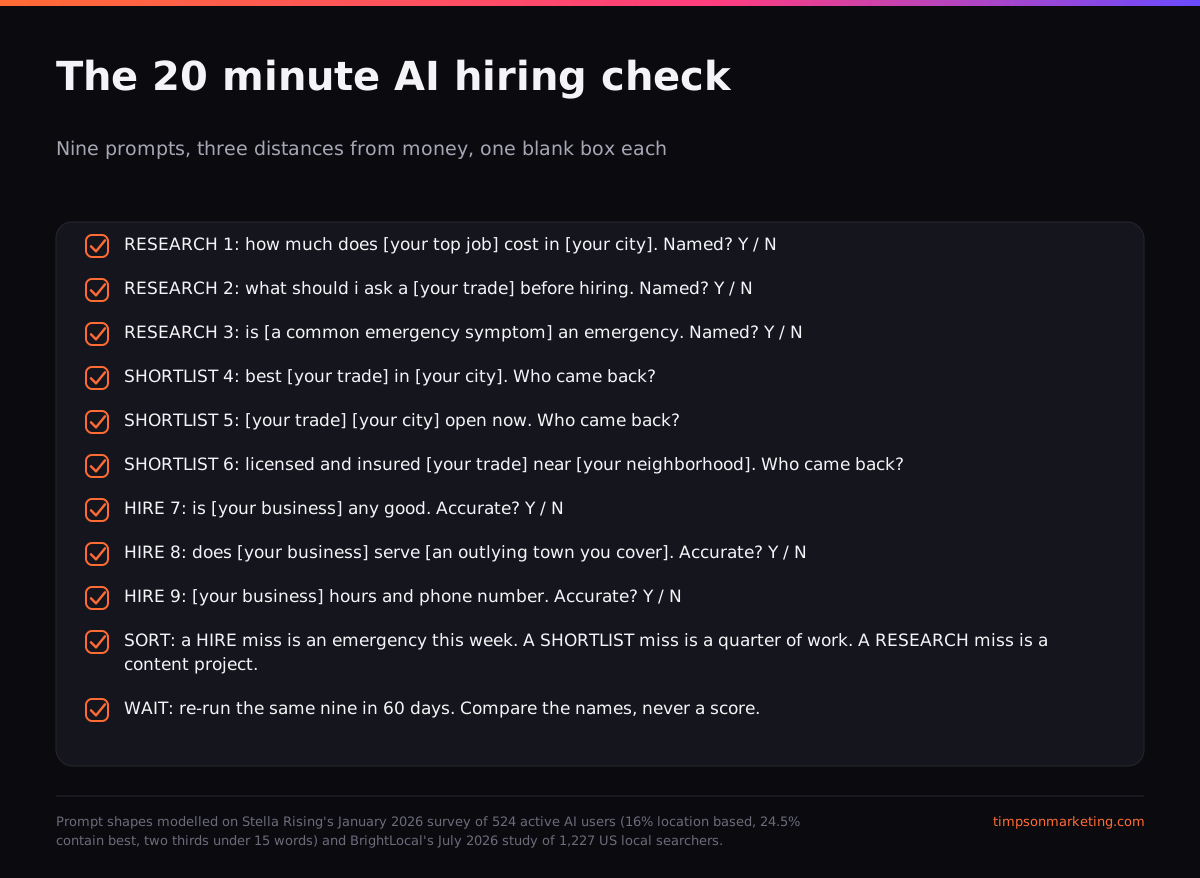
Run the check in twenty minutes without fooling yourself
Pick nine prompts
Three from each band. Use your real city, your real service, your real business name.
Open a logged out window
Signed in, the model has your history and your location and will flatter you.
Run each one once
Write down the businesses named, in order, and whether you were one of them.
Run the same nine in a second tool
BrightLocal found ChatGPT used by 31% of consumers for local recommendations and Google's AI Mode by 23%, so one tool is half a picture. The surfaces are not interchangeable, as we broke down in AI Overviews versus AI Mode versus ChatGPT.
Sort the misses by band
A band three miss is an emergency. A band one miss is a content project.
This nine prompt check is the first thing we run on every ChatGPT marketing engagement, before anyone touches a word of the website, because a wrong phone number in band three is faster and cheaper to fix than a content gap in band one, and it costs more when it is left alone.
Darren Shaw, who runs the largest annual survey of local search practitioners, puts the honesty bar where it belongs for the whole category.
None of the experts have special access to the internal workings of Google's local search algorithm.
That applies double to AI answers, where the retrieval step happens before you ever see the words.
By the time a user sees an answer, the model has already decided which sources matter.
If you are missing, fix things in this order
Most of what gets sold as AI optimization is decoration. We went through the full diagnosis in why AI does not recommend your business, and the short version is that the expensive parts are the ones that do not work. Google's own generative AI documentation states plainly that structured data is not required for generative AI search and that you do not need to create new machine readable files, AI text files, markup, or Markdown to appear in Google Search. Ahrefs tested that empirically, tracking 1,885 pages that added JSON-LD against 4,000 controls and finding no meaningful citation uplift on any platform. Separately, 97% of published llms.txt files got zero requests in May 2026. That is the same evidence trail we walk in is schema markup worth it and in GEO versus SEO, and it points the same direction both times.
So skip all of that. The order that actually matters:
- Confirm OAI-SearchBot is allowed in robots.txt. OpenAI states that sites opted out of OAI-SearchBot will not be shown in ChatGPT search answers.
- Confirm your key pages are indexed in Google and snippet eligible. Google states a page must be indexed and eligible to show with a snippet to appear in its AI features.
- Confirm your Google Business Profile name, hours, phone, service area and services are correct and complete.
- Confirm your reviews are recent, not just numerous. 74% of consumers look for reviews from the last three months.
- Confirm you have a real page for each service you sell, with prices or ranges where you can publish them.
- Confirm you appear on third party pages that a model can retrieve: best-of lists, association directories, local press, Yelp.
- Re-run the nine prompts sixty days later and compare the named businesses, not a score.
Step four is not padding. BrightLocal's 2026 review survey of 1,002 US adults found 74% of consumers seek out reviews written in the last three months, so a wall of five year old five stars reads as a closed business to a human and offers a model nothing current to summarize.
Step six is the one owners resist and the evidence keeps pointing at it. Aleyda Solis measured 15 brands and found 84% to 93% of AI citation weight sat on third party sites rather than the brand's own domain. On the local side, Whitespark's 2026 ranking factors survey of 47 experts scored presence on expert-curated best-of lists as the single highest factor in its new AI search visibility column, with a dedicated page for each service second. You cannot write your way into an AI answer from your own website alone.
That also cuts against the crawler-blocking instinct. If you or your host blocked AI bots wholesale, you removed yourself from ChatGPT search answers and Claude search answers to prevent training you were never going to get paid for. OpenAI documents four separate bots with four different jobs, and only one of them is the visibility gate.
## Why the answer changes every time you ask Run band two twice in a row and you will get different names. That is not a bug you can engineer around, and anyone who tells you they can guarantee a spot is selling you something. It gets worse for local. Sterling Sky compared AI local packs against traditional 3-packs across 322 markets and found 5,943 unique businesses surfaced versus 18,330, roughly a third as many winners. SOCi analyzed nearly 350,000 locations across 2,751 multi-location brands and found only 1.2% of locations were recommended by ChatGPT, against 11% by Gemini, 7.4% by Perplexity, and 35.9% appearing in Google's local 3-pack.
See how we run this→| Google local pack | AI assistant answer | |
|---|---|---|
| Unique businesses surfaced across 322 markets | 18,330 | 5,943 |
| Share of multi-location brand locations surfaced | 35.9% in the 3-pack | 1.2% by ChatGPT |
| How many make the cut | three plus a map, then a full list | one paragraph, sometimes three names |
| What gets you in | proximity, category, reviews, prominence | retrieval of pages and third party sources about you |
The reasonable read across both datasets is that AI answers compress the winner list far harder than the local pack does, which raises the value of being in the compressed set and lowers the odds for any individual business. That is an argument for working on it, and an argument against paying for it as though it were a guaranteed placement. We laid out how to tell the difference in whether AI SEO is worth paying for. It is also an argument for not abandoning the surface that still produces the volume, which is ranking higher on Google Maps.
What the model is actually reading about you
It is not reading your llms.txt. Ahrefs analyzed 1.4 million ChatGPT prompts and found the general web search index accounted for 88.46% of cited retrievals, with news at 12.01%, Reddit at 1.93% and YouTube at 0.51%. The same study found URLs with natural language slugs were cited at 89.78% versus 81.11% for opaque ones, and the median age of a cited search result was around 500 days. Old pages get cited. Unreadable URLs get skipped.
The local picture is changing underneath that. On July 23, 2026, Search Engine Land reported that ChatGPT gained access to Yelp's reviews, ratings, photos and business information, including Yelp's Request a Quote flow so users can contact a provider from inside the answer. Yelp CEO Jeremy Stoppelman told Axios that Yelp sees value in distributing its content beyond its own properties when it benefits consumers.
Read that as an operator, not a marketer. A licensing deal means the profile you ignored on a review site you do not like is now feedstock for the answer a customer sees. Your Yelp page is no longer a page. It is a data source. The same logic applies to every directory you abandoned in 2019, which is the same argument we make about reviews across more than one platform.
What this is worth in dollars, honestly
Small, for now, as a traffic channel. Ahrefs measured traffic share across 76,000 sites and estimated Google sends 190 times more referral traffic than ChatGPT, at 39.98% versus 0.21%. Semrush's channel mix study across more than 50,000 sites put AI systems at 0.14% of total website traffic in 2025 against 16.04% for organic search, though AI grew 66% in the year while organic grew 2.38%.
So do not move your budget. Fund this the way we fund GEO marketing generally, as a slice alongside local SEO rather than a replacement for it. Do the work anyway, for a reason that has nothing to do with clicks: the calls are leaking from the other end at the same time.
If you have a business profile that ranks really well, even if you don't see a drop in ranking, your calls from the business profile are going down over time.
Put the two together and the picture is uncomfortable but clear. Your Google Business Profile is producing fewer calls at the same ranking, and the surface absorbing that attention sends almost no clickable traffic. The person who read an AI answer about you does not arrive with a referrer. They arrive by typing your name into Google, or by dialing. Which is why the honest KPI here is not sessions from ChatGPT. It is whether you get named, and whether what gets said about you is true. If you want the measurement argument in full, we made it in how to tell if your SEO agency is working.
What we would actually do on Monday
Run band three first. Ten prompts, ten minutes, your own name. It is the cheapest audit in this entire category and it finds the errors that cost you jobs you already won.
Then run band two and write down who did get named. Those are your real competitors in the surface that is growing, and they are frequently not the same firms you fight in the local pack. If a name surprises you, go read what the internet says about them that it does not say about you. Usually it is a best-of list, an association page, a news mention, or a service page you never wrote.
Then leave it alone for sixty days. Ten prompts a week is not a program, it is a nervous habit, and the noise in these answers will happily convince you of a trend that is not there.
The rest of the plain-English series on this, including the local pack, reviews and paid, sits on the blog.
Frequently asked questions
Do customers really use ChatGPT to find local businesses?
Yes, but as a research step rather than a hiring step. BrightLocal found 45% of US consumers asked an AI tool for a local recommendation in the past year, and 8% started their most recent local search there. Of those who started on AI, only 2% used it as their only channel.
What do customers actually type into ChatGPT before hiring a contractor?
Short, plain questions. Stella Rising's survey of 524 active AI users found two thirds write prompts of 15 words or fewer, 60% phrase them as questions, 16% are explicitly location based, and 24.5% include the word best. Think ac repair st george, not a paragraph.
My customers are older. Does this still matter?
Partly. Pew Research surveyed 5,119 US adults and found 63% of adults under 50 use AI chatbots, versus 42% of ages 50 to 64 and 23% of those 65 and older. Twenty three percent of the oldest group is still roughly one in four callers.
How do I check whether ChatGPT recommends my business?
Open a logged out browser, paste nine prompts covering research, shortlist and hire questions, and write down which businesses get named. Run the same set in a second tool. Treat it as a smoke test, not a metric, and never convert nine answers into a score.
Will adding schema markup or an llms.txt file get me into AI answers?
No. Google's documentation states structured data is not required for generative AI search and that you do not need AI text files or markup. Ahrefs tested 1,885 pages that added schema and found no meaningful citation uplift, and 97% of llms.txt files got zero requests.
Why does ChatGPT give a different answer every time I ask?
Because retrieval and generation both vary by session, account history, location and model version. There is no fixed ranking behind an AI answer. That variability is why any AI visibility percentage needs its prompt set, location and run count disclosed before you believe it.
How hard is it for a local business to get recommended by ChatGPT?
Harder than ranking in the local pack. SOCi analyzed nearly 350,000 locations across 2,751 multi-location brands and found only 1.2% were recommended by ChatGPT, compared with 35.9% appearing in Google's local 3-pack. Sterling Sky found AI local packs surface about a third as many businesses.
Does ChatGPT use Yelp for local business answers?
Yes, since 2026. Search Engine Land reported on July 23, 2026 that ChatGPT gained access to Yelp's reviews, ratings, photos and business information, including Yelp's Request a Quote flow. Directory profiles you stopped maintaining are now feedstock for AI answers about you.
Should I move budget from Google to AI search?
No. Ahrefs estimates Google sends 190 times more referral traffic than ChatGPT, and Semrush put AI systems at 0.14% of total website traffic in 2025. Treat AI visibility as brand and consideration work funded alongside local SEO, not instead of it.
What should I fix first if I am missing from AI answers?
Crawler access, then indexing. Confirm OAI-SearchBot is allowed in robots.txt, since OpenAI states opted-out sites will not appear in ChatGPT search answers. Then confirm your key pages are indexed and snippet eligible in Google, then fix your profile data and reviews.
Sources
- BrightLocal. Consumer Search Behavior: Channels (2026-07)
- BrightLocal. Consumer Search Behavior: Decisions (2026-07)
- BrightLocal. Half of consumers are asking AI for business recommendations (2026-03)
- BrightLocal. Local Consumer Review Survey 2026 (2026-02)
- Pew Research Center. How opinions and use of AI differ by age (2026-06)
- Search Engine Land (John Morabito, Stella Rising). How real people actually prompt AI and what it means for GEO (2026-06)
- Search Engine Land (SOCi Local Visibility Index). AI local visibility is up to 30x harder than ranking in Google (2026-01)
- Search Engine Land. ChatGPT gains access to Yelp reviews, ratings and photos (2026-07)
- Google Search Central. Optimizing your website for generative AI features on Google Search (2026-07)
- OpenAI. OpenAI bots documentation (2026-07)
- Ahrefs. Does schema markup increase AI citations? (2026-05)
- Ahrefs. 97% of llms.txt files receive zero requests (2026-06)
- Ahrefs. Why ChatGPT cites the pages it cites (2026-04)
- Ahrefs. ChatGPT has 12% of Google's search volume (2026-02)
- Semrush. Traffic channel mix study (2026-04)
- Sterling Sky (Joy Hawkins). The state of local SEO in 2026 (2026-06)
- Whitespark (Darren Shaw). Local Search Ranking Factors 2026 (2025-11)
- Aleyda Solis. SaaS AI search optimization: where citation weight sits (2026-07)
- Clearscope (Bernard Huang). The search engine wars are back with AI (2026-03)
Joseph Timpson has worked in search since 2010 and runs Timpson Marketing out of St. George, Utah. He built The Cited Method, a five stage framework for earning and proving real citations in AI answers, and publishes what does not work alongside what does.
Want this done for you, with the receipts to prove it worked?
One call, no pitch deck. We look at what is actually blocking you and tell you the truth about whether we can help.
Book a free consultation →