What AI Overviews Are Doing to Law Firm Website Traffic
The traffic your blog lost and the traffic that hires you are two different lines on the same chart. Almost nobody separates them, which is why a scary graph keeps getting mistaken for a revenue problem.

- The 19% law firm traffic decline circulating across legal marketing comes from a single agency blog post with no stated sample size, date range, or methodology.
- In a 540 query study across six local verticals including personal injury lawyers, AI Overviews appeared on about 92% of informational queries and about 15% of local hiring queries.
- Local packs run the opposite way, appearing on about 93% of local hiring queries and about 6% of informational ones, so the two query families are being handled by two different systems.
- Google's own generative AI report in Search Console gives impressions only, with no clicks, no click-through rate, and no query data, so you cannot isolate AI Overview clicks.
- A drop in informational blog sessions is only a revenue problem if those sessions were producing consultations. Most firms have never measured that link, which is the actual work.
The number every legal marketer is quoting does not have a study behind it
Law firm traffic is falling, but not evenly across your site. AI Overviews appear on roughly 92% of informational local queries and roughly 15% of the local hiring queries that actually produce consultations. Split your own analytics along that line before you treat a traffic chart as a revenue emergency.
Search "law firm traffic dropped 19%" and you will find it repeated across legal marketing right now. We chased it to the origin. It comes from a Rocket Clicks article by Anthony Karls, the firm's President and a co-founder of Sterling Lawyers, which states the legal industry saw a 19% decline in organic traffic in 2025 with some firms losing nearly 80%.
That page carries no sample size, no date range, no keyword universe, and no description of how traffic was measured. Every secondhand repetition we could find, including the RepuClinic write-up that put the figure in a headline, cites Rocket Clicks and adds nothing to it.
That does not make the number wrong. It makes it one agency's client set presented as an industry finding, and you should not run a marketing decision off it.
Here is what is documented. Pew Research Center tracked 900 US adults through 68,879 real Google searches in March 2025 and found people clicked a traditional result on 8% of visits when an AI summary appeared, versus 15% when it did not. Ahrefs compared 150,000 keywords carrying AI Overviews against 150,000 without, using aggregated Search Console data, and measured a 58% lower click-through rate for the top ranking page, up from the 34.5% it measured a year earlier.
Those are the numbers worth building on. They are also platform wide, not legal specific, and that gap is exactly where the legal marketing coverage of this subject falls apart.
For every 100 clicks you could historically earn for a top-ranking page, Google now 'keeps' 58.
Your website is two businesses and only one of them is being hit
A law firm site does two unrelated jobs. One set of pages answers questions: what to do after a rear end collision, how long you have to file, whether a settlement is taxable. Another set of pages gets you hired: the practice area page, the city page, the attorney bio, the contact page.
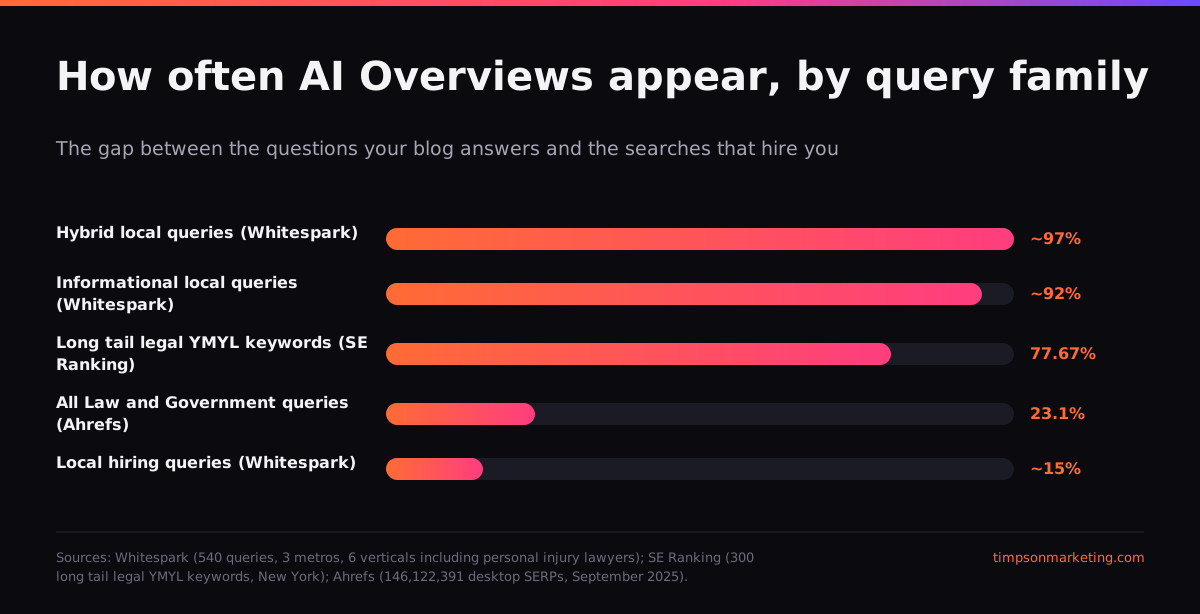
Those two page families serve two query families that Google now routes through two different systems. Whitespark ran 540 queries across three US metros (Houston, Phoenix, Denver) and six local verticals including personal injury lawyers, and split them by intent. The result is the single most useful finding in this whole subject and it is barely cited in legal marketing at all.
On pure local intent queries, AI Overviews appeared about 15% of the time while local packs appeared about 93% of the time. On informational queries, the ratio flipped almost exactly: AI Overviews about 92%, local packs about 6%. Hybrid queries that mix a question with a hiring motion drew AI Overviews about 97% of the time.
Where local packs are most prominent, AI Overviews are least prominent, and vice versa.
Read that against your own site and the picture resolves. The pages losing sessions are almost certainly the ones that answered questions. The pages that get you hired sit behind a query type where AI Overviews are the exception, not the rule. Those are not the same loss and they should never share a chart without a label.
Two legal specific numbers that look contradictory and are not
You will see two very different figures quoted for how often legal queries trigger AI Overviews, and legal marketing blogs use whichever one suits the argument.
SE Ranking hand built 300 long tail legal keywords and found 77.67% of them triggered an AI Overview, the highest of the four Your Money or Your Life categories it tested (Health 65.33%, Finance 41.67%, Politics 16.67%). Ahrefs went the other direction and analyzed 146,122,391 desktop SERPs from September 2025, finding that 23.1% of Law and Government queries carried an AI Overview.
Both are correct. SE Ranking pre selected long tail question keywords in a single location in September 2024, and its own page notes long tail queries are the ones most likely to trigger AI Overviews. That is an upper bound on a curated question set. Ahrefs measured the whole population of a broad category. The 77.67% describes your blog. The 23.1% describes your category.
Anyone who quotes one without the other is telling you half the story, and the half they pick usually matches what they are selling. We cover the mechanics of which surface answers which question in our breakdown of how AI Overviews, AI Mode and ChatGPT actually differ.
Run the split yourself, in about twenty minutes
This is the part no one publishes, so here it is. You do not need a tool. You need Search Console and a definition.
Define the two groups
In Search Console, open Search results, then the Pages tab. Group one is every URL under your blog, resources, or FAQ path. Group two is practice area pages, city pages, attorney bios, and contact. Use the Page filter with a custom regex if your paths are messy.
Pull 16 months for each group
Set the date range to the full 16 months and export clicks and impressions for both groups separately. Sixteen months lets you compare the same season, which matters in personal injury.
Compute CTR per group, not sitewide
Sitewide CTR hides everything. You want clicks divided by impressions inside each group. The decoupling shape is impressions flat or rising while CTR falls.
Check whether impressions actually held
If impressions fell too, this is not an AI Overview story. That is a ranking, indexing, or demand story, and the fix is completely different.
Tie group two to consultations
In your intake system or CRM, count signed matters whose first touch was a group two page. That is the only line that pays the rent.
One mechanical caution before you start. Google's generative AI performance report in Search Console reports impressions only. There are no clicks, no click-through rate, and no query data in it. Meanwhile Google's own documentation confirms that clicking a link inside an AI Overview counts as an ordinary click in the standard report, and that an AI Overview occupies a single position with all of its links assigned that same position.
So AI Overview clicks are inside your totals, you cannot pull them out, and the one report built for AI surfaces will not tell you what they earned. Any vendor showing you a clean AI Overview click number is modeling it, not measuring it. That is worth asking about directly, and it belongs on the list of questions in how to tell whether your SEO agency is actually working.
What would have to be true for this to be a revenue problem
Here is the test, and most firms fail it not because the answer is bad but because they have never asked.
A decline in informational sessions is a revenue problem only if those sessions were producing signed matters. Three links have to hold: the blog page attracted a real prospect, that prospect moved to a hiring page, and that visit produced a consultation that converted.
| What moved | What it probably means | What to do |
|---|---|---|
| Blog clicks down, blog impressions up, hiring page clicks flat | AI Overviews are answering questions you used to answer. Your hiring funnel is intact. | Nothing urgent. Stop reporting blog sessions as a KPI. |
| Blog clicks down and hiring page clicks down | Ranking, indexing, or crawler access problem, not an AI problem | Technical audit first. Check access before content. |
| Everything down and consultations down | Real revenue problem, and it started before the traffic chart | Look at intake and speed to response, not content volume |
| Blog clicks down, consultations flat or up | Your informational traffic was never producing cases | Reallocate that budget to the hiring pages |
That last row is the one nobody wants to print. A lot of law firm blog traffic was never buying anything. It was researchers, students, opposing parties, and people whose problem resolved itself. Losing it costs a report line, not a case.
The honest version of this analysis often ends with a firm discovering their informational traffic was a decade long expense they had mislabeled as an asset. That is a good outcome. It just does not feel like one on a dashboard.
We run this split before we quote anyone a program. If the hiring line is healthy, we will tell you so and we will tell you not to buy anything yet.
See how we measure AI visibility→Do not declare victory on the hiring queries
The intent split is real today and it is moving. Semrush tracked more than 600,000 US desktop keywords from November 2025 to April 2026 and found AI Overviews on commercial intent queries grew 71% while transactional intent AI Overviews fell 5%. Law was not one of the ten industries in that study, which we are flagging rather than glossing, but the direction of travel matters: AI Overviews are climbing into research and comparison queries, and "best personal injury lawyer in Phoenix" is a comparison query.
While we are correcting things, one more. Legal marketing content still repeats that roughly 92% of AI Overview citations come from top 10 organic results. Ahrefs, the source of the original figure, revised its own number to 38% in March 2026 after analyzing 863,000 SERPs and 4 million AI Overview URLs, down from about 76% in July 2025. If your agency is still quoting the old number, they are quoting a figure the publisher has itself cut in half.
Your firm might still be ranking. People just aren't clicking through.
Where the hiring query actually goes now
If local packs answer 93% of local hiring queries, then your Google Business Profile is doing more of the hiring work than your website is. That reframes the budget conversation entirely.
BrightLocal surveyed 1,227 US consumers who had searched for a local business in the last three months and found 72% look at three or fewer businesses before deciding, and only 1% look at more than ten. Separately it found 75% decide in under 30 minutes and 28% decide in under five. Being outside the visible three is functionally being invisible, and no amount of blog traffic fixes that.
Consumers are not hanging around. It's clear from the data that most consumers want to make quick decisions on the businesses they use.
On the legal side specifically, iLawyerMarketing surveyed 1,110 US consumers aged 18 to 65 on which online sources they would use if they needed to hire a lawyer for a very important legal issue. Google came first at 71.9% and ChatGPT came second at 41.9%, ahead of Facebook, YouTube and Yelp. The page names no methodology author and reports stated intent rather than observed behavior, so treat it as directional. It still says something useful: a second discovery surface now sits alongside Google for legal hiring, which is why what ChatGPT says about your firm is now a real intake variable rather than a curiosity.
That is also why reviews and profile completeness outrank content volume for a firm whose hiring queries are healthy, and why city and practice area pages are worth more attention than another explainer post.
What is worth doing, ranked by how strong the evidence is
We hold these positions publicly and they cost us work sometimes.
Start with crawler access. It is the only lever in this space that is mechanical and binary: if an AI crawler gets a challenge page instead of your content, nothing downstream matters. It is also the step most vendors skip because it does not sell as a retainer.
Then topic coverage. Surfer analyzed 10,000 keywords and 173,902 URLs and found pages ranking for both the main query and its fan out queries were 161% more likely to be cited in an AI Overview than pages ranking only for the main term. Breadth of subtopic coverage, not page length.
Then the things we will tell you not to buy. llms.txt is not a citation lever: SE Ranking studied nearly 300,000 domains and found no relationship between an llms.txt file and how often a domain gets cited, and removing the feature actually improved their prediction model. Schema is classic search hygiene and not an AI citation lever: Ahrefs ran 1,885 pages that added JSON-LD against 4,000 matched controls and found no meaningful uplift in citations on any platform, which we unpack in is schema markup worth it. Neither of those is a scam. They are just not what they are being sold as, which is the same problem we describe in is AI SEO worth paying for.
And one economic point that outranks all of it for law firms. WordStream's 2026 benchmark study of 13,474 US search campaigns found Attorneys and Legal Services paying $9.87 per click against a $5.42 all industry average, while converting at 5.55% against an 8.18% average. Legal pays the most per click and converts worse than average. For most firms, intake and response speed have a higher marginal return than another content push or another bid increase.
What we cannot tell you, and neither can anyone else
SparkToro ran 12 prompts 2,961 times across ChatGPT, Claude and Google AI with 600 volunteers and found the same prompt rarely returns the same brand list twice. A screenshot of your firm appearing in ChatGPT is not evidence of anything.
AIs do not give consistent lists of brand or product recommendations. If you don't like an answer, or your brand doesn't show up where you want it to, just ask a few more times.
There is also a real contradiction in the research that we are not going to hide. Semrush took keywords that did not trigger an AI Overview in May 2025 but did by October 2025 and compared the same keywords before and after. Zero click rate went down, from 33.75% to 31.53%. That is the cleanest experimental design in the field and it points the opposite way from the trend data. The causal question is not settled.
And Google disputes the whole premise.
Overall, total organic click volume from Google Search to websites has been relatively stable year-over-year.
Google publishes no data behind that statement. Pew, Ahrefs and Whitespark all publish theirs. Weigh it accordingly, then go weigh your own numbers, which are the only ones that describe your firm. If you want help running the split, that is what our GEO measurement work starts with, and the rest of this series lives in our blog.
Frequently asked questions
Are AI Overviews reducing law firm leads or just traffic?
For most firms so far, traffic. AI Overviews concentrate on informational queries, which appear about 92% of the time in Whitespark's study, against about 15% for local hiring queries. Leads come mostly from the hiring queries. Confirm it in your own data before assuming either way.
How do I tell if my traffic drop is AI Overviews or a ranking problem?
Check impressions. If impressions held flat or rose while clicks fell, that is the AI Overview pattern. If impressions fell alongside clicks, you have a ranking, indexing, or crawler access problem instead, and the fix is technical rather than editorial.
Can I see AI Overview clicks in Google Search Console?
No. Google's generative AI performance report shows impressions only, with no clicks, no click-through rate, and no query data. Clicks from AI Overview links are folded into your standard totals and cannot be isolated. Any vendor showing a clean AI Overview click number is modeling it.
Is the 19% law firm traffic decline figure reliable?
Treat it as one agency's observation. It originates in a Rocket Clicks article that states no sample size, date range, or methodology, and every repetition we found simply cites that article. The Pew and Ahrefs studies are better sourced but measure all sites, not law firms.
Should law firms stop writing informational blog content?
Not automatically. Measure whether those pages ever produced consultations first. If they did, keep them and consolidate the thin ones. If they never did, that budget belongs on practice area pages, city pages, reviews and intake speed, which is where the hiring queries actually land.
Do AI Overviews appear for personal injury searches?
It depends entirely on the query. Whitespark's study, which included personal injury lawyers among six verticals, found local hiring queries drew AI Overviews about 15% of the time while local packs appeared about 93% of the time. Question style queries flip that ratio almost exactly.
Does schema markup help my firm get cited in AI Overviews?
The best available evidence says no. Ahrefs compared 1,885 pages that added JSON-LD against 4,000 matched control pages and found no meaningful uplift in citations on any platform. Schema is still worth doing for classic search results, just not as an AI citation lever.
What should a law firm actually fix first?
Crawler access, because it is binary and most vendors skip it. Then the hiring pages and Google Business Profile, since local packs answer the majority of hiring queries. Then intake speed, because legal converts below the all industry average while paying the highest cost per click.
Sources
- Pew Research Center. Google users are less likely to click on links when an AI summary appears in the results (2025-07)
- Ahrefs. AI Overviews Reduce Clicks by 58% (Update) (2026-02)
- Whitespark. Case Study: The Prevalence of AI Overviews in Local Search (2025-05)
- SE Ranking. Google's AI Overviews and YMYL Topics: Research Study (2024-09)
- Ahrefs. What Triggers AI Overviews? 86 Factors and 146 Million SERPs Analyzed (2025-09)
- Ahrefs. Only 38% of AI Overview Citations Come From the Top 10 (2026-03)
- Google Search Console Help. Generative AI performance report (Search) (2026-06)
- Google Search Console Help. Search performance report: AI Overviews and AI Mode counting rules (2026-07)
- Semrush. AI Overviews and Commercial Search Study (2026-07)
- BrightLocal. Consumer Search Behavior: How Decisions Get Made (2026-07)
- BrightLocal. Consumer Search Behavior: Speed of Decision (2026-06)
- iLawyerMarketing. What Online Sources Do People Use to Research and Find Attorneys in 2026? (2026-07)
- Rocket Clicks. AI Search SEO: Why Family Law Traffic Is Declining (2026)
- RepuClinic. Law Firm Web Traffic Dropped 19% While Rankings Held (2026)
- Surfer. The Impact of Query Fan-Out on AI Overview Citations (2025-12)
- WordStream by LocaliQ. 2026 Google Ads Benchmarks for Every Industry (2026-05)
- SparkToro. New Research: AIs Are Highly Inconsistent When Recommending Brands (2026-01)
- Google. AI in Search is driving more queries and higher quality clicks (2025-08)
- Attorney at Law Magazine. AI Overviews Are Answering Your Clients' Questions (2026)
- Ahrefs. Does adding schema markup increase AI citations? (2026-05)
- SE Ranking. LLMs.txt: Adoption and Impact Study Across 300,000 Domains (2025-11)
- Semrush. Semrush AI Overviews Study (2025-12)
Joseph Timpson has worked in search since 2010 and runs Timpson Marketing out of St. George, Utah. He built The Cited Method, a five stage framework for earning and proving real citations in AI answers, and publishes what does not work alongside what does.
Want this done for you, with the receipts to prove it worked?
One call, no pitch deck. We look at what is actually blocking you and tell you the truth about whether we can help.
Book a free consultation →