How Many Location Pages Should a Local Business Have?
Thirty five near duplicate city pages is the most common thing we inherit. Deleting them all is wrong, leaving them is wrong, and nobody publishes the decision in between. This is that decision.

- Similarity is not the offense. A lawn care company ran 35 service area pages measured at 84% similar to each other and they ranked and sold work, per a published Sterling Sky case study.
- Google's spam policies do not list duplicate content. They list doorway abuse, and the definition turns on pages that are "not as useful as the final destination," which is a funnel problem, not a word count problem.
- The test that decides every page: delete the city name from it. If nothing distinctive is left, it is a merge or a redirect, not a rewrite.
- Redirect the ones that had links, never delete them. Google calls a permanent redirect a strong signal that the target should become canonical, while a 404 or 410 just removes the URL.
- City pages compete in organic results, not the map pack. Whitespark's 2026 panel scores a dedicated page per service as the top local organic factor at 210, and a physical address in the city of search is a separate factor entirely.
The number is not the question
There is no correct number of location pages. The correct test is whether a page would still deserve to exist if you deleted the city name from it. Pages that pass get kept and thickened. Pages that fail get merged or redirected into the page that survived. A thirty five page set usually collapses to somewhere between five and a dozen.
A lawn care company ran thirty five service area pages that a duplicate content checker scored at 84 percent similar to each other. They ranked. They produced sales. That is a published Sterling Sky case study, and it contradicts nearly every article warning you that near duplicate city pages will sink your site.
So the honest starting point is uncomfortable. Similarity is probably not what is wrong with your thirty five pages. Something else is, and the fix is a decision rather than a rewrite.
Every article on this topic splits into two camps: build a page for every town, or never build city pages. Neither camp addresses the situation almost every owner is actually in. The pages already exist. An agency built them. They do not rank. And nobody will tell you what to do with them now, because the answer is per page and it takes real work.
Here is that work, in the order we do it.
Google's rule is about the destination, not the word count
Google's spam policies do not contain a duplicate content offense. Read the list. Doorway abuse is there. Scaled content abuse is there. Thin affiliation is there. Duplicate text between two of your own pages is not, and never has been.
Doorway abuse is defined this way, verbatim: "sites or pages are created to rank for specific, similar search queries. They lead users to intermediate pages that are not as useful as the final destination." One of the named examples is almost a description of your site: "Having multiple domain names or pages targeted at specific regions or cities that funnel users to one page".
Now read the second half of that definition again. Not as useful as the final destination. The offense is the funnel, not the similarity.
That single distinction reorders the entire problem. A city page that answers the question, shows the work and lets somebody book is a destination. A city page whose only job is to push a reader toward the real service page is an intermediate step, and it is an intermediate step whether it is 300 words or 1,300.
The companion policy is scaled content abuse, which Google defines as "when many pages are generated for the primary purpose of manipulating search rankings and not helping users." The clause people skip is the last one: "no matter how it's created." Hand written thin pages and generated thin pages sit in the same bucket.
Google's Quality Rater Guidelines go further and tell raters to apply the Lowest rating for suspected scaled content abuse "even if you are unsure of the method of creation," after looking at several pages on the website. Note the phrase several pages. This is judged as a pattern across your site, not URL by URL. That is the real risk of thirty five templates, and it is a site level risk, not a page level one.
That risk is not theoretical. Search Engine Land documented service area sites losing rankings and having location pages deindexed after Google's late 2022 helpful content and spam updates, with lower authority sites hit hardest and sites carrying genuinely distinct location content largely holding. That is four years old now, so treat it as a pattern rather than a forecast, but the pattern has not reversed.
Duplication itself is handled somewhere much more boring. Google's canonicalization documentation treats near identical pages as a deduplication problem, ranks the ways you can express a preference, and calls a redirect "A strong signal that the target of the redirect should become canonical." A rel=canonical tag is also a strong signal, and a sitemap entry is explicitly "a weak signal." None of that is enforcement. It is filing.
The case that near duplicate city pages can work
Colan Nielsen, VP of Search at Sterling Sky, published the case study that most consultants in this space have quietly decided not to mention. Thirty five service area pages built over several years, similarity measured at "84% on average, according to Siteliner."
And guess what? They all ranked well and led to new sales for the business.
We do not think that finding gives anyone permission to spin up templates, and neither does he. In the same piece he draws a hard volume line: "you should be fine to rinse and repeat a few dozen times", before warning that hundreds or thousands of pages raise the odds of Google taking notice.
So there are two variables in that case study, and only one of them is content. A few dozen pages sat inside a real business with real coverage. Hundreds would not have. Volume is doing as much work in that result as prose is.
The second variable is which surface these pages compete on, and this is where most owners are quietly disappointed. City pages fight in organic results. They do not put you in the map pack.
It's important to remember that these pages will only be shown organically for now, but if you ever open a physical location in that city and verify a Google Business Profile (GBP), then this could very well be a GBP landing page in the future.
That matches the ranking factor data. In Whitespark's 2026 survey of 47 local search experts scoring 187 factors, a dedicated page for each service is the number one local organic factor at 210, with geographic keyword relevance of content second at 190. Meanwhile a physical address in the city of search sits at rank 30 with a score of 135, in a completely separate column. A page cannot buy you a pin. If you were hoping otherwise, the mechanics are in our piece on why you cannot rank in the next town over.
So why do your thirty five pages fail while the lawn care company's thirty five worked? In our experience it is one of three things, and it is almost never the similarity percentage.
The three tests that decide keep, merge or redirect
Run these in order on every URL. Any page that fails test one is finished, and you do not need to run the other two.
The delete test
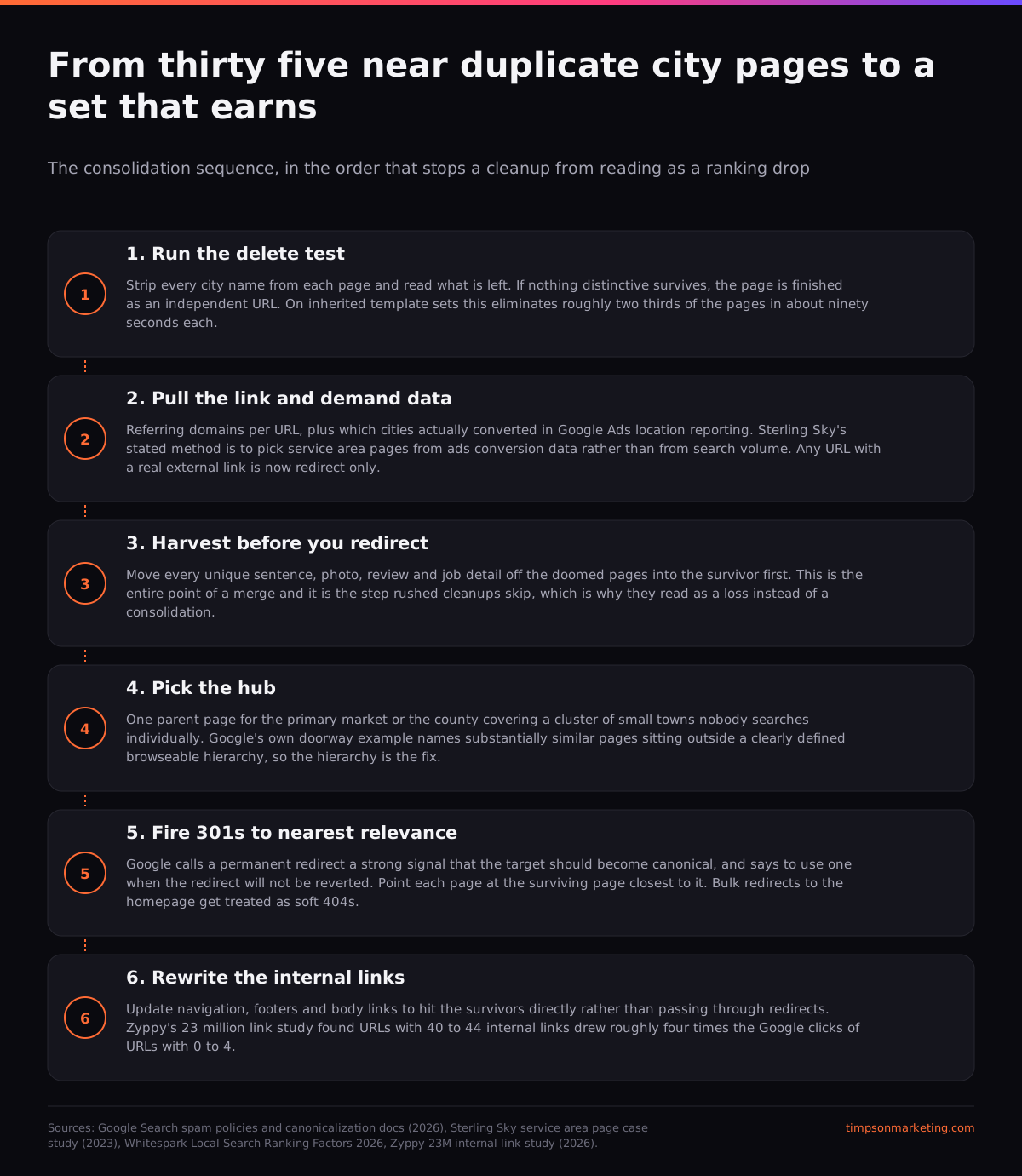
Remove every instance of the city name from the page. Read what is left. If a stranger could not tell which town it is about, and nothing distinctive survives, the page fails. This kills roughly two thirds of inherited city pages in about ninety seconds each.
The destination test
Can a customer finish the job on this page? Pricing, coverage, real photos of work in that town, named crew, reviews from that town, a booking path. If the page's only outcome is a click to another page, Google's own doorway definition describes it as an intermediate page.
The demand test
Does anyone search this way, and can you genuinely serve it tomorrow? A town you visit twice a year does not get a page. Colan Nielsen's method for picking locations is blunt and correct: "The best way to pick locations to create service area pages for is to use ads data if you have it," then look at which cities actually converted.
The delete test is the one that does the real work, because it is the only one an owner can run honestly on their own site. It is also the closest practical translation of what Marie Haynes calls the thing Google will not index.
Commodity content is content that almost anyone could write about a subject.
A city page that survives the delete test is not commodity content, by definition, because the surviving material is yours. Photos from a job on that street. The permit office you deal with. The two neighborhoods where every house has the same failing panel. Nobody else can write that paragraph, which is exactly why it is the paragraph worth writing.
One extension on Nielsen's demand test that we would add. Ads data tells you where money came from, but it does not tell you where you can service work profitably. If the drive time kills the margin, the page is a liability even when the search volume is real. Whitespark's 2026 report also scores service areas larger than two hours of driving time as a negative factor, which is the same discipline expressed on the profile side.
What a thirty five page set actually looks like after the tests
This is the shape we see when the three tests get run on an inherited set of thirty five near duplicate city pages. It is a decision map, not a promise about your site.
| Verdict | Roughly how many | What triggers it | Mechanism |
|---|---|---|---|
| Keep and thicken | 3 to 5 | Real work volume, real proof available, survives the delete test today or could with an afternoon of gathering photos and reviews | Leave the URL. Rewrite the unique 60%. Add the booking path. |
| Promote to a hub | 1 | Your primary market, or the county that covers a cluster of small towns nobody searches individually | Becomes the parent page. Everything merged points here. |
| Merge into a sibling | 6 to 10 | Adjacent suburbs of a city you already have a strong page for, with no separately searched demand | Move any unique sentence into the survivor first, then 301. |
| Redirect to the parent | 12 to 18 | Fails the delete test, no unique material exists to move, some have inbound links or aged history | 301 to the nearest relevant survivor. Never the homepage. |
| Delete outright | 2 to 5 | Towns you do not serve, duplicated by mistake, or built for a service you no longer offer | 410, and only after confirming zero referring domains. |
The two rows people get wrong are the last two. Redirecting and deleting feel like the same action and they are not. Google's HTTP status documentation says a 404 and a 410 both remove a previously indexed URL, which means anything a deleted page had earned is simply gone. A 301 moves it.
So the rule is simple and it is the opposite of what most cleanups do. Check referring domains per URL before you decide anything. Any page with even one real external link gets redirected, never deleted, no matter how thin it is.
We run the three tests across every location and service URL you have, hand you the keep, merge and redirect call for each one, and map what should exist instead. You get the decision list whether or not we do the work.
See how we map the pages that should exist→The mechanics, so the redirects do not undo the point
Five things have to happen in order. Doing them out of order is why some consolidations look like a ranking drop for a month.
- Move the unique material first. Before a single redirect fires, lift every distinctive sentence, photo and review off the pages you are killing and put it into the survivor. This is the entire point of a merge, and it is the step that gets skipped.
- 301, not 302. Google's redirect documentation is precise about the difference: a permanent redirect will "Show the new redirect target in search results," while a temporary redirect will "Show the source page in search results." Its instruction is to "Use permanent redirects when you're sure that the redirect won't be reverted."
- Point each redirect at the nearest surviving relevance. Bulk redirecting thirty pages to the homepage is a well known way to have Google treat every one of them as a soft 404. Springfield goes to the county hub, not to the front page.
- Rewrite the internal links. Do not leave your navigation and footer pointing at redirected URLs. This is the step with the best supporting data: Cyrus Shepard's analysis of 23 million internal links across 1,800 sites found URLs with 40 to 44 internal links pulled roughly four times the Google clicks of URLs with 0 to 4, with the effect reversing past about 50.
- Build a browsable hierarchy. Google's own doorway examples call out "Creating substantially similar pages that are closer to search results than a clearly defined, browseable hierarchy". A real service areas index that a human would use is the structural antidote, and it is the thing thirty five orphaned templates never had.
On the canonical question, which comes up every time: use a rel=canonical only when the page has a non search reason to stay live, such as an active ads landing page. Google describes it as a strong signal rather than a directive, so if the page has no human purpose, redirect it and remove the ambiguity.
Shepard's own caveat is worth carrying with his numbers, and it is a good habit generally.
We recommend you consider any conclusions drawn from these numbers directionally useful but not necessarily scientific truth.
What consolidation actually does to your numbers
The strongest argument for cleaning this up is not the pages you delete. It is what those pages were doing to the pages you keep.
So, it's definitely the case if our systems are seriously worried about the quality of the website that they will reduce the number of pages at the index.
That is the mechanism in one sentence. Site level quality assessment is why a set of thin city pages can suppress a good service page that has nothing wrong with it. It also explains the symptom owners describe most often, which is a Search Console report full of pages crawled and not indexed that nobody can account for.
The best documented pruning outcome we can point to is not a local business. In a case study written up by Tory Gray, Home Science Tools removed roughly 200 blog pages, about ten percent of that blog, and reported a 104% increase in organic sessions and a 102% increase in transactions measured more than ninety days later. Two caveats you should hold onto: that is an ecommerce content library rather than a set of city pages, and the experiment ran in 2018 with no control group.
We are not going to attach a number to what happened after our own consolidations, and here is why. A single site's before and after has no control, and the pages that survive get rewritten in the same window, so nothing in the result is cleanly attributable. What we will publish is the method, which is what this article is. If you want the outcome side of our work, the numbers we can actually stand behind are in the case study, stated with their limits.
If your agency has been billing for thirty five city pages every month and none of them rank, that pattern is worth checking against our list of what a working engagement looks like, and the realistic clock is in how long local SEO takes.
So how many location pages should you have
One per market where you can name the crew, show the work and answer the phone the same day. For most single location service businesses that is between four and a dozen, not thirty five, and the ceiling is set by your operations rather than by your keyword tool.
Three practical boundaries to size it against.
- Coverage you can actually service. If you cannot dispatch there this week, the page is fiction and will read like fiction.
- Demand that shows up separately. Suburbs that nobody searches by name belong inside a parent page, not on their own URL.
- Proof you can put on the page. A location page without a photo, a review or a job from that town has already failed the delete test. Go get one before you publish, not after.
The rest of your local visibility is not a page problem at all. Your primary and secondary categories do more for map pack position than any city page will, the map pack itself is covered in ranking higher on Google Maps, and the surface where thin location pages are most punishing is AI answers, where Sterling Sky's State of Local SEO in 2026 found AI local packs surfaced 5,943 unique businesses against 18,330 in traditional 3-packs. A third as many seats means near duplicate pages are competing for a much smaller field, which is the argument in why AI does not recommend your business.
One last note on scope. Location pages carry the geography side of your site. Service depth carries the rest, and Whitespark's panel scores it higher. Getting both right is a structural mapping job rather than a publishing schedule, and it is the same discipline behind what local SEO should cost and behind steady construction lead flow. If you would rather hand the audit over than run it, that is what we do. The rest of this cluster lives on the Timpson blog.
Frequently asked questions
How many location pages should a local business have?
One per market you can genuinely service, prove and dispatch to. For most single location service businesses that is four to a dozen, not thirty five. The ceiling is set by your operations and by whether you have a photo, a review or a completed job from that town to put on the page.
Does duplicate content across city pages cause a Google penalty?
No. Google's spam policies do not list duplicate content as a violation at all. They list doorway abuse, defined as pages that lead users to intermediate pages that are not as useful as the final destination. Duplication itself is handled through canonicalization, which is deduplication rather than enforcement.
Should I delete my thin city pages or redirect them?
Redirect any page with even one external link, and delete only pages with none. Google's documentation says a 404 and a 410 both remove a previously indexed URL, so anything the page earned disappears. A 301 is described as a strong signal that the target should become canonical instead.
Where should the redirects from deleted city pages point?
To the nearest surviving relevance, which is usually a county or region hub page or the city page you kept. Never bulk redirect a set of location pages to your homepage. Irrelevant bulk redirects are commonly treated as soft 404s, which wastes the entire consolidation.
Will city pages get me into the Google map pack for that town?
No. City pages compete in organic results only. Sterling Sky states plainly that these pages will only be shown organically unless you open a verified physical location there. Whitespark's 2026 data scores a physical address in the city of search as a separate factor from page content entirely.
How similar is too similar for service area pages?
There is no threshold. A published Sterling Sky case study measured thirty five service area pages at 84% similar to each other, and they ranked and produced sales. The failure test is whether anything distinctive survives when you delete the city name, not what a similarity checker reports.
Can thin location pages hurt the rest of my website?
Yes, and this is the real cost. Google's John Mueller said that if their systems are seriously worried about the quality of a website, they will reduce the number of pages in the index. Quality is assessed as a site level pattern, so thin templates can suppress pages that have nothing wrong with them.
How long after consolidating location pages will I see a change?
Plan on a quarter before the picture is readable, and longer for the survivors to mature. Ahrefs found that between 1.74% and 6.11% of newly published pages reach the top 10 within a year, depending on how the sample is filtered, and 72.9% of top 10 pages are more than three years old. Redirect processing is the fast part. Earning position is not.
Is crawl budget a reason to consolidate location pages?
Almost never for a local business. Google scopes crawl budget concerns to sites with over a million pages changing weekly, or over ten thousand pages changing daily. A sixty page contractor site is nowhere near that. The reason to consolidate is site level quality assessment, not crawl capacity.
How do I decide which cities deserve a page in the first place?
Use conversion data, not search volume. Sterling Sky's stated method is to use Google Ads location reporting to see which cities actually produced conversions, then build pages for those. Add one constraint of your own: if the drive time destroys the margin, skip it even when demand is real.
Sources
- Google Search Central. Spam policies for Google web search (2026-05)
- Google Search Central. Consolidate duplicate URLs with canonicals (2026-07)
- Google Search Central. Redirects and Google Search (2026-04)
- Google Search Central. HTTP status codes, network and DNS errors (2026-02)
- Google Search Central. Managing crawl budget for large sites (2026-07)
- Google LLC. Search Quality Rater Guidelines (General Guidelines), Section 4.6.5 (2025-09)
- Sterling Sky (Colan Nielsen). Can Service Area Pages With Duplicate or Similar Content Increase Traffic? (2023-01)
- Sterling Sky (Colan Nielsen). Stop Spending 1000's of Hours on Service Area Pages! (2024-05)
- Sterling Sky (Colan Nielsen). How do you pick locations that need Service Area Pages? (2024-06)
- Sterling Sky (Elizabeth Rule). How To Create Unique and Helpful Service Area Pages for Local Businesses (2024-01)
- Sterling Sky (Joy Hawkins). The State of Local SEO in 2026 (2026-06)
- Whitespark (Darren Shaw). Local Search Ranking Factors 2026 (2025-11)
- Marie Haynes Consulting. Crawled, currently not indexed: what it means and what to do (2026-07)
- Search Engine Journal (Roger Montti). Google Explains SEO Connection Of Site Quality To Non-Indexed Pages (2026-07)
- Zyppy SEO (Cyrus Shepard). We Analyzed 23 Million Internal Links: SEO Study (2026-02)
- InFlow (Tory Gray). Content Pruning Case Study: Deleting Pages to Boost SEO (2022-11)
- Ahrefs (Patrick Stox). How Long Does It Take To Rank In Google, And How Old Are Top Ranking Pages? (2025-05)
- Search Engine Land (Jake Hundley). Location pages in Google's crosshairs after October spam update (2022-12)
Joseph Timpson has worked in search since 2010 and runs Timpson Marketing out of St. George, Utah. He built The Cited Method, a five stage framework for earning and proving real citations in AI answers, and publishes what does not work alongside what does.
Want this done for you, with the receipts to prove it worked?
One call, no pitch deck. We look at what is actually blocking you and tell you the truth about whether we can help.
Book a free consultation →