Why You Can't Rank in the Next Town Over
Google Maps measures one thing you cannot edit: the distance from a verified pin to a searcher. This is where that leaves you, town by town, and what the virtual office guy is not telling you.

- Google Maps ranks the pin on your verified address, not the service area you type into your Business Profile. Sterling Sky tested it and found the service area setting has zero ranking effect.
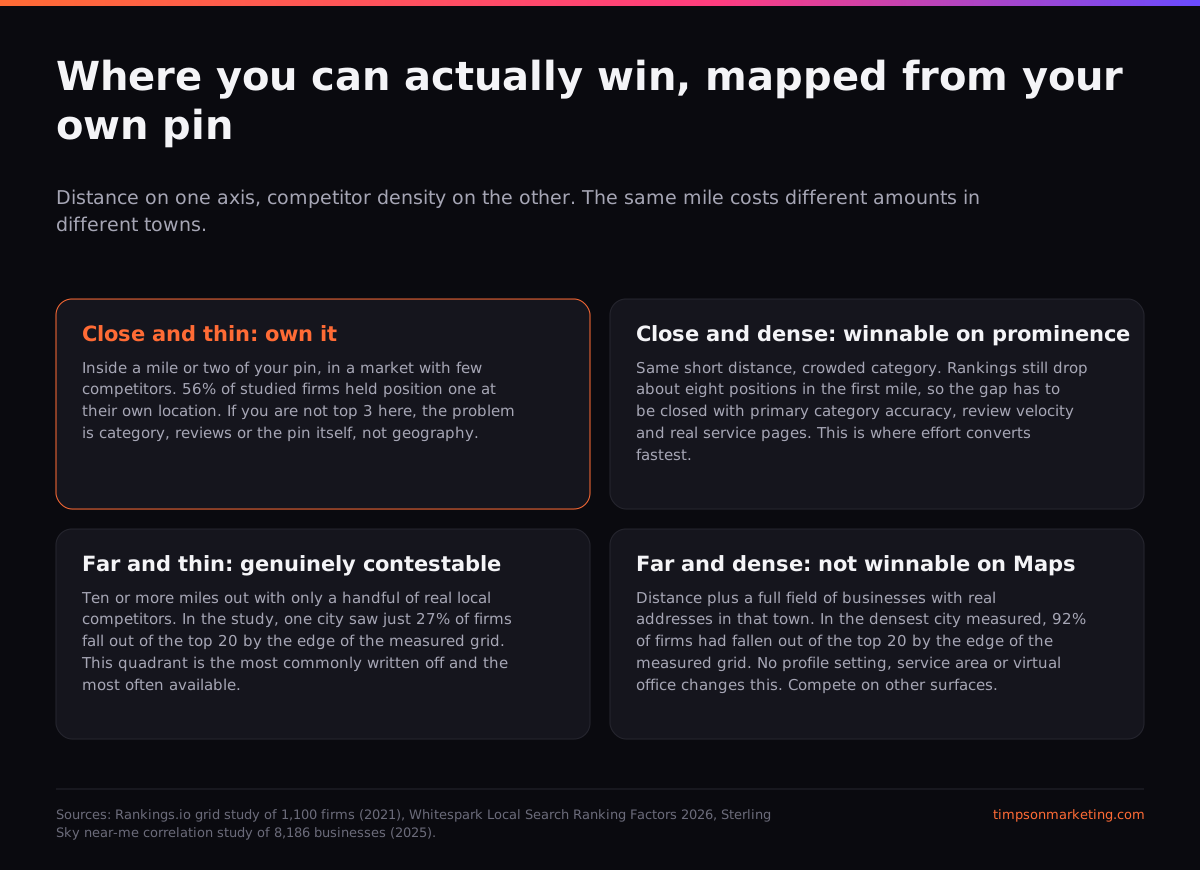
- In the only public grid study of distance decay, 56% of top ranked firms held position one at their own front door and lost an average of eight positions within the first mile.
- Distance has no fixed price in miles. At the outer edge of the same measured grid, 27% of firms had fallen out of the top 20 in Pittsburgh against 92% in Queens. Competitor density sets the exchange rate.
- A virtual office is not a workaround. Google's guidelines say a rented mailing address you do not operate out of is not eligible, and Google will disable a profile if it decides the business does not exist there.
- In a town where you have no staffed location, the winnable surfaces are organic results, Local Services Ads, and AI answers. The map pack is not one of them.
The one sentence answer
Google Maps ranks your pin, not your service area. The towns you can win on Maps are the ones close enough to your verified address that distance stops counting against you, and no setting inside your Business Profile changes that. Everything else in that town has to be won outside the map.
You drive forty minutes to that town every week. You have done good work there for years. You do not appear in its map results at all. And somebody just told you a virtual office at $99 a month will fix it.
It will not fix it. It will get the profile disabled, and it will take every review attached to it.
Below is what is actually happening, with the numbers, plus an honest map of where you can win, where you can fight, and where the answer is simply no.
What Google means by distance, in plain words
Google publishes three local ranking inputs and only three. Its own local ranking documentation defines the middle one in a single sentence: "Distance refers to how far each business is from the customer who's searching."
Read that again. From the business. Not from your truck, not from the service area you drew, not from the job you finished this morning. From the single point on the map where Google verified you exist.
Two different searches produce two different distances, and both start at that same fixed point.
- Somebody standing in that town types "electrician near me." Google measures from your pin to their phone.
- Somebody types "electrician in Hurricane" from anywhere. With no useful searcher location, Google falls back to the middle of the named place. Whitespark's 2026 survey of 47 local search experts scores that separately as Proximity of Address to Centroid, the #12 local pack factor out of 187.
So there is no version of this where you get to substitute your own geography for Google's. The only editable input in the distance calculation is where the pin sits, and most owners have never looked at that.
Claudia Tomina, a Google Product Expert who works on Business Profile policy, makes the point harder in Search Engine Land: the address printed on your listing is not necessarily what Google is measuring from.
If your pin is in a highway median or a city center due to a formatting error, that is where your proximity authority lives.
She also writes, in the same piece, that "A profile verified at a physical address doesn't rank based on the visible address." If you have never dragged your pin in Google Maps to confirm it lands on your building, do that before you spend a dollar on anything else here. It is free and it is the one distance input you control.
How far your pin actually reaches
The only public dataset that measures distance decay properly is now five years old, and nobody has replaced it. Rankings.io ran a 15 by 15 grid around 1,100 top ranked firms in the 50 largest US cities, 225 measurement points per firm, out to a ten mile radius, using Local Falcon. It was last updated in 2021, so treat the exact figures as a shape rather than a law.
The shape is consistent and it is brutal. "Most of the 1100 law firms rank 1st at their own location (56%)." Then: "The ranking drops dramatically in the first mile; in all cities." The average loss inside that first mile is eight positions.
The average, though, is the least useful number in the whole study. At the outer edge of the measured grid, the share of firms that had fallen out of the top 20 ranged from 27% in Pittsburgh to 92% in Queens.
That spread is the real finding, and almost nobody reports it. Distance does not have a fixed price in miles. It has a price set by how many competitors sit between you and the searcher. A mile in a thin rural market costs you almost nothing. A mile in a dense one costs you the entire ranking. Any consultant who quotes you a radius in miles without first asking how many competitors are inside it is guessing.
Here is the part that should decide your budget. In Whitespark's 2026 scoring, primary category is the top local pack factor at 227 and proximity of address to the searcher is second at 225. Two points separate the single most powerful lever you can change from the single most powerful one you cannot. Getting your primary and secondary categories exactly right is the closest thing to a free move that local search offers, and it is the move that buys back some of the distance you are losing.
The service area box does nothing for your rankings
This is the most expensive misunderstanding in local search, and it appears as an action step in most of the guides currently ranking for this question.
Sterling Sky tested it on their own profile: physical address in Uxbridge, Toronto listed as a service area. They never ranked in Toronto. Their conclusion is unambiguous.
The service area listed in Google Business Profiles (GBP) does not currently impact rankings.
He adds that "The only impact that the service area has is visual", meaning the shaded overlay a customer sees on Google Maps.
Now the other half, which almost nobody pairs with it. That box has no ranking upside and it does carry downside. Google's guidelines for representing your business state that "The boundaries of your profile's overall service area shouldn't extend farther than about 2 hours of driving time from where your business is based." Whitespark's 2026 report lists "Setting Service Areas Larger Than 2-hours Driving Distance" among its negative factors, scored both for ranking damage and for suspension risk.
So a control that cannot raise your ranking but can cost you your profile is not a control. It is a liability. Set it to what you honestly serve, then stop thinking about it.
The address paradox nobody resolves
Here is a genuine tension in the evidence, and it matters for anyone deciding whether to hide their address.
Whitespark's 2026 report ranks "Address Is Showing on GBP (Not SAB)" as the #7 local pack factor with a score of 176. That is higher than quantity of Google reviews with text, which sits at #9 with 170. Independently, Sterling Sky's correlation study of 8,186 businesses across 200 cities found that being configured as a service area business was one of the negative correlations for "near me" rankings.
Two separate methods, same direction: a visible address appears to be worth more than your review count. Whitespark founder Darren Shaw offers a mechanical explanation.
I think that sometimes (not always) when you remove an address from a profile, Google loses the geo coordinates of the location and just makes a best guess of where to put the business.
And yet the same report scores "Showing Your Address on GBP When Business is a Service Area Business" among its highest suspension risk negative factors. Both things are true. A real, staffed, customer facing address is a large ranking asset. A fake one is the fastest way to lose the profile. The evidence does not offer you a third option, and the honest reading is that the address advantage is not something you can manufacture. If you have a real shop, show it. If you do not, hide it and compete on everything else, which is the subject of what a ranking drop actually looks like when the underlying cause is geography rather than a penalty.
The virtual office pitch, told honestly
Someone is selling you a mail forwarding address in that town for under a hundred dollars a month, on the promise it will get you a map pin there. Here is what Google's own documentation says, verbatim, in the guidelines for representing your business.
"If your business rents a physical mailing address but doesn't operate out of that location, also known as a virtual office, that location isn't eligible for a Business Profile."
Coworking is not a loophole either. "Businesses can't list an office at a co-working space unless that office maintains clear signage, receives customers at the location during business hours, and is staffed during business hours by your business staff." Read that as three simultaneous requirements: signage, customers received, and your own staff on site. A hot desk you visit on Thursdays fails all three.
Neither is a second profile. The same page says "Do not create more than one page for each location of your business, either in a single account or multiple accounts."
And here is the consequence, stated by Google in its Business Profile policy overview: "If we determine that your business doesn't exist in the location you claim, Google will disable your profile." A disabled profile takes its reviews with it, and reinstatement is a request, not a right.
The pitch is not lying about whether the trick works. It works, for a while. It lies by omission about the downside and about who ends the party. It will not be Google's crawler that catches you first. It will be the competitor in that town who already knows you are not there, using the Business Redressal Complaint Form, which Google built to accept ten or more profiles in a single submission. Your competitors are not reporting you one at a time. They are reporting you by spreadsheet.
If a marketer pitches you a virtual office, they are not offering you a growth strategy. They are offering to spend your review equity on a rental. That is a different conversation from whether an agency is actually working, and it is a faster way to find out.
Draw your own circle before you spend anything
Stop reasoning about your service area in words and start looking at it as a picture. This takes about an hour.
Confirm the pin
Open Google Maps, search your business name, and check that the marker sits on your building and not on a road, a block over, or the town center. Fix it in your Business Profile before anything else.
Run a grid
Use any geo grid rank tracker to scan your primary keyword across a 10 by 10 mile area centered on your pin. You now have a picture instead of an opinion.
Mark the three bands
Circle where you hold the top 3, where you sit in 4 to 10, and where you fall past 20. Those are your win, contest and unwinnable bands, measured rather than assumed.
Count the competitors
In the far band, count how many businesses in your category have a real address inside that town. Three changes the math completely versus thirty.
Price the town
Estimate jobs per year from that town and average job value. If the number is small, the honest answer is to stop trying to rank there on Maps and go get the work another way.
Most owners discover two things doing this. First, the win band is smaller than they assumed, often two or three miles rather than the whole county. Second, there is usually one adjacent town sitting in the contest band that they had written off, where a serious push on categories, reviews and service pages would actually move them into the pack. That town is worth more than the far one they have been obsessing over.
We run the grid, count the competitors, and tell you which towns are worth fighting for and which ones are not. If a town is unwinnable on Maps, we will say so and show you the route that does work.
See how we map a service area→What actually works in a town where you have no address
The map pack is one surface. It is not the town. Four levers still work, ranked by how reliably they pay for a business with no location there.
1. The organic results, which run on a different algorithm. Below and around the map pack, distance carries far less weight. In Whitespark's local organic scoring, the top factor is a dedicated page for each service at 210, ahead of geographic keyword relevance at 190 and inbound link quality at 187. That is the mechanism behind a real location page strategy, and the emphasis on service specificity is exactly why thin, duplicated city pages fail. One substantial page about the work you do in that town beats twelve near identical templates.
2. Paid placement, the only honest way to buy proximity you do not have. Google's Local Services Ads documentation says "You can set your service area by choosing geographic areas (cities, counties, neighborhoods) where you would like your ad to show," and that ads can show "to people who are estimated to be located within a particular geographic area (cities or postal codes) at the time of their search." That targeting is set by you, not by your pin. Joy Hawkins of Sterling Sky is careful about how far this stretches, noting in a Whitespark discussion of local pack ads that they do not solve the proximity problem outright but do help suburban businesses reach people searching the name of the big city nearby. The same arithmetic applies to Search ads for contractors: you are renting the distance you cannot earn.
3. AI answers, where distance is softer but the field is narrower. Local Falcon's study of 60,000 simulations across 4,423 businesses found businesses closer to the searcher appeared in AI Overview results 72.0% of the time versus 68.5% for those farther away, inside a four mile radius. That 3.5 point gap is a rounding error compared with what the map pack does over the same distance. The catch is that Sterling Sky's State of Local SEO in 2026 found AI local packs surfaced 5,943 unique businesses where regular 3-packs surfaced 18,330. Distance matters less, but there are far fewer seats. In Whitespark's first ever AI visibility column, the top factor is being on expert curated "best of" lists, which is an offsite job, not a profile setting. That is the whole argument for treating AI recommendation as its own channel.
4. Reviews from customers in that town. Not because keywords in reviews rank you, but because 97% of consumers read reviews and a review that names the town is the only proof a stranger has that you actually work there. Sterling Sky's 8,186 business study also found reviews containing written text had a stronger ranking association than star only ratings, which is a good reason to make your review request process ask for a sentence.
One correction while we are here. Several of the guides currently ranking for this question tell you to stuff the target city names into your Business Profile description. Whitespark's 2026 report lists keyword stuffing the GBP description among its negative ranking factors. Those guides are recommending a documented negative as step four. Ignore it.
When a real second location is worth the money
Sometimes it is. Google's requirements are the test: signage, customers received during business hours, your staff on site. If a town produces enough work to justify a real office with a real person in it, open one, verify it, and you get a genuine pin with genuine proximity.
Before you do, price it against the alternative. A staffed satellite is rent plus payroll plus a new profile that starts at zero reviews. A location page, a Local Services Ads budget and a focused review push in that same town costs a fraction of that and can start producing inside a quarter. Our view is that the second location only wins when the town is already producing work you are struggling to service, never as a speculative ranking play. That is the same discipline behind what local SEO should cost and how long it takes to see movement.
And if the honest answer is that the far town is unwinnable, redirect that budget to the adjacent town in your contest band, or into the commercial and repeat work that does not depend on a map pin at all.
Two things nobody can honestly promise you
The second caution is about what winning is worth now. Joy Hawkins, reporting on Google Business Profile performance across a large set of tracked profiles, describes a trend that shows up even for businesses whose rankings never moved.
If you have a business profile that ranks really well, even if you don't see a drop in ranking, your calls from the business profile are going down over time.
That is the strongest argument in this whole article against spending a year trying to force a pin into a town where you have no address. The map pack is not the prize it was five years ago, and it is the single hardest surface to win at distance. Spend the effort where geography is not the referee. The full sequence for the towns you can win is in our guide to ranking higher on Google Maps, and the rest of the cluster lives in the Timpson blog.
Frequently asked questions
Why can't I rank in another city on Google Maps?
Because Google measures distance from your verified pin to the searcher, and the service area you set in your profile has no ranking effect. Sterling Sky tested this on their own listing and never ranked in the city they had listed as a service area. Distance is the input you cannot edit.
Does adding cities to my service area in Google Business Profile help me rank there?
No. Sterling Sky's testing found the service area setting does not impact rankings and its only effect is the visual overlay shown on Google Maps. Set it to the areas you honestly serve, keep it inside Google's two hour driving guideline, and do not expect ranking movement from it.
Will a virtual office get me ranked in a city where I have no location?
It will get the profile disabled. Google's guidelines state that a rented mailing address you do not operate out of is not eligible for a Business Profile, and Google says it will disable a profile if it determines the business does not exist at the claimed location. Reviews go with it.
Can I use a coworking space address to rank in another city?
Only if it is a genuine office. Google requires that a coworking office maintain clear signage, receive customers during business hours, and be staffed during business hours by your own employees. A hot desk you occasionally use fails all three requirements and risks suspension.
How far from my address can I realistically rank on Google Maps?
There is no fixed mileage. In a grid study of 1,100 firms, rankings dropped an average of eight positions in the first mile, but at the outer edge of the measured grid the share of firms that had fallen out of the top 20 ranged from 27% in one city to 92% in another. Competitor density sets the range, not miles.
Should I hide my address if I am a service area business?
If you have no real staffed location, yes, because showing a false one sits among the highest suspension risks in Whitespark's negative factor list. Expect a ranking cost. Both Whitespark's expert scoring and Sterling Sky's correlation study found service area configurations rank worse than visible addresses.
What is the best way to get customers in a city where I have no office?
Three surfaces where distance carries less weight: organic results supported by a real service page for that town, Local Services Ads where you choose the cities yourself, and AI answers where proximity influence is far smaller. The map pack is the one surface you should stop chasing.
Do location pages actually work for cities I do not have an address in?
Yes, in organic results, which run on a different weighting than the map pack. Whitespark's local organic scoring puts a dedicated page for each service as the top factor, ahead of geographic keyword relevance. Thin duplicated city pages fail. One substantial page about real work in that town does not.
Can my competitor report my listing if I use an address I do not staff?
Yes, and it is easy. Google directs reports of misleading business information to the Business Redressal Complaint Form, which accepts ten or more profiles in a single submission. Competitors in that town already know you are not there, and they report in batches rather than one at a time.
Is opening a second real location worth it for local rankings?
Only when the town is already producing work you struggle to service. A staffed satellite means rent, payroll and a profile starting at zero reviews. A location page, an ads budget and a review push in that town cost far less and can produce inside a quarter.
Sources
- Google Business Profile Help. Improve your local ranking on Google (2026-07)
- Google Business Profile Help. Guidelines for representing your business on Google (2026-07)
- Google Business Profile Help. Overview of Google Business Profile policies (2026-07)
- Google Maps Help. Report a business on Google Maps (2026-07)
- Google Local Services Help. About reaching customers with your Local Services Ads (2026-07)
- Whitespark (Darren Shaw). Local Search Ranking Factors 2026 (2025-11)
- Sterling Sky (Colan Nielsen). Does the Service Area in Your Google Business Profile Impact Ranking? (2025-03)
- Sterling Sky (Joy Hawkins). We Analyzed 8,186 Businesses in 200 Cities: What Actually Gets You Ranking for Near Me (2025-11)
- Sterling Sky (Joy Hawkins). The State of Local SEO in 2026 (2026-06)
- Search Engine Land (Claudia Tomina). If your local rankings are off, your map pin may be the reason (2026-03)
- Rankings.io (Chris Dreyer) with frontpagedata.com. Google Maps Proximity and Rankings Study (2021-06)
- Whitespark. A Quick Guide to Local Pack Ads with Special Guest Joy Hawkins (2024-10)
- Local Falcon via GlobeNewswire. Local Falcon Study Uncovers How Google AI Overviews Are Impacting Local Businesses (2025-05)
- BrightLocal. Local Consumer Review Survey 2026 (2026-02)
Joseph Timpson has worked in search since 2010 and runs Timpson Marketing out of St. George, Utah. He built The Cited Method, a five stage framework for earning and proving real citations in AI answers, and publishes what does not work alongside what does.
Want this done for you, with the receipts to prove it worked?
One call, no pitch deck. We look at what is actually blocking you and tell you the truth about whether we can help.
Book a free consultation →