Direct to Consumer Farm Marketing That Sells Out the Season
You do not have a demand problem. You have four quarters, one kill date and a pickup radius, and every marketing guide you have read was written for a business with none of those limits.

- Your marketing deadline is the processing date, not the end of the season. Under custom exempt rules the share has to be sold before the animal is slaughtered, because the meat cannot legally be sold afterward.
- One 1,200 pound steer is two halves or four quarters. Your demand target is four households inside a 45 minute drive, not national traffic.
- Quantity of product, not price, is the top barrier for direct beef buyers at 41.7 percent. Lack of freezer space is second at 25 percent.
- Only 2.5 percent of surveyed buyers found their producer through a stand alone website. Your site is the conversion channel, not the discovery channel.
- Being open at the moment of search is the number five local pack ranking factor, which turns a four hour Saturday pickup window into a visibility problem.
Your deadline is a date somebody else already picked
Direct to consumer farm marketing runs backward from the processing date, not forward from the season. You have a fixed number of units, a hard date on which they exist, and a pickup radius measured in miles. Anything unsold on that date is not a missed opportunity. It is inventory you now store, finance and re-market yourself.
Every marketing article you have read assumes the business can serve one more customer. Yours cannot. A steer is two halves or four quarters, and the kill date was picked by somebody else.
That date is further out than most owners plan for. The Rural Advancement Foundation International reported in May 2026 that many farmers report wait times of six months to a year for local processing, plus long transport distances and little flexibility once the appointment is set. Ohio State University Extension says the same thing in its freezer beef factsheet: it is common for local meat processors to be booked months in advance.
Then there is the legal part that farm marketing content skips entirely. If your animals go through a custom exempt plant, the meat cannot be sold after slaughter at all. The Niche Meat Processor Assistance Network at Oregon State puts the rule plainly: a custom exempt plant can only slaughter and process livestock for the exclusive use of the owner(s). The National Agricultural Law Center adds that products processed under custom exempt guidelines may not be sold or donated, which is exactly why buyers have to own their share of the live animal before the trailer leaves the farm.
Read those two rules together and the calendar reorders itself. Under federal inspection, unsold meat is inventory you can still move. Under custom exempt, an unsold share is a dead loss, because you cannot legally convert it into retail sales after the fact. Almost no farm marketing guide asks which regime you are in, which makes the rest of its advice unusable.
Count the units before you count the clicks
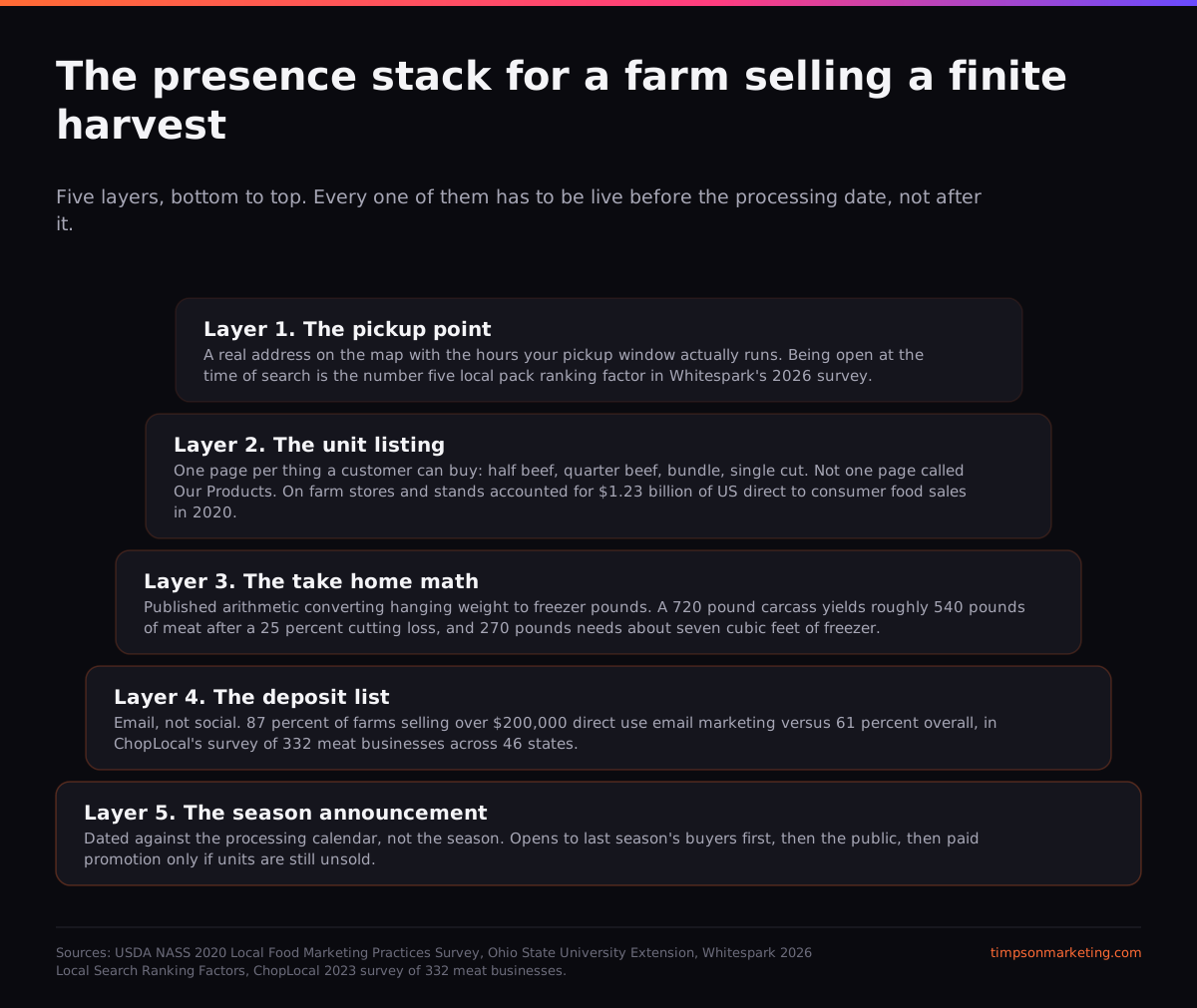
Run the arithmetic before you run an ad. Ohio State's worked example starts with a 1,200 pound steer at a 60 percent dressing percentage, which gives a 720 pound carcass and two halves of roughly 360 pounds each. Apply a 25 percent cutting loss and the carcass yields approximately 540 pounds of various meat products, or about 270 pounds per half.
So one animal is two customers, or four, or maybe fifty if you go to retail cuts. That is the entire demand target. Ranking nationally for a farm term does nothing for you. You need four households inside a 45 minute drive, and you need them before a date on a calendar. That constraint is the whole reason farm and food marketing does not look like ecommerce marketing.
Mississippi State University Extension supplies the two numbers that actually close the sale. Its Direct Marketing Beef publication tells producers to expect about 25 percent waste, 25 percent ground beef and stew meat, 25 percent steaks, and 25 percent roasts from a carcass, and that one cubic foot of freezer space stores approximately 35 to 40 pounds of cut and wrapped meat. A 270 pound half therefore needs about seven cubic feet of freezer.
Put that number on the product page. Here is why.
A Kansas State University team surveyed 43 producers and 174 consumers who buy beef direct, publishing the results in Translational Animal Science. They found that quantity of product (41.7%), lack of freezer space (25%) and price (24.9%) were the largest barriers to consumer participation. Price came third. The thing standing between you and a sold half beef is usually a chest freezer, not a dollar figure.
The consumer often overestimates the quantity of meat products he or she should be taking home.
Which means the highest converting asset you can publish is not your family story. It is a photograph of 270 pounds of wrapped meat sitting inside a seven cubic foot freezer, with the price per pound of what is actually in that freezer printed beside it.
Build the calendar backward from the kill date
Lock the date
Book processing 6 to 12 months out and treat that date as the campaign deadline, not as the harvest.
T minus 120 days
Publish the unit count. Two halves, four quarters, the exact pickup window and the exact pickup address.
T minus 90 days
Email last season's buyers first, with a deposit link, before anyone else sees availability.
T minus 60 days
Open it publicly. A Google Business Profile post, local groups, and a page that names the month and the town.
T minus 45 days
Run the freezer space and take home weight explainer. This is where undecided buyers convert or leave.
T minus 14 days
Cut sheet conversations, deposit balances collected, and a confirmed pickup slot against every single unit.
T plus 7 days
Ask for the review while the freezer is full, then take the deposit for next season.
The last two steps get skipped most often and compound the hardest. A customer who has just filled a freezer is at peak satisfaction, and BrightLocal's 2026 consumer survey found that 83% of people who were asked to leave a review went on to leave one. Ask in week one or do not bother.
One caution on timing. Search visibility does not move on your processing calendar, so the site work has to start seasons ahead of the animals. We put honest timelines in how long local SEO takes.
Sell to last season's list before you sell to strangers
ChopLocal, a marketplace for farms and butcher shops, surveyed 332 meat businesses across 46 states in 2023. Among farms selling more than $200,000 direct, 87% used email marketing, compared to 61% overall, and producers with an online store averaged $104,715 in sales, 41% higher than those without one. That is vendor conducted research from a company that sells farms a storefront, so treat it as directional. The gap between 87 and 61 is still wide enough to be worth acting on.
The Kansas State survey shows the mechanism. Producers advertised mostly through word of mouth (91.3%) and social media (65.8%). But when consumers were asked how they actually located a producer, the answers were personal recommendation (36.2%), other marketplaces (28.5%), social media (23.9%), and stand alone websites (2.5%).
Two and a half percent. That number gets misread constantly. It does not mean your website is worthless. It means a farm website is not a discovery channel, it is the conversion channel. Word of mouth starts the sale and the site has to finish it with a price, a unit count, a pickup date and a deposit button. Confusing those two jobs is why so many farm sites read like brochures instead of order forms.
The same paper found the one fix both sides agreed on: consumer testimonials would be the most beneficial in improving producer/consumer interactions, with educational materials from government sources rated least beneficial. Your customers' words outrank the extension PDF, including the ones cited in this article.
The number of reviews you've gotten this month matters more than your total number of reviews.
That matters mechanically for a seasonal business. Sterling Sky's analysis of 8,186 businesses across 200 cities found the number of reviews received in the current month correlates with local pack ranking more strongly than lifetime review count. So stagger review requests across your pickup weeks instead of blasting every buyer the same afternoon. The full process is in our guide to getting more Google reviews.
The pickup window is a ranking factor nobody told you about
Your farm store hours are a marketing asset, not an operations detail. In Whitespark's 2026 Local Search Ranking Factors survey, 47 local search experts scored 187 factors, and business is open at time of search landed at number five in the local pack with a score of 189, ahead of high star ratings.
You can watch it happen in real time. When your business is open you can be sitting pretty at #1 in the local results, and then 60 minutes before you close you'll start to drop off, and then when you're actually closed you'll be displaced by businesses that are open.
Now read that against a farm store open Saturdays from nine to one. That is four hours out of 168. For the other 164 you are structurally demoted in Maps in favor of anybody who is open. The fix is not more posts. It is a wider or more honest pickup window, entered correctly, plus special hours loaded for the weeks around your processing date.
Two more mechanical points that farms get wrong. First, if you have a real pickup address, publish it. Sterling Sky's 8,186 business analysis found that being configured as a service area business, which hides the address, correlated negatively with local pack rankings. Second, Google's own guidelines state that your overall service area should not extend farther than about two hours of driving time from where the business is based, which happens to match how farms already operate. USDA found that approximately 78 percent of farms selling food directly sold all of it within a 100 mile radius.
Category choice does the rest. Whitespark's panel scored primary category as the single highest local pack factor at 227 points. Choosing Butcher Shop versus Farm versus Meat Products Store changes which searches you appear in, and it takes five minutes. We walk through the decision in choosing Google Business Profile categories and the broader mechanics in ranking higher on Google Maps. If you also sell at three farmers markets, each recurring pickup point deserves its own page, which is covered in location pages for local SEO.
BrightLocal's 2026 study of 1,227 US local searchers found the top deciding factors were clear and complete information such as hours, address and phone (32%), the most or best reviews (30%), and clear pricing or a deal (29%), and that 72% look at three or fewer businesses before deciding. Hours and price beat storytelling, every time.
We build the season around the processing date instead of around a content calendar. If you have units to move and a date already booked, that is the work.
See how we market farms and food businesses→Price the thing they take home, not the thing that hangs
Customers compare your price to the grocery shelf. If you quote hanging weight, you are handing them two different denominators and you will lose the comparison.
| Hanging weight | Take home meat | |
|---|---|---|
| What it measures | The carcass on the rail | What ends up in the freezer |
| Example half beef | About 360 pounds | About 270 pounds |
| Cost in the Ohio State example | $616.50 | $616.50 |
| Effective price per pound | $1.71 | $2.28 |
| What it gets compared to | Nothing on any shelf | The per pound price on the shelf |
Those figures come straight from Ohio State's break even example for a half carcass, which lands at approximately $2.28 per pound of actual meat. Publish the second column. University of Missouri Extension's January 2026 revision of its direct marketing guide shows the same shape in gross returns per pound of live weight: $2.38 selling live, $2.78 as halves, $2.93 as quarters and $4.69 as retail cuts, against slaughter and processing costs of $800 to $900 per animal.
That guide also names the constraint nobody markets around: producers must manage inventory and pricing in such a way that both the fast and slow moving cuts are sold so as to clear storage space for the next animal processed. Your marketing problem is not steaks. It is shanks and soup bones, and it is the reason bundles exist.
The complaint data closes the argument. In the Kansas State survey, more than 40% of producers reported experiencing customer complaints, with 50% citing take home weight or pricing concerns as the primary issue. That is a content problem you can solve before it happens, on one page, with a photograph and a calculator.
Prove the label claim or stop making it
Grass fed, pasture raised and no antibiotics are what every competitor within 50 miles also writes. The differentiator is not the claim. It is the proof behind it.
USDA's Food Safety and Inspection Service ran an exploratory sampling project on cattle carrying raised without antibiotics claims and reported that residues were found in 37 of 189 sampled cattle, equal to 20 percent of the animals sampled, drawn from 79 slaughter establishments across 34 states. FSIS responded by strongly encouraging third party certification and routine pre slaughter testing. Note the scope carefully: that was a targeted exploratory study, not a survey of retail shelves, so do not repeat it as 20 percent of antibiotic free meat.
Here is the marketing read, which the ag content field does not make. That finding converts third party certification from an operations cost into the only defensible claim available in your category. If you hold a certification and the farm down the road uses the same three adjectives without one, say so on the page, name the certifier and link the certificate. That is a moat you can actually buy.
Do not manufacture the other kind of proof. The FTC's rule on consumer reviews and testimonials took effect on October 21, 2024 and reaches businesses that write, buy or suppress reviews, with civil penalties for knowing violations. When a bad review lands, answer it in public. The script is in responding to a bad Google review.
What AI search changes for a farm, and what it does not
45 percent of consumers now use ChatGPT or a similar tool for local business recommendations, up from 6 percent a year earlier, according to BrightLocal's 2026 AI research. That sounds like a reason to drop everything. The counterweight: SOCi's 2026 index of 2,751 multi location brands found only 1.2% of locations were recommended by ChatGPT, against 35.9% appearing in Google's local 3 pack. AI is now a real discovery surface and still a small one.
The useful signal is where AI visibility comes from. In the first AI Search Visibility column of Whitespark's 2026 report, the top scoring factor was presence on expert curated best of lists at 179 points. For a farm that means the county food guide, the state grown directory, the extension local meat list, the regional food hub page and the two food writers who publish where to buy local beef near your town. Those are the pages a model reads about you, and your own site is not enough on its own. Longer version in why AI does not recommend your business and whether customers really use ChatGPT to find local businesses.
If you run the butcher shop instead of the herd
Same constraint, inverted. Your finite unit is not an animal, it is a slot on the kill floor, and your calendar is the product. Publish your available processing dates the way a clinic publishes appointments, because the farmers hunting for a slot are the highest intent audience you will ever have and they are searching right now. The same finite inventory logic drives our self storage marketing playbook, where the unit count is the campaign.
We sell our products via culture.
The policy weather is moving your way, and that is a local news hook. In June 2026 the Virginia Farm Bureau reported a USDA small processor plan paired with $60 million in additional funding for the Meat and Poultry Processing Expansion Program.
Why are we shipping these beautiful beef cattle from Virginia all the way to the middle of the country to get processed?
A processor that gets quoted in the county paper about local capacity ends up on exactly the kind of third party page that both Google and AI models read. Pitching that story is cheaper than any ad you will run this year.
Start here if you have one animal and eight weeks
The scale of this market is smaller and more local than the headlines suggest. USDA counted 116,617 farms selling directly to consumers in 2022 with $3.3 billion in sales, which is roughly $28,000 per farm, and the number of farms selling direct fell 10.3 percent from 2017 even as total direct marketing sales rose 25 percent after inflation to $17.5 billion. Fewer farms, each selling more. The ones still standing are the ones that treat the season as a deadline.
- Confirm the exact processing date and the exact number of units you have to sell.
- Publish one page per unit type with price, take home pounds and pickup address.
- Add the freezer space number and a photo of the real quantity of wrapped meat.
- Email last season's buyers with a deposit link before anyone else sees availability.
- Fix the Google Business Profile category, address and pickup hours.
- Announce with a month and a town name, never with a season.
- Ask every buyer for a review in the week after pickup.
- Take next season's deposit at the pickup table.
None of that requires a rebrand or a content calendar. It requires treating the processing date as the deadline it already is. If you want the season built around it, that is what our agriculture marketing work does, and the rest of the Timpson Marketing blog covers the local search mechanics underneath it.
Frequently asked questions
When should I start marketing a beef share?
Start 120 days before the processing date, not before the season. Under custom exempt rules the buyer has to own the share before slaughter, so the sale must close while the animal is alive. Book processing 6 to 12 months out and count backward from that date.
How much meat do you actually get from a half beef?
About 270 pounds. Ohio State University Extension's example runs a 1,200 pound steer at a 60 percent dressing percentage to a 720 pound carcass, then applies a 25 percent cutting loss to reach roughly 540 pounds of meat, split into two halves of about 270 pounds each.
How much freezer space does a half beef need?
Roughly seven cubic feet. Mississippi State University Extension estimates that one cubic foot of freezer space holds approximately 35 to 40 pounds of cut and wrapped meat, so a 270 pound half needs about seven. Publish that number, because freezer space is the second biggest buyer objection.
Should I sell halves or individual cuts?
Halves clear inventory faster, cuts earn more per pound. University of Missouri Extension estimates gross returns of about $2.78 per pound of live weight for halves versus $4.69 for retail cuts. Retail cuts require inspected processing and leave you holding the slow moving cuts.
Can I sell beef by the cut from my own farm?
Only if the animal was processed under state or federal inspection. Meat from a custom exempt plant may not be sold or donated, per the National Agricultural Law Center. Custom exempt lets you sell shares of the live animal, which is a different transaction with a different deadline.
Do I need a website if most of my customers come from word of mouth?
Yes, but not for discovery. In a Kansas State University survey, only 2.5 percent of direct beef buyers found their producer through a stand alone website. The site closes the sale that word of mouth started, so it needs a price, a unit count, a pickup date and a deposit button.
How far will customers drive to pick up a farm order?
Not far. USDA found that approximately 78 percent of farms selling food directly sold all of it within a 100 mile radius. Google's own guidelines also cap a service area at about two hours of driving time, so set your radius to match how customers actually behave.
Why do my farm store hours matter for Google rankings?
Because being open at the time of search is the number five local pack ranking factor in Whitespark's 2026 survey of 47 local search experts, scoring higher than star ratings. A farm store open four hours on Saturday is structurally demoted in Maps for the other 164 hours.
What is the fastest way to get repeat buyers each season?
Take the next deposit at the pickup table. ChopLocal's survey of 332 meat businesses found 87 percent of farms selling over $200,000 direct use email marketing, versus 61 percent overall. Email your prior buyers before you open availability publicly, every single season.
Sources
- USDA National Agricultural Statistics Service. Direct Farm Sales of Food: Results from the 2020 Local Food Marketing Practices Survey (2022-04)
- USDA National Agricultural Statistics Service. USDA releases 2022 Census of Agriculture data (2024-02)
- USDA Economic Research Service. Agricultural Census shows strong growth in direct sales from farms and ranches (2024-03)
- Ohio State University Extension, Department of Animal Sciences. Selling and Pricing Freezer Beef (2020)
- Mississippi State University Extension Service. Direct Marketing Beef, Publication P2563 (2023-09)
- University of Missouri Extension. Evaluating Direct-to-Consumer Marketing Opportunities for Local Beef in Missouri, G204 (2026-01)
- Translational Animal Science (Kansas State University). A survey of Kansas beef producers and consumers who participate in business-to-consumer marketing of beef (2023-11)
- ChopLocal University. 2023 Direct-to-Consumer Meat Sales Survey Results (2024-07)
- Niche Meat Processor Assistance Network, Oregon State University. Meat Regulations for Producers (2022-09)
- National Agricultural Law Center. Custom Exempt Slaughter: The Exception, or the Rule? (2021-11)
- Rural Advancement Foundation International USA. Building the Bridge for Local Livestock Processing (2026-05)
- Virginia Farm Bureau Federation. USDA small processor plan aims to boost local meat capacity (2026-06)
- USDA Food Safety and Inspection Service via GovInfo. Updated FSIS Guideline on Substantiating Animal-Raising or Environment-Related Labeling Claims, 89 FR 73253 (2024-09)
- Federal Trade Commission via GovInfo. Trade Regulation Rule on the Use of Consumer Reviews and Testimonials, 89 FR 68034 (2024-08)
- Whitespark. 2026 Local Search Ranking Factors (2025-11)
- Sterling Sky. What Gets You Ranking for Near Me Searches in 2025 (2025-11)
- BrightLocal. Local Consumer Review Survey 2026 (2026-02)
- BrightLocal. Consumer Search Behavior: How consumers decide (2026-07)
- BrightLocal. Local Consumer Review Survey: AI and trust (2026-03)
- SOCi, reported by Search Engine Land. AI local visibility report 2026 (2026)
- Google Business Profile Help. Guidelines for representing your business on Google (2026-07)
Joseph Timpson has worked in search since 2010 and runs Timpson Marketing out of St. George, Utah. He built The Cited Method, a five stage framework for earning and proving real citations in AI answers, and publishes what does not work alongside what does.
Want this done for you, with the receipts to prove it worked?
One call, no pitch deck. We look at what is actually blocking you and tell you the truth about whether we can help.
Book a free consultation →