Restaurant Local SEO: What a Single Location Controls
Roughly a dozen surfaces are displaying your restaurant right now, and you own about four of them. This is the control map, tier by tier, with the fields that actually move rank and the ones that only move invoices.

- A single restaurant location typically appears on ten to fifteen distinct surfaces, and only three or four are fully editable by the owner.
- Google's own documentation confirms that third-party ordering links can appear on your Business Profile automatically, and that providers have five days to remove one after a request.
- Whitespark's 2026 expert survey scores primary category as the top local pack factor and being open at the time of search as number five, while GBP posting frequency ranks 148th.
- Your menu belongs in HTML, not a PDF. Google classifies PDF as an encoded format needing a parser to extract text, and an exported design file has no text to extract.
- Reviews are the only asset that ranks you on the surface you own, converts on the surfaces you correct, and gets repeated on the surfaces you can only watch.
Search your own restaurant name and count what comes back
Restaurant local SEO is a control problem before it is a ranking problem. About a dozen surfaces are showing your restaurant right now and you fully control three or four of them. Sort every surface into own, correct, or monitor. Fix the owned ones first. Stop paying anyone for work on surfaces nobody can change.
Open a private browser window. Search your restaurant name plus your city. Count the distinct places your business shows up.
A typical single location returns ten to fifteen. The Google Business Profile panel. The Maps card. Your own site. Yelp. TripAdvisor. Apple Maps. Facebook. Two Instagram location tags. DoorDash, Uber Eats, Grubhub. A reservation platform. Two or three aggregator pages you have never heard of. And now an AI answer summarizing all of it.
You own four of those. Maybe five.
That is the actual problem, and almost nothing written about restaurant marketing addresses it. Restaurant advice is about photography and social media. Local search advice is written for businesses that take quote requests, where success is a form fill. A restaurant is neither. The decision happens across surfaces you did not create and cannot delete, and the menu does more ranking and converting work than the homepage ever will.
Google is explicit that some of these surfaces install themselves. Its documentation on local business links states that "Links to certain services can automatically appear on your Business Profile on Google Search and Maps" and that they are "provided and updated by third-party partners or through automated data from Google." You did not sign up for the delivery link sitting on your profile. It arrived.
The three tiers, and why the middle one quietly costs the most
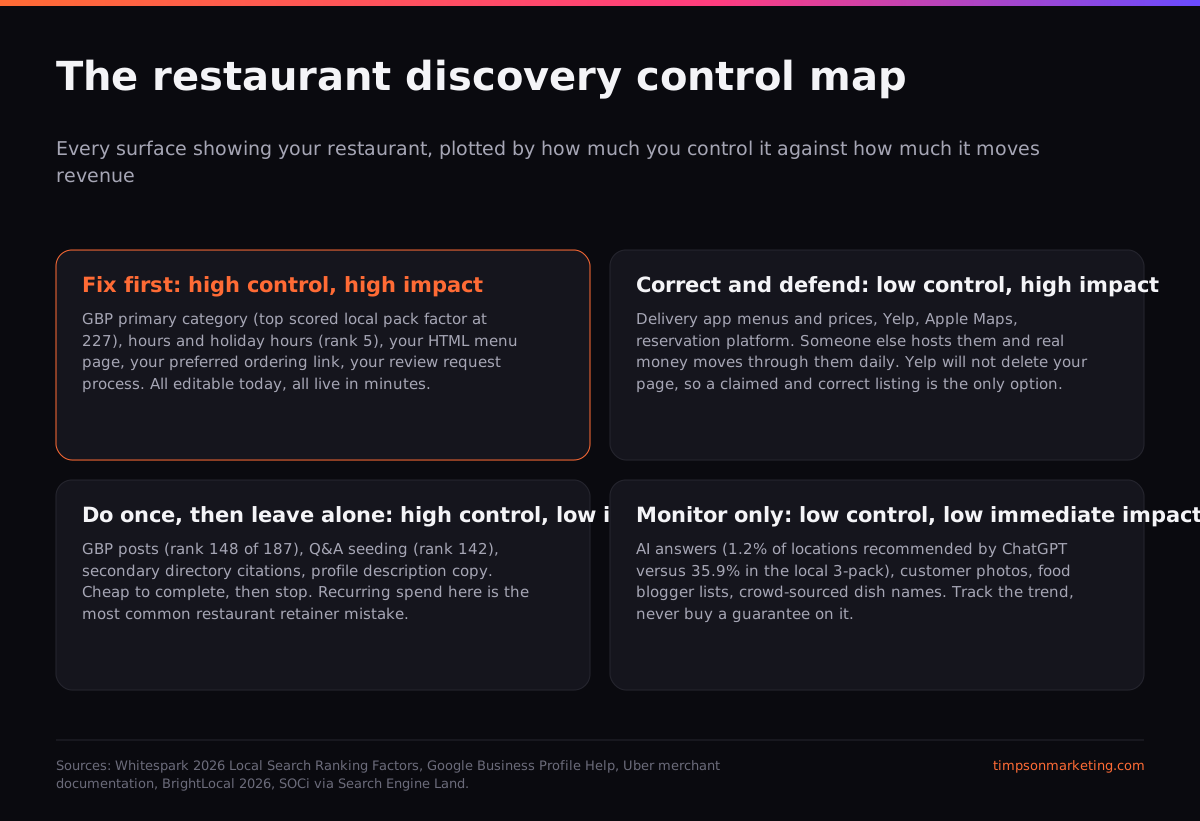
Every surface belongs in one of three buckets. The bucket determines the budget.
| Tier | What it means | Surfaces |
|---|---|---|
| Own | You edit it directly, changes are live in minutes | Google Business Profile fields, your website and menu page, your ordering links, your review request process |
| Correct | Somebody else hosts it, you can claim and fix it | Yelp, delivery app menus and prices, Apple Maps, reservation platform, aggregator citations |
| Monitor | You influence it indirectly, you cannot edit it | AI answers, customer photos, food blogger lists, social mentions, Google's crowd-sourced dish names |
Most restaurant marketing money goes to tier one, where the work is visible, and to tier three, where the pitch is exciting. Tier two is where the money leaks, because nobody owns it. A stale price on a delivery app is not a marketing problem. It is a live pricing decision made by whoever last touched that menu, and in most restaurants that person no longer works there.
Tier one: the fields you own, ranked by what the evidence actually says
Whitespark's 2026 Local Search Ranking Factors report asked 47 local search practitioners to score 187 factors from zero to five. The results are a survey of expert opinion, not a leaked algorithm, and the author says so himself. They are still the best-organized public ranking of what to touch first.
Four numbers from that report matter more to a restaurant than anything else in it:
- Primary Google Business Profile category scored 227, the single highest local pack factor, ahead of proximity of the address to the searcher at 225.
- Business is open at the time of search scored 189 at rank five, ahead of your star rating.
- Photo recency ranked 89th and photo quantity 96th.
- Posting frequency ranked 148th and post quantity 168th, out of 187.
You can watch it happen in real time. When your business is open you can be sitting pretty at #1 in the local results, and then 60 minutes before you close you'll start to drop off, and then when you're actually closed you'll be displaced by businesses that are open.
For a restaurant, that factor is not an SEO setting. It is a schedule. Kitchen closes thirty minutes before the door. Patio season changes hours twice a year. Holiday hours are a separate field that most profiles never fill in. Every one of those is a visibility event.
On categories, Google's guidelines for representing your business tell owners to "Use as few categories as possible to describe your overall core business from the provided list" and to pick categories that complete the sentence "This business IS a" rather than "this business HAS a." A brewpub that serves food is a brewpub. We work through the tradeoffs in our post on picking the right GBP categories.
Here is the uncomfortable synthesis. If your agency's monthly restaurant deliverable is four Google posts and a photo dump, they are billing you for factor 148 while factor 5 sits wrong on your profile. That is not a small misallocation. It is the whole retainer pointed at the bottom of the list.
Your menu is a page, not a download
Google's local business structured data documentation lists a menu property as a recommended field: "For food establishments, the fully-qualified URL of the menu."
A PDF satisfies that literally and fails everything downstream. Google's indexable file types documentation classifies PDF as an encoded file type, meaning "binary files or complex containers that require a specific parser to extract the human-readable text." A menu that your designer exported as artwork has no human readable text inside it to parse. Every dish name, price and allergen note is invisible.
Dish names are not a small prize. Google built a product on them. Its help page on popular dishes says "Both you and your customers can add photos and names of dishes" and that "dish names added by you will get precedence over dish names added by customers." That is a rare, explicit statement that the owner outranks the crowd on a specific field, and almost no independent restaurant uses it.
Go further than the sources do. Your dish names are the only keyword set no competitor in your city shares. Nobody sells a rank tracking package for "green chile smashburger." There is no difficulty score. And a plain HTML menu page carrying dish names, short descriptions, prices and dietary tags does three jobs at once: it is the conversion asset a hungry person actually reads, the keyword asset that matches long-tail dish searches, and the machine readable fact sheet an AI system needs to answer "who has gluten free pasta near me." Nothing else on a restaurant website does all three. If you want the markup layer on top, we cover when it earns its keep in is schema markup worth it.
Tier two: correct it, because you will never own it
Yelp. You cannot delete your page. Yelp's own support documentation states that "Yelp publishes business information so that consumers can share their experiences about local businesses, and because the information is typically a matter of public record and public concern. Therefore we don't remove such information from the site." The only two options are a claimed page that is correct, or an unclaimed page that is wrong. Claiming takes about an hour.
Delivery apps. This is the expensive one. DoorDash publishes its partnership plan pricing openly: 15% delivery commission on Basic, 25% on Plus, 30% on Premier, with 6% pickup commission on all three. That is the visible cost of the channel. The invisible cost is a neglected menu. Uber's merchant help page on the menu markup metric reports that "Almost half of delivery app users that responded say they often or always compare in-store restaurant prices to those listed on the apps," that "If users notice menu markups, only ~22% say they would complete their order through the app," and that "The average customer considers a markup of around 10% to be reasonable."
Read that as an operations instruction rather than a statistic. Your delivery menu is a second price list published under your name, and roughly half the people looking at it are checking it against your first one. If it is two price increases behind, you are not protecting margin. You are losing carts.
Ordering links on Google. Google stopped processing food orders itself and now tells diners "To browse the menu and place your order, you'll be redirected to the provider's website." Which provider that is happens to be your decision. Google's online ordering documentation says third-party providers "who state they have authorized relationships with your business are automatically listed on your profile," and that "For pickup and delivery, you can mark third-party order options and links as preferred." The local business links page adds the enforcement detail: "Providers need to remove third-party links from your profile within 5 days of receiving a removal request."
So the routing is yours to set. Mark your own commission-free ordering link as preferred and every order that follows it keeps its own margin. Most independents have never opened that screen.
Apple Maps. Apple Business Connect is free. Apple describes it as "a free tool that allows businesses of all sizes to claim their location place cards" and says businesses can invite "customers to take actions like ordering food or making a reservation directly from Maps." Every iPhone user who taps a map link lands there, and the listing exists whether or not you claim it.
We created Business Connect to provide Apple users around the world with the most accurate information for places to eat, shop, travel, and more.
Rank tier two work by how many dollars flow through each surface, not by how much SEO advice exists about it. Delivery menus first, because that is where real money moves daily. Yelp second. Apple third. Nearly every published restaurant SEO checklist inverts that order, because citations are easy to sell in bulk and menu audits are not.
## Tier three: watch it, do not buy it AI answers are the newest surface on the list and the least controllable. They are also the most oversold. SOCi's 2026 Local Visibility Index, reported by Search Engine Land, analyzed nearly 350,000 locations across 2,751 multi-location brands and found only 1.2% of locations recommended by ChatGPT, 11% by Gemini and 7.4% by Perplexity, against 35.9% appearing in Google's local 3-pack. Search Engine Land puts the gap at three to thirty times harder to earn than a local pack slot, depending on the engine. The demand side says take it seriously anyway. BrightLocal's AI trust research found 45% of consumers have used AI tools to find local business recommendations, up from 6% a year earlier. But its channels research found only 18% felt ready to contact the business an AI tool recommended, and 43% of the people who started on AI went on to check Google anyway.
See how we run local search→What's incredibly clear is that businesses that operate with a 'Google-only' mindset are at high risk of missing out on customers and revenue.
The practical move on tier three is upstream, not direct. AI systems largely repeat what the reviewed, structured, well-cited surfaces already say about you. Fix tiers one and two and tier three tends to drift your way. When it does not, the failure is usually a stale fact rather than a missing tactic, which we walk through in what to do when ChatGPT has wrong information about your business.
Reviews move all three tiers at once
The only causal estimate of what reviews are worth to a restaurant is still Michael Luca's Harvard Business School working paper, Reviews, Reputation, and Revenue: The Case of Yelp.com. Using Washington State Department of Revenue restaurant data and a regression discontinuity design built on Yelp's rounding thresholds, he found that a one star increase in Yelp rating leads to a 5 to 9 percent increase in revenue, and that ratings do not affect restaurants with chain affiliation. The paper is old, so treat the magnitude as directional. The direction has never been contradicted, and the independent-only finding is the part that matters if you run one location.
That last number is the one restaurant owners underrate. The bottleneck is the ask, not the willingness. Sterling Sky's study of 8,186 businesses across 200 cities found that reviews received in the current month correlate with local pack ranking more strongly than lifetime review count does. Reviews are a flow, not a balance.
If you have a business profile that ranks really well, even if you don't see a drop in ranking, your calls from the business profile are going down over time.
One hard boundary. Google's fake engagement policy prohibits offering "incentives - such as payment, discounts, free goods and/or services - in exchange for posting any review or revision or removal of a negative review." A free dessert for a five star review is a policy violation, and the enforcement includes a public banner on your profile telling diners fake reviews were removed. That banner costs more than the reviews were worth.
Here is why reviews sit at the top of the whole map. They raise rank on the surface you own, they close the sale on the surfaces you can only correct, and they are the raw material the surfaces you can only monitor are summarizing. Nothing else in restaurant marketing touches all three tiers. Our full process is in how to get more Google reviews, and the harder half is in how to respond to a bad Google review.
The first 30 days, in order
Day 1, build the inventory
Search your name plus city in a private window. List every surface that appears. Mark each one own, correct, or monitor. This list is the actual deliverable, and almost no restaurant has one.
Day 2, fix the owned fields
Primary category, all hours including holiday hours, dine-in and takeout and delivery attributes, phone, and the menu link. These are the highest scored factors and they take an afternoon.
Week 1, build the menu page
Move the menu out of the PDF and into HTML with dish names, descriptions, prices and dietary tags as real text. Keep the PDF for printing if you like. Stop linking to it as the menu.
Week 2, audit the delivery menus
Open every app you are on. Compare item by item against today's in-house prices. Fix the gaps, then set your own direct ordering link as preferred on Google.
Week 3, claim what you do not own
Yelp, Apple Business Connect, Bing Places, your reservation platform, TripAdvisor if you get tourist traffic. Same name, same address, same phone, same hours everywhere.
Week 4, start the review engine
A written ask at a fixed moment in service, every shift, forever. No incentives. Respond to everything within a week.
- Hours are correct, including any upcoming holiday
- Delivery app prices match the in-house menu
- New dishes are on the HTML menu page and on the profile
- Every review from the last 30 days has a response
- At least one new review landed in the last two weeks
- No new third-party ordering link appeared on the profile uninvited
The pattern behind all of this is simple and it is not a growth hack. Discovery for a restaurant is distributed across a dozen places, and the winner is usually the operator whose facts agree with themselves everywhere. Timelines and what to expect are in how long local SEO takes, and if you already pay someone for this work, how to tell if your SEO agency is working will tell you whether the control map is being maintained or just reported on. The same structure applies to other verticals where the customer never fills out a form, which we cover in self storage marketing. More of these playbooks live on the Timpson Marketing blog.
The restaurant industry is not short of demand. The National Restaurant Association projects $1.55 trillion in sales for 2026 across more than a million outlets, alongside 42% of operators reporting their restaurant was not profitable in the previous year. Visibility is not the scarce thing. Agreement between your surfaces is.
Restaurants remain an economic powerhouse that, even when faced with soft consumer spending and sustained margin pressures, drives job growth and fosters entrepreneurship.
If you want help running this, our local search and GEO services start with exactly the inventory above, because there is no point optimizing a surface until you know who is allowed to change it.
Frequently asked questions
How many places online show my restaurant that I do not control?
Usually eight to eleven. Yelp, TripAdvisor, Apple Maps, Bing, Facebook, two or three delivery apps, a reservation platform, aggregator directories and AI answers. Most can be claimed and corrected. Yelp states it does not remove business pages on request, so correcting is the only option there.
Should my restaurant menu be a PDF or a web page?
A web page. Google classifies PDF as an encoded file type that needs a parser to pull out readable text, and a menu exported as artwork has no text to pull. HTML dish names, descriptions and prices are readable by search engines and AI systems. Keep the PDF for printing only.
What is the single highest impact field on a restaurant Google Business Profile?
Primary category, according to Whitespark's 2026 survey of 47 local search experts, which scored it 227 and ranked it above proximity to the searcher. Being open at the time of search ranked fifth at 189, above your star rating, which makes accurate hours a close second.
Do Google Business Profile posts help a restaurant rank?
Barely. Whitespark's 2026 report ranks posting frequency 148th and post quantity 168th out of 187 local pack factors. Posts can still communicate a special or a closure to people already looking at your profile. They are a communication tool, not a ranking lever.
Why are my prices different on DoorDash than in the restaurant?
Because you set them there, usually once, and never revisited them. Uber's merchant documentation reports that almost half of delivery app users compare app prices to in-store prices, and that when a markup is noticed only about 22% say they would complete the order.
Does my restaurant show up in ChatGPT recommendations?
Probably not yet. SOCi's 2026 index found only 1.2% of locations across 2,751 multi-location brands were recommended by ChatGPT, against 35.9% appearing in Google's local 3-pack. Fix your facts on Google, Yelp and your own menu page first, because AI answers largely repeat those.
How many Google reviews does a restaurant need?
Twenty is the practical floor. BrightLocal's 2026 survey found 47% of consumers will not use a business with fewer than 20 reviews and 74% look for reviews written in the last three months. Recent flow matters more than a large lifetime total that stopped growing.
Can I offer a free dessert for a Google review?
No. Google's fake engagement policy prohibits incentives including payment, discounts and free goods or services in exchange for a review. Enforcement can include unpublishing your reviews and displaying a public warning on your profile telling diners that fake reviews were removed.
Is Apple Maps worth claiming for a restaurant?
Yes, and it is free. Apple Business Connect lets you claim your place card and control hours, photos, ordering and reservation actions across Apple Maps, Siri and Wallet. Every iPhone user who taps a map link sees that card, claimed or not.
How do I stop a delivery app link from appearing on my Google profile?
Request removal through your Business Profile. Google's documentation states that providers need to remove third-party links within 5 days of receiving a removal request, and that you can report the provider if they miss it. You can also mark your own ordering link as preferred so it appears first regardless.
Sources
- Google Business Profile Help. Manage your local business links (2026-07)
- Google Business Profile Help. Manage online ordering options (2026-07)
- Google Business Profile Help. Find and edit popular dishes for restaurants (2026-07)
- Google Business Profile Help. Guidelines for representing your business on Google (2026-07)
- Google Business Profile Help. Prohibited and restricted content: fake engagement (2026-07)
- Google Business Profile Help. Business Profile restrictions for policy violations (2026-07)
- Google Search Central. Local business structured data (2026-07)
- Google Search Central. File types indexable by Google (2026-07)
- Google Search Help. Discover food ordering with Google (2026-07)
- Whitespark. Local Search Ranking Factors 2026 (2025-11)
- Sterling Sky. What gets you ranking for near me searches, 8,186 business study (2025-11)
- Sterling Sky. The State of Local SEO in 2026 (2026-06)
- BrightLocal. Local Consumer Review Survey 2026 (2026-02)
- BrightLocal. Consumer trust in AI for local business recommendations (2026-03)
- BrightLocal. Consumer search behavior: channels (2026-07)
- Yelp Support Center. Can I remove my business page from Yelp? (2026-07)
- DoorDash Merchants. DoorDash Marketplace partnership plan pricing (2026-07)
- Uber Merchants and Restaurants Help. How is the Menu Markup metric calculated (2026-07)
- Apple Newsroom. Introducing Apple Business Connect (2023-01)
- Harvard Business School working paper 12-016 (Michael Luca). Reviews, Reputation, and Revenue: The Case of Yelp.com (2011-09)
- National Restaurant Association. Persistent cost increases and enduring demand will shape the restaurant industry in 2026 (2026-02)
- Search Engine Land. AI local visibility report 2026 (SOCi Local Visibility Index) (2026)
Joseph Timpson has worked in search since 2010 and runs Timpson Marketing out of St. George, Utah. He built The Cited Method, a five stage framework for earning and proving real citations in AI answers, and publishes what does not work alongside what does.
Want this done for you, with the receipts to prove it worked?
One call, no pitch deck. We look at what is actually blocking you and tell you the truth about whether we can help.
Book a free consultation →