Self Storage Marketing: How Facilities Get Found and Filled
Occupancy is one number on your report and at least five different marketing problems on your property. Full tiers and empty tiers need opposite tactics and opposite prices.

- Demand in self storage is unit size specific, so one facility should be running several campaigns at once, not one.
- A full tier is a pricing problem and an empty tier is a demand problem. Discounting a full 5x5 row and advertising an empty 10x20 row both lose money.
- About 70 percent of self storage customers rent online at a discounted rate, which means your public price, not your brochure, is doing most of the selling.
- The map pack is where storage searches get decided, and the two levers that move it most are your primary Google category and how many reviews you got this month.
- Build one page per unit size with live availability and a real price. City pages with no inventory on them do not rent units.
Occupancy is an average, and the average is hiding your money
Seventy-one percent occupancy tells you almost nothing you can act on. Eleven 10x20 units sit empty while people call every week asking for a 5x5 you do not have. That is not one marketing problem. That is one sold out tier that should be priced up and one dead tier that needs demand created, at the same time, on the same property.
Every marketing guide you have read treats the facility as the unit of demand. It is not. The unit of demand is the unit size.
The gap you are trying to close is real and it is measurable. Matthews' H1 2026 market update puts REIT portfolio occupancy between 84 and 93 percent while private and CMBS assets average around 82 percent. The REITs are not better at storage than you are. They are better at running each unit tier as its own business.
Self storage marketing works when you stop marketing the facility and start marketing each unit tier on its own. Demand, price and the right next move all change by size. Full tiers get a rate increase. Empty tiers get a demand campaign. A single occupancy number cannot tell you which one you are looking at.
Why the marketing advice written for your industry does not work
We read the pages that currently rank for self storage marketing before writing this. The result was worse than expected.
The Inside Self-Storage best practices page is a landing page for an e-book published in June 2009, and its topic list still includes Yellow Pages. Storable's self storage marketing guide runs six sections on occupancy, pricing and tenant experience and contains no statistics at all and no mention of watching competitor rates. Several agency pages ranking on the first page state that 70 percent of storage searches are "storage near me" and that 73 percent of storage searches end in a map pack click. Neither figure traces to any study we could find. We are not repeating them.
That is the real content gap. It is not that the advice is thin. It is that the advice is a home services template with the word storage swapped in, and it ignores the two things that make this business structurally different.
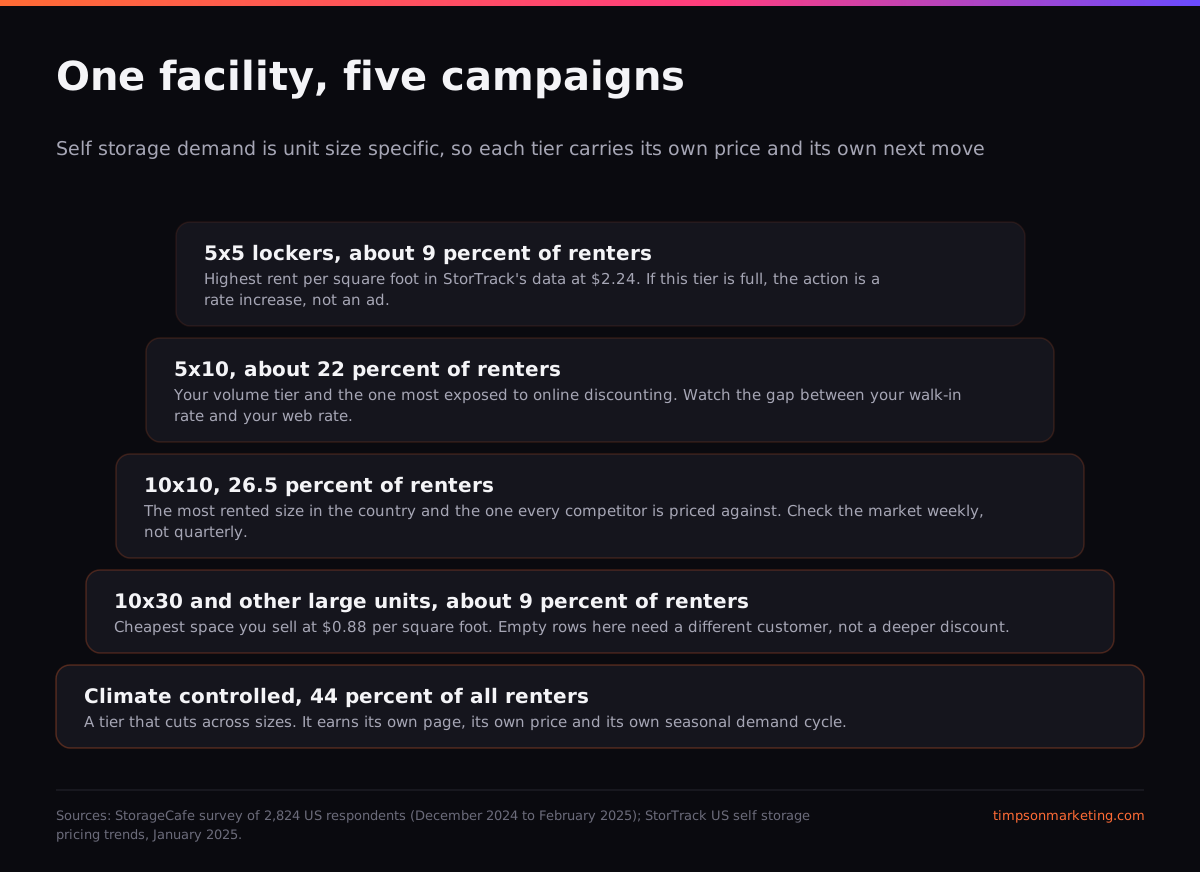
One: demand is unit size specific, not business wide. A plumber sells one thing to everybody who needs a plumber. You sell six or eight different products with different customers, different price points and different seasonality, out of the same building, under one brand. Nationally, StorageCafe's survey of 2,824 US respondents found 26.5 percent of renters in a 10x10, nearly 22 percent in a 5x10, and roughly 9 percent each in a 10x30 and a 5x5. Your building's mix will not match that. The gap between the two is the whole strategy.
Two: your price is public and permanently comparable. A homeowner cannot see what your competitor charged the last customer for a water heater. Anyone can see what the facility down the road charges for a 10x10 right now, on their phone, in about nine seconds. Rate is not a back office decision in this business. It is the ad.
Rule one: one facility, several campaigns
Start by throwing away the single occupancy figure and rebuilding it as a table: unit size, units total, units vacant, current street rate, rate per square foot, and move-ins in the last 30 days. That table, not the headline percentage, is your marketing plan.
A district manager who prices facilities for a living put it plainly.
Next, price at the unit level, not the building level.
Fincher's pricing playbook also gives the decision rule: "Let vacancy drive the decision. If it's high, get aggressive and compete." We would extend that one step further, because she is describing a pricing action and most owners reach for a marketing action instead. Vacancy in a tier tells you which lever to pull, and the two levers are not interchangeable.
Here is the split we use.
| Tier state | Wrong move | Right move |
|---|---|---|
| 95 to 100 percent full | Keep advertising it | Raise the street rate and stop paying for clicks on it |
| 80 to 95 percent full | Discount to "be safe" | Hold rate, keep the page live, watch weekly |
| 50 to 80 percent full | Run a facility wide promo | Run a size specific offer with the size in the ad copy |
| Under 50 percent full | Cut the price again | Find a different customer for the space |
That last row is where most facilities bleed. Eleven empty 10x20s are not a price problem. Large units are already the cheapest space you sell. StorTrack's pricing data shows 5x5 units at $2.24 per square foot against $0.88 for a 10x30, so cutting the rate on a big unit gives away real dollars for very little demand response. What actually moves large units is a different buyer: contractors storing tools and materials, small ecommerce sellers holding inventory, restaurant and event equipment, seasonal retail overflow, RV and boat owners. Those people do not search "storage units near me." They search for what they are storing.
Rule two: your price is public, so decide what it is saying
The single most useful fact about this industry that almost no marketing article mentions: most of your customers never see the price you tell people at the counter.
On average, about 70% of self-storage customers rent their units online at a discounted rate.
Mellon and Roossien go on to report that in the fourth quarter of 2024, Public Storage's average in-place rate was 74 percent higher than its average move-in rate. The same analysis shows move-in rates falling 33 percent between the second quarter of 2022 and the fourth quarter of 2024 while in-place rates still grew 6 percent. StorTrack's national numbers show the same shape at market level: street rates at $1.38 per square foot against online rates at $1.14.
Read that as a marketing instruction, because that is what it is. The number on your website is an acquisition price, and the money is made after move-in. If you are pricing your website like a price list rather than like a front door, you are competing at a disadvantage against every REIT in your market, and they are the ones setting the comparison shopper's expectations.
Three practical consequences.
- Publish a real, current, bookable price for every size. Hiding it does not protect margin, it removes you from the comparison. BrightLocal's panel of 1,227 recent local searchers found clear pricing or a deal was the deciding factor for 29 percent, just behind complete business information at 32 percent and reviews at 30 percent.
- Check the market at tier level, weekly. Fincher's team reviews street rates weekly. Most independents review them when something feels wrong, which is usually a quarter late.
- Be honest about the increase. Existing customer rate increases are standard practice and they are also the reason this industry gets bad press. If your first bill after move-in is a surprise, you buy a one star review that costs you more than the increase earned. Handle it in writing at move-in, and if it still goes wrong, respond to the review properly.
The local search work that actually fills units
Storage is close range. That makes the map pack, not the blue links, the thing worth winning. The point is made well by the search lead at one of the industry's website vendors.
Self-storage is hyperlocal, and the Google algorithm rewards your Map Pack placement rather than your organic ranking.
He is right about where the attention is. He understates what it takes to get it, so here is the ranked version, using the best evidence available rather than folklore. Google's own documentation says local results come down to relevance, distance and prominence, and states plainly that there is no way to pay for a better local ranking.
Primary category first. In Whitespark's 2026 survey of 47 local search experts scoring 187 factors, the primary Google Business Profile category scored 227, ahead of proximity of address at 225. It is the highest impact factor and one of the few you fully control. Self Storage Facility is usually right. Moving and Storage Service, Warehouse, or RV Storage Facility as a primary is a common and expensive error. We cover the mechanics in how to choose your Google Business Profile categories.
Review velocity second. Sterling Sky analysed 8,186 businesses across 200 cities and found that reviews received in the current month correlate with local pack ranking more strongly than lifetime review count.
The number of reviews you've gotten this month matters more than your total number of reviews.
That is awkward for storage, because your customers move in once and then you rarely see them. The fix is to build the ask into the move-in, not into the move-out, and to a lesser extent into every gate code reset and unit transfer. There is a floor to clear too: BrightLocal's 2026 consumer survey found 47 percent of consumers will not use a business with fewer than 20 reviews, and 74 percent look for reviews written in the last three months. Our full method is in how to get more Google reviews.
Distance you cannot fix, so stop trying. Proximity was the second highest scoring factor in the same Whitespark data, at 225. If a competitor with a thinner profile sits closer to the searcher, they will beat you inside their own few blocks and you will beat them inside yours. That is the mechanic behind a competitor with fewer reviews outranking you, and no amount of content fixes it.
Hours, but the right hours. Whitespark's panel put "business is open at time of search" at number five in the local pack, ahead of star rating.
You can watch it happen in real time. When your business is open you can be sitting pretty at #1 in the local results, and then 60 minutes before you close you'll start to drop off, and then when you're actually closed you'll be displaced by businesses that are open.
Storage has a wrinkle nobody else has: your office hours and your gate hours are different, often by six or eight hours. If your profile shows the office hours, you go invisible at exactly the time people search from their driveway with a loaded truck. Post the hours a customer can actually access the property, and add the office hours as a separate line in the description.
One more thing worth knowing. Sterling Sky's 2026 analysis of 322 markets found Google's AI powered local packs surfaced 5,943 unique businesses against 18,330 in traditional 3-packs, roughly a third as many winners. The set of businesses that get shown at all is shrinking. If you want the fuller picture of that shift, start with how local businesses rank in AI Overviews and how to rank higher on Google Maps.
## Build pages by unit size, not by city The standard agency deliverable for a storage client is a stack of city pages. It is the wrong architecture, and it is copied from home services, where a plumber genuinely serves ten towns. You serve a radius, and inside that radius you sell sizes. Whitespark's panel scored a dedicated page for each service as the top local organic ranking factor at 210, ahead of geographic keyword relevance at 190. Translate service to unit size and the answer falls out. Build one page per size and per major feature, so: 5x5, 5x10, 10x10, 10x15, 10x20, 10x30, climate controlled, drive up, RV and boat, business storage. Climate control is worth its own set, since StorageCafe found 44 percent of renters choose it. Each of those pages needs four things a city page never has: the live count of units available, the actual current price, what physically fits in that size, and a booking button that completes without a phone call. A page that says "we have 10x10 units" and stops is a brochure. A page that says "three 10x10 drive up units available, $118 first month, reserve now" is inventory. Build it for a phone held in one hand. BrightLocal's panel of recent local searchers ran 73 percent of their searches on a mobile phone against 19 percent on a computer. Your reservation flow is being used in a parking lot, next to a rented truck, by someone who is already annoyed. If you run more than one property, the city question does become real. That is a different problem, and we cover it in location pages for local SEO and why you cannot rank in another city. ## Measure economic occupancy, not physical occupancy Physical occupancy is the number that makes owners feel good and tells them nothing. Economic occupancy, revenue collected against revenue if every unit rented at street rate, is the number that pays for the roof. Run four numbers monthly, by tier:
See how we run local search for storage→- Move-ins in the last 30 days, split by unit size, not just totalled
- Rate per square foot achieved versus your market's rate for the same size
- Cost per move-in by channel: organic, map pack, paid, aggregator, walk-in
- Economic occupancy per tier, so a full tier at a bad rate stops looking like a win
The channel split matters more than owners expect, because self storage has a marketplace layer most trades do not. Aggregator listings can fill units fast, but you rent that tenant relationship rather than own it, and the commission is charged per move-in. That is a legitimate trade for a lease-up or a dead tier. It is a bad permanent substitute for your own map pack presence, because the aggregator keeps the customer.
StoragePug's Robert Priester makes a related point about reading your own data: if the 10x10 is your most rented size in person but the 5x10 is your most rented size online, that is a real signal about how your site presents inventory versus how your manager sells it. Most facilities never look, because the report they read is a single occupancy percentage.
Two verified figures from our own client work, for shape rather than promise: 2,718 organic visits a month and 472 Google Business Profile calls a month. Different vertical, different market, not from the same engagement, and not a promise of anything. It is here to show the shape of the number, not to suggest it is typical. If you want a straight answer on how to judge whether the work is landing, read how to tell if your SEO agency is working. For the two questions every owner asks next, we have written what local SEO costs and how long local SEO takes with real ranges rather than "it depends."
What does not work, and why it keeps getting sold
Honesty is cheaper than churn, so here is what we would not spend your money on.
Blog volume. Fifteen posts about packing tips will not rent a unit. Storage buying is fast and local. BrightLocal found 72 percent of consumers look at three or fewer businesses, most decide inside 30 minutes, and more than a quarter decide in under five. There is no consideration phase to nurture.
Hiding your address as a service area business. Sterling Sky's 8,186 business study found configuring a profile as a service area business, which hides the address, showed a negative correlation with local pack rankings. You have a physical location. Show it.
Google Posts as a ranking lever. Whitespark's panel scored posting frequency at 148th out of 187 factors. Post if it helps you communicate a promotion. Do not buy a retainer built on it.
Discounting a full tier. If your 5x10s are at 97 percent, the market is telling you the price is too low. Raise it.
Supply denial. StorageCafe projects 55.4 million square feet of new self storage delivering in 2026, about 2.6 percent of the existing 2.12 billion square foot inventory, and Yardi Matrix tracks 32,266 completed US facilities plus 2,846 in the development pipeline. In markets where that supply is landing, marketing does not restore 2021 rates. It decides which facility absorbs the softness and which one gets picked.
If you want to see where your own facility currently stands across search and AI answers before spending anything, our free AI visibility audit covers it, and the rest of the full blog goes deeper on the individual levers above.
Frequently asked questions
What is the best way to market a self storage facility?
Market by unit size, not by facility. Build a page and an offer for each size, price each tier against live competitor rates, and win the Google map pack for your radius. Full tiers get a rate increase. Empty tiers get a demand campaign aimed at a different customer.
How do I fill large storage units that stay empty?
Stop discounting them. Large units are already your cheapest space per square foot, so price cuts give away margin without creating demand. Target a different buyer instead: contractors, small ecommerce sellers, event and restaurant equipment, seasonal retail overflow, and RV or boat owners.
Should I show storage unit prices on my website?
Yes, per size, current and bookable. About 70 percent of self storage customers rent online at a discounted rate, so the published price is doing the selling. BrightLocal found clear pricing or an offer was the deciding factor for 29 percent of local buyers.
How do I rank in the map pack for storage units near me?
Set your primary Google category to Self Storage Facility, keep reviews arriving every month, publish the gate hours customers can actually use, and keep your address visible rather than hiding it. Category and current month review count are the two strongest controllable levers.
How many Google reviews does a storage facility need?
Twenty is the floor, not the goal. BrightLocal's 2026 survey found 47 percent of consumers will not use a business with fewer than 20 reviews, and 74 percent look for reviews written in the last three months. Recent reviews outrank total count in Sterling Sky's data.
Do storage listing sites like SpareFoot or StorageCafe help or hurt?
They fill units quickly and they charge per move-in, and the customer relationship stays with the marketplace. That is a reasonable trade during lease-up or on a dead tier. It is a poor permanent substitute for your own map pack visibility, which you keep.
What should I track instead of occupancy?
Track four numbers per unit size: move-ins in the last 30 days, achieved rate per square foot against your market, cost per move-in by channel, and economic occupancy. Economic occupancy stops a full tier at a bad rate from looking like a success.
Should a storage facility run Google Ads?
Only on tiers that are actually vacant, with the unit size in the ad and the landing page. Paying for clicks on a 97 percent full 5x10 row is buying inventory you cannot sell. Pause ad groups by size as tiers fill, then reopen them when vacancy returns.
Sources
- StorageCafe. Self Storage Demand and Trends 2025: 1 in 3 Americans Rent Self Storage (2025)
- Inside Self-Storage (Steve Mellon and Adam Roossien, JLL Capital Markets). The ECRI Evolution: Modern Self-Storage Rate Management and Its Impact on Asset Revenue, Value and Underwriting (2025-06)
- Inside Self-Storage (Larissa Fincher, Atomic Storage Group). Your Street Rates and ECRI Must Work Hand in Hand: My Playbook for Self-Storage Pricing (2026-05)
- Inside Self-Storage (David Austin, StoragePug). Surviving the Squeeze: 4 Ways to Adjust Your Self-Storage Marketing in This Time of Heightened Competition (2025-11)
- StorTrack. Self-Storage U.S. Pricing Trends Update (2025-01)
- StorageCafe. 2026 Self Storage Supply Report: Florida Leads a Strong National Expansion (2026)
- Yardi Matrix. U.S. self storage market steps cautiously into 2026, Yardi Matrix reports (2026-01)
- Matthews Real Estate Investment Services. National Self-Storage Market Update: Current Performance, 2025 Trends, and H1 2026 Outlook (2026)
- Whitespark. Local Search Ranking Factors 2026 (2025-11)
- Sterling Sky. What Gets You Ranking for Near Me Searches in 2025 (2025-11)
- Sterling Sky. The State of Local SEO in 2026 (2026-06)
- BrightLocal. Consumer Search Behavior: How People Decide Which Local Business to Use (2026-07)
- BrightLocal. Local Consumer Review Survey 2026 (2026-02)
- Google Business Profile Help. Improve your local ranking on Google (2026)
- StoragePug (Robert Priester). 5 Metrics to Track for Your Self Storage Website (2025-06)
- Storable. Self-Storage Marketing: New Tenant Growth Strategies (2026)
- Inside Self-Storage. Best Practices for Self-Storage Marketing (2009-06)
- BrightLocal. Consumer Search Behavior: Channels (2026-07)
Joseph Timpson has worked in search since 2010 and runs Timpson Marketing out of St. George, Utah. He built The Cited Method, a five stage framework for earning and proving real citations in AI answers, and publishes what does not work alongside what does.
Want this done for you, with the receipts to prove it worked?
One call, no pitch deck. We look at what is actually blocking you and tell you the truth about whether we can help.
Book a free consultation →