Do Facebook Ads Work for a Home Service Contractor?
Eight components decide whether a contractor's Meta account produces booked jobs or junk. Meta's own documentation names the one that produces the junk.

- The most-cited Facebook cost per lead benchmark for home improvement is built on data collected between November 2016 and January 2017, on a page stamped as updated in June 2026.
- No credible 2026 Meta benchmark exists for the trades, so the only Facebook number that means anything is the one from your own account measured against booked revenue.
- Meta's developer documentation states that lead ads are optimized for volume by default and that higher intent forms are something you have to switch on.
- The bad lead problem is usually two things together: a prefilled instant form with no qualifying question, and nobody calling the lead back inside five minutes.
- Judge the channel on cost per booked job, not cost per lead. A form that produces fewer, more expensive, more qualified leads is the correct outcome.
The Facebook benchmark you are about to Google was measured in 2016
Search for what a Facebook lead should cost a home improvement business and you land on $44.66. The figure is real. It is also drawn from 256 WordStream client accounts advertising between November 2016 and January 2017, sitting on a page stamped as last updated on June 30, 2026. Nine years of drift hiding behind a fresh date.
That is the state of this question. Agencies say Facebook works. Owners who tried it say the leads are junk. Neither side publishes what a working contractor account actually contains, part by part, so you can open yours and compare.
This is that comparison. Eight components, working account against typical account, plus the one specific misconfiguration that manufactures the bad lead problem everyone complains about.
Facebook ads work for contractors, but Meta's defaults are tuned for lead volume rather than lead quality, and Meta states this plainly in its own developer documentation. A working contractor account overrides those defaults in six places. A broken account overrides none of them. "My Facebook leads are terrible" is almost always a form setting plus a follow up gap, not a verdict on the channel.
No credible 2026 Meta benchmark exists for the trades, and that changes the question
We went looking for one. Every candidate collapsed. The highest-ranking page runs 2016 data. Others publish projections rather than measurements, or cite each other in a closed loop with no sample size, no spend volume, and no date range of their own.
Compare that to the paid search side. WordStream's 2026 Google Ads benchmark report discloses 13,474 US search campaigns running April 1 2025 through March 31 2026, a minimum of 52 active campaigns per subcategory, and states outright that its averages are medians. Home and Home Improvement lands at an $8.33 cost per click and a $90.92 cost per lead. You can argue with that number because you can see how it was built. There is no Meta equivalent for the trades.
The absence is not neutral. It means every "our Facebook leads cost $34" claim you read is either one agency's first-party data from a handful of accounts or a copy of a copy. So stop shopping for a benchmark. The only Facebook number that can tell you anything is the one from your own account, measured against your own booked revenue. Everything below is how to get that number to mean something.
Focusing too much on cost per click can lead you to cheaper clicks that don't convert.
The eight components, side by side
| Working contractor account | Typical inherited account | |
|---|---|---|
| Geography | ZIP codes for the actual service area, home residents only | Radius pin around the shop, Meta default of home plus recent |
| Offer | One named job with a price anchor or a real constraint | "Free estimate" with no qualifier |
| Form type | Higher intent, review screen on | Default volume form |
| Form questions | At least one custom question that cannot be autofilled | Name, email, phone, all prefilled |
| Feedback loop | CRM lead stages returned to Meta | Leads sit in Leads Center and nothing goes back |
| Response | Automated text inside 60 seconds, human call inside 5 minutes | Next business morning |
| Creative | Job site photos and a named person on camera | Stock imagery and a logo |
| Scorecard | Cost per booked job and revenue per lead | Cost per lead only |
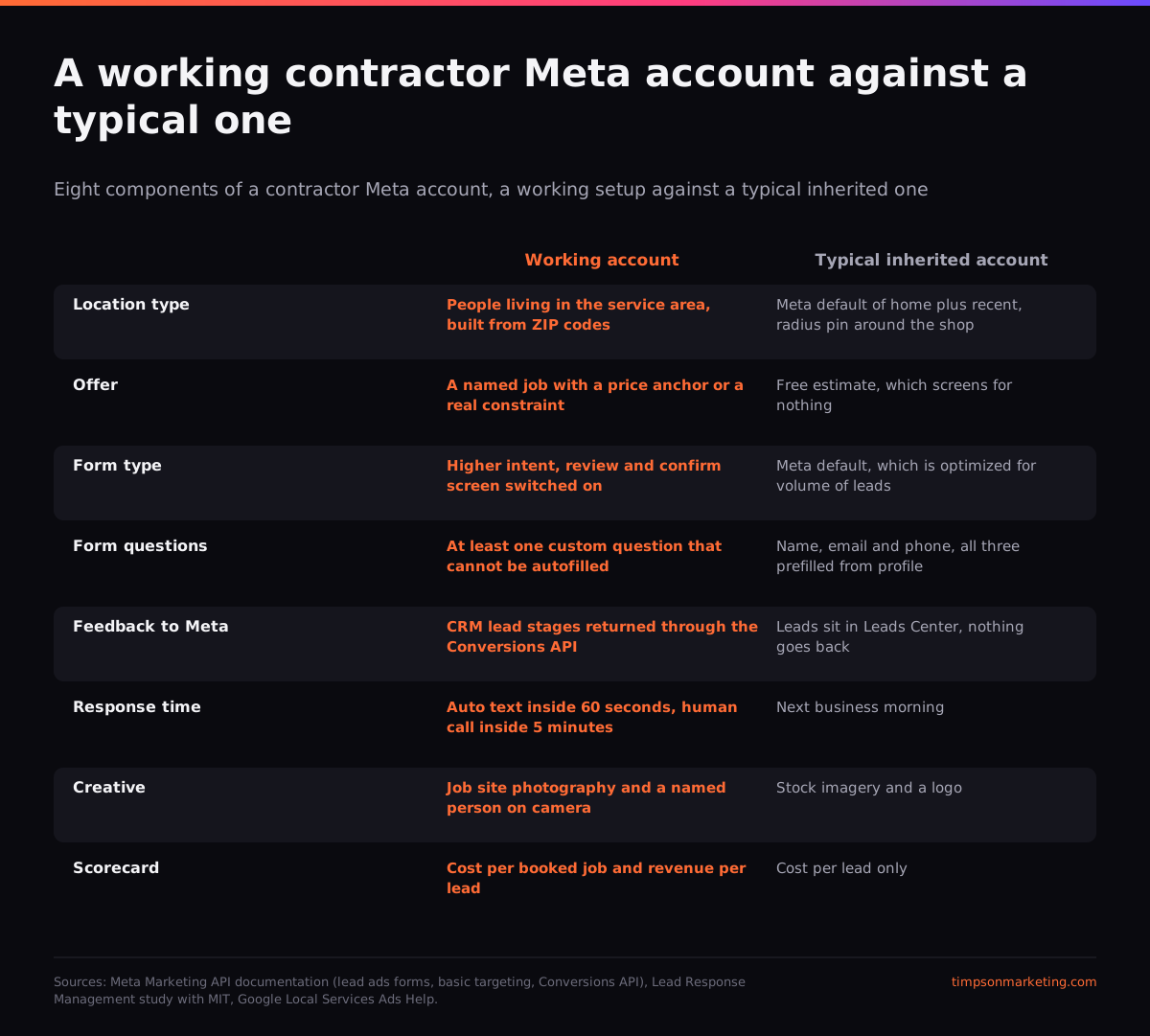
That table is not a ranking, and no published study ranks these components against each other. In our own account audits the two form settings and the missing feedback loop do more damage than anything else, while component seven, the creative, is where almost all of the agency conversation goes. Creative matters. It is just the last thing on this list that is actually broken.
Components 1 and 2: what the account is actually pointed at
Geography is the quiet money leak. Meta's targeting reference states that when no location type is supplied, targeting defaults to both home and recent, where recent means "People whose recent location is in a selected area, as determined from mobile device data." For a plumber in a metro corridor that includes everyone who drove through last week. The same page sets the minimum radius around a city at 10 miles, which in a dense market can sweep in four municipalities you will not drive to. A working account is built from ZIP codes and set to home only.
The offer decides who raises a hand. "Free estimate" is not an offer, it is an industry standard. It attracts price shoppers because it screens for nothing. A named job with a price anchor ("panel upgrades, most homes 1,800 to 3,400") or a real constraint ("we book two full re-pipes a week") does the screening before the form does.
Budget concentration is not on the list of eight, but it decides whether any of them get tested. Three ad sets at $8 a day each is one starved campaign wearing a costume. One ad set at $25 a day gives the delivery system enough signal to learn from.
Of these, geography is the one that quietly doubles cost per booked job while every dashboard metric still looks fine, because the leads are real people who simply cannot hire you.
Components 3 and 4: the form is where the bad leads get manufactured
This is the part nobody names, and it is written down in Meta's own documentation. From the lead ads form guide: "By default, lead ads are optimized for the volume of leads, however, you can create forms that result in higher intent leads."
Read it again. The default is volume. Higher intent is a thing you have to go and switch on.
Meta's marketing API exposes the switch as a single form parameter, is_optimized_for_quality. Setting it to true, Meta's form creation documentation says, "adds a step to the form submission flow where a person reviews and confirms their answers before the person submits the form." In Ads Manager it is the form type choice somebody clicked past in four seconds when the account was built.
The second half is the question set. A default instant form asks for name, email and phone, all three prefilled from the person's Meta profile. The entire submission is three taps and zero typing, on a phone, often mid-scroll. The same documentation lists a CUSTOM question type that takes your own label and optional dropdown options. One question that cannot be answered by tapping a prefilled value is the cheapest lead filter available: the property address, or whether they own or rent, or which of four job types they need.
Here is the honest tradeoff, because the guides that push higher intent forms rarely state it. Adding a review screen and a question will cut your raw lead count. That is the point. You are not buying leads, you are buying booked jobs. If cost per lead rises 40 percent and the booked rate doubles, you won, and your dashboard will look worse while your bank account looks better. This is the same reasoning that governs whether Google Ads are worth it for a contractor: the cheap number and the right number are usually different numbers.
Component 5: nothing flows back, so the system keeps finding the wrong person
Ask what happens to a Meta lead after it lands. In most contractor accounts the answer is that it sits in Leads Center, gets exported to a spreadsheet, and nothing about its outcome ever returns to Meta.
Meta is explicit that this is a loss. Its lead ads documentation states: "To see a better performance in your lead ads, you can choose to share your CRM data about your leads back to Meta to unlock quality lead optimization." The ad set reference exposes a matching QUALITY_LEAD optimization goal, described as optimizing "for people who are likely to have a deeper conversation with advertisers after lead submission." The plumbing is the Conversions API, which Meta describes as creating a connection from "an advertiser's server, website platform, mobile app, or CRM to Meta systems that optimize ad targeting, decrease cost per result and measure outcomes."
This is the component that separates accounts that get better every month from accounts that get worse. Without a feedback loop the delivery system is being graded on form submissions, so it goes and finds the humans most likely to submit a form. Those are not the humans most likely to sign a $14,000 change order. The algorithm is not broken. It is doing precisely what you told it to do, and nobody told it what a customer looks like.
Component 6: speed to lead, the half of the problem that is not Meta's fault
The lead came in at 8:41pm. Someone called it at 11:15 the next morning. Then everyone blamed Facebook.
The Lead Response Management study, run with Professor James Oldroyd of MIT across three years of data from six companies, more than fifteen thousand leads and more than a hundred thousand call attempts, found what it calls "a staggering 21-fold decrease in the odds of qualifying a prospect if the response time stretched from 5 to 30 minutes." Inside the first hour, contact success dropped more than tenfold and qualification success more than sixfold.
Google has already priced this in on the paid side. Its Local Services Ads documentation states that "If you regularly fail to answer calls or respond to messages, your ad ranking may be affected". Answer rate is a literal ranking input in one major paid local channel. Treating it as a soft best practice in another one is a decision, not an oversight.
The practical version for a contractor: an automated text inside sixty seconds that says a human is calling, then an actual human calling inside five minutes during business hours. Anything slower and the form settings above stop mattering, because the same discipline that wins emergency service calls is what converts a cold social lead.
Component 8: the number you judge the whole thing on
Most contractor Meta accounts are graded on cost per lead, which is the one metric guaranteed to reward the broken setup. Strip the review screen, strip the question, keep the prefill, and cost per lead falls. Booked revenue falls with it. The practitioners quoted in LocaliQ's 2026 search advertising benchmarks make the same argument from the paid search side, repeatedly and independently.
I generally advise that CPC and CTR are health metrics. They're important to keep a pulse on and to use as levers to achieve your goals. However, they aren't KPIs.
The scorecard that works has three lines and fits on an index card: leads, booked jobs, and revenue from those jobs, all tagged by source and all reviewed monthly. Cost per booked job is the number that decides whether you keep spending. Revenue per lead is the number that tells you whether the form change worked.
You can manage higher CPLs if the bottom line is growing.
This is also the honest test of whoever runs the account. A report that leads with impressions and cost per lead and never mentions booked jobs is a report designed to survive, not to inform, which is the same tell covered in how to tell if your marketing agency is actually working.
Run this audit on your own account this afternoon
- Open Ads Manager, Audience column: is location set to people living in this location, or does it still include people recently in this location?
- Check the radius or ZIP list against the areas your trucks actually go.
- Open the instant form: is the form type set to higher intent with a review screen, or the default volume form?
- Count the questions. If every field can be answered by tapping a prefilled value, that is the bad lead source.
- Ask whether any lead outcome data has ever been sent back to Meta through the Conversions API or a CRM connection.
- Pull the last twenty leads and write down the minutes between submission and first outbound contact.
- Open the creative: is there a photograph of your crew on a real job, or a stock image?
- Ask your bookkeeper how many jobs closed from Meta last quarter and what they were worth. If nobody can answer, that is the finding.
What Facebook will not do for a contractor
It will not create urgent demand. A person standing in three inches of water opens Google, not Instagram. Facebook is where you reach the homeowner who has been putting off the panel upgrade for two years, which is a real and valuable audience, and a slower one. Pair it with search, not instead of it. The same caution applies before anyone talks you into TikTok ads for a local business.
It is also not the cleanest inventory. Lunio's 2026 invalid traffic analysis of 2.7 billion clicks across six platforms measured Meta at 8.20 percent invalid traffic against Google's 7.57 percent, using unprotected monitor-only campaigns to catch what the platforms' own filters miss. The gap is small. It is not zero, and it compounds when your form is built to accept anything.
One more piece of context that reframes the whole channel. LocalImpact's September 2025 survey of 400 US local small business owners found social media advertising takes the largest share of budget for 44 percent of local businesses, against 17 percent for Google Ads and 10 percent for SEO. Contractors are not underspending on social. They are overspending on it relative to search, and doing it with default settings. That combination is what produced the reputation.
It is still a better deal than renting leads. Angi's audited 10-K reports $587.1 million in US lead revenue on 20.195 million leads in 2025, about $29 a lead, and defines that revenue as fees paid by professionals for consumer matches "regardless of whether the Pro ultimately provides the requested service." The FTC separately ordered HomeAdvisor to pay up to $7.2 million for deceptively marketing those leads and set up two redress funds to pay back the service providers it found had been misled. A Meta account you control and can audit beats a marketplace you cannot. Both lose to demand you own, which is why ranking higher on Google Maps and knowing what local SEO actually costs belong in the same budget conversation.
If the audit above turns up five or more failures, the answer to whether Facebook ads work for contractors is still yes. It just has not been tested yet at your company. What was tested was Meta's defaults, and Meta's defaults are optimized for a different outcome than the one you are paying for.
Fix the eight components, run it for eight weeks, and judge it on booked jobs. Then decide where the next dollar goes. That decision is the whole point of running paid media across channels rather than one platform at a time, and it sits alongside the residential playbook for more construction leads and the very different one for winning commercial contractor clients. Both live on the blog index.
Frequently asked questions
Why are my Facebook leads so bad?
Usually two causes stacked. Your instant form is Meta's default volume form with prefilled name, email and phone, so submitting takes three taps and no thought. And nobody calls back fast enough. Switch the form to higher intent, add one question that cannot be autofilled, and respond inside five minutes.
What should Facebook ads cost a contractor per lead?
Nobody can honestly tell you. No 2026 Meta benchmark for home services publishes a sample size, spend volume and date range. The most-cited figure comes from a November 2016 to January 2017 sample. Measure your own account against booked revenue and ignore published Facebook cost per lead numbers entirely.
Are Facebook ads or Google Ads better for a contractor?
They do different jobs. Google captures someone who already has the problem and is searching now. Facebook reaches someone who has been postponing a project. If you can only fund one and you sell emergency work, fund search first. Facebook earns its place on planned, higher ticket jobs.
Should I use an instant form or send traffic to my website?
Instant forms convert better because they prefill and never leave the app, which is exactly why they produce weaker leads. Use one, but switch it to higher intent with the review screen on and add a qualifying question. A landing page is the fallback when you need longer qualification.
How much should a contractor spend to test Facebook ads?
Concentrate rather than spread. One ad set at roughly $25 a day for six weeks gives the delivery system enough signal and gives you enough leads to judge booked rate. Three ad sets at $8 a day each is a starved test that will produce an unclear answer you cannot act on.
Does adding questions to my Facebook form hurt performance?
It reduces raw lead volume and raises cost per lead. Both of those are the intended effect. The metric that matters is cost per booked job. If a question drops leads by a third and doubles the share that book, you spent less to fill the same calendar.
What is conversion leads optimization on Meta?
It is Meta's option to optimize toward leads that progress in your sales process rather than leads that submit a form. It requires sending lead stage data from your CRM back to Meta. Meta's documentation states that sharing CRM data back unlocks quality lead optimization for lead ads.
How fast do I actually have to call a Facebook lead?
Inside five minutes during business hours. The Lead Response Management study with MIT found a 21-fold drop in the odds of qualifying a prospect when response time moved from five minutes to thirty. Use an automated text inside sixty seconds to hold the lead until a person calls.
Can I just boost posts instead of running proper campaigns?
Boosting gives you almost none of the controls that decide lead quality. You cannot set the form type, add qualifying questions, restrict targeting to home residents, or connect CRM feedback. It is the fastest way to spend money on reach that never becomes a booked job.
How long before I know whether Facebook ads work for my company?
Six to eight weeks with a concentrated budget and a working setup. You need enough leads to judge booked rate, not just cost per lead. Judge it once, on booked jobs and revenue. If the form and follow up were wrong the whole time, you tested Meta's defaults, not the channel.
Sources
- Meta. Lead Ads, Create a Form (Marketing API) (2026-07)
- Meta. Lead Ads (Marketing API overview) (2026-07)
- Meta. Ad Set Reference (optimization_goal, QUALITY_LEAD) (2026-07)
- Meta. Conversions API (2026-07)
- Meta. Basic Targeting Reference (geo_locations, location_types, radius) (2026-07)
- WordStream by LocaliQ. Facebook Advertising Benchmarks (2026-06-30)
- WordStream by LocaliQ. 2026 Google Ads Benchmarks for Every Industry (2026-05-19)
- LocaliQ. Search Advertising Benchmarks 2026 (2026-06-01)
- Lead Response Management, with Professor James Oldroyd, MIT. Lead Response Management Study (2026-07)
- Google (Local Services Help). About Local Services Ads (2026-07)
- Lunio. Invalid Traffic Rates by Ad Platform, 2026 Global Invalid Traffic Report (2026-01-21)
- LocalImpact. The State of Small Business Marketing (2025-09-25)
- U.S. Federal Trade Commission. FTC Order Requires HomeAdvisor to Pay $7.2 Million and Stop Deceptively Marketing Its Leads (2023-01-23)
- Angi Inc.. Angi Inc. Form 10-K, fiscal year ended December 31, 2025 (2026-02)
Joseph Timpson has worked in search since 2010 and runs Timpson Marketing out of St. George, Utah. He built The Cited Method, a five stage framework for earning and proving real citations in AI answers, and publishes what does not work alongside what does.
Want this done for you, with the receipts to prove it worked?
One call, no pitch deck. We look at what is actually blocking you and tell you the truth about whether we can help.
Book a free consultation →