Are Google Ads Worth It for a Contractor?
Most failed contractor ad accounts were not badly managed. They were funded below the level at which management is possible. Here is the arithmetic, using your numbers instead of a national average.

- Google's own bidding documentation says to evaluate a campaign over a window containing at least 30 conversions. At the 2026 median cost per lead for home improvement, that is about $2,728 a month.
- At $500 a month a home improvement contractor buys roughly 60 clicks and under 5 leads, so it takes six months to accumulate one window Google considers readable.
- Carrying the lead-to-customer rate implied by 1,774 Local Services Ads campaigns onto the median search cost per lead puts a paying customer from Google Search at roughly $400. If a job does not clear that in gross profit, stop.
- Local Services Ads cost $53 per lead blended versus $90.92 on search, but take 3 to 4 weeks of screening and require a verified Google Business Profile.
- Google's own pause research found paid clicks are only 50 percent incremental when you already hold the top organic result, and 96 percent incremental when you rank below position four. The ads-or-SEO question is settled per keyword, not per channel.
The answer is a number, not a yes
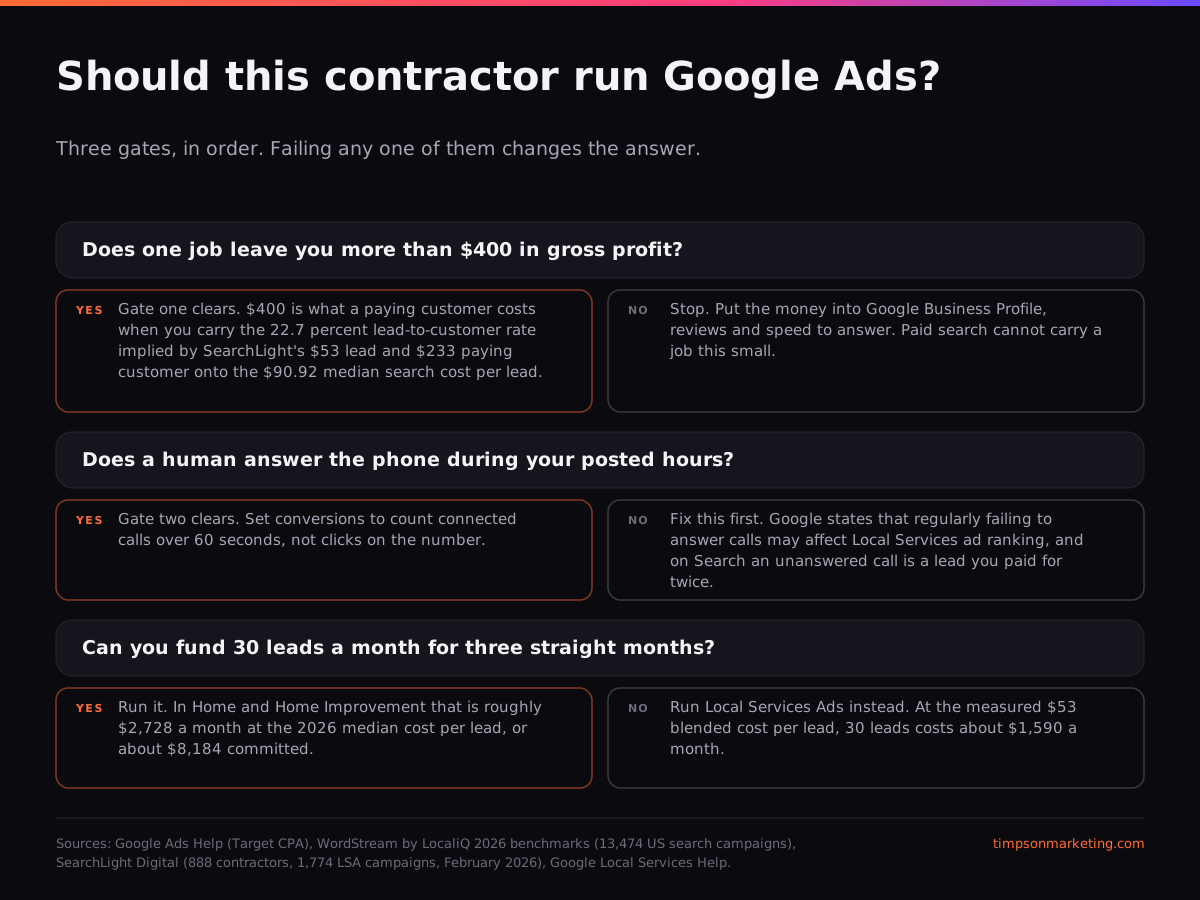
Google Ads are worth it for a contractor when three things are true at the same time: one job leaves you more than about $400 in gross profit, a human answers the phone during your posted hours, and you can fund at least 30 leads a month for three straight months. Miss any one of those and the answer is no, no matter how good the account manager is.
The three grand you lost two years ago was probably not lost to bad keywords. It was lost because the budget was too small to produce a readable month, so nobody, including you, could tell a bad campaign from a slow one.
That is not a soft claim. It is arithmetic you can do on the back of an invoice, and it comes out of Google's own documentation.
Every agency post on this question answers yes and then hands you a national average cost per click. A national average CPC is not a decision input. It does not survive contact with your trade in your city. The number that decides this is your gross profit per job, multiplied against a spend floor that Google itself defines.
The floor nobody publishes
Start with the sentence that should be at the top of every contractor PPC article and is at the top of none of them. Google's bidding documentation tells advertisers that for evaluation, it recommends measuring performance over the last 30 days including at least 30 conversions. That is Google describing the minimum amount of evidence it considers a real read on a campaign.
Now price 30 leads. WordStream's 2026 benchmark report, built on 13,474 US search campaigns run between April 2025 and March 2026, puts the median cost per lead in Home and Home Improvement at $90.92, from an $8.33 median cost per click and an 8.05 percent conversion rate. Those are medians, not means, which is why they are usable.
Thirty leads at $90.92 is $2,728 a month. Google sets a monthly spending limit of 30.4 times your average daily budget, so that is a daily budget of about $90.
Run the same arithmetic at $500 a month. At $8.33 a click you buy roughly 60 clicks. At an 8.05 percent conversion rate those 60 clicks produce fewer than 5 leads. To reach the 30 conversions Google says it needs to read the campaign, you would wait six months. By then the season has turned, the auction has moved, and half your competitors have changed their bids. There is no version of that account that a skilled manager can rescue, because there is nothing in it to read.
There is a second mechanism that makes small accounts opaque, and it is worse than the first. Google's own description of the search terms report says it is a list of search terms that a significant number of people have used. Terms that a handful of people searched do not appear. At 60 clicks a month, most of what you actually bought is invisible to you by design. You cannot write negative keywords against searches you are not shown.
When algorithms try to work with limited data, the result is often wasted spend and chronic underperformance.
Gate one: does one job clear $400 in gross profit
The cleanest measured data on what a home services customer actually costs comes from Local Services Ads, because those accounts close the loop. SearchLight Digital published a February 2026 sample of 888 contractors running 1,774 LSA campaigns on $6.72 million in spend, tracking 126,650 leads and $52.7 million in closed revenue. Blended cost per lead was $53, book rate 43.9 percent, cost per paying customer $233, average ticket $1,826.
Carry that forward. $233 per paying customer at a $53 lead cost means roughly 22.7 percent of leads became paying customers, which is barely half the 43.9 percent book rate. Booking an appointment and paying an invoice are not the same event, and that gap is the part of the funnel you own rather than the part Google sells you. Apply the 22.7 percent to the $90.92 median search cost per lead and a paying customer from Google Search costs about $400. That is our arithmetic on their published figures, not a number either company printed, and it assumes search leads convert like LSA leads. Treat it as an order of magnitude, not a quote.
It is still the most useful number in this article, because it converts the question into one you can answer without a marketing consultant. If a job leaves you $400 in gross profit after materials and labor, paid search is break-even at best. If it leaves you $1,400, you have room.
SearchLight's per-trade cut is where it gets practical: electrical $39 per lead against a $1,434 average ticket, HVAC $51 against $2,110, plumbing $57 against $1,714, drain and sewer $59 against $1,521. A second, separately published analysis of 760 home services businesses landed at $55.08 per lead and a 43.5 percent book rate, within two dollars. Do not read that as independent confirmation. Both cuts come from the same platform's customer base, so the samples almost certainly overlap, and both describe contractors who already run lead management software. Their book rates are better than the trade average, which makes these ceiling numbers, not middle ones.
You can manage higher CPLs if the bottom line is growing.
That is the correct frame and almost nobody applies it. Cost per lead is not a score. It is one term in a division problem whose other term is your margin. A $130 lead is cheap for a panel upgrade and ruinous for a service call. If your average ticket is small, the fix is not a better ad account, it is a bigger job. That is a sales and packaging problem, and it is the same one behind chasing commercial accounts instead of one-off residential calls.
Gate two: does a human answer the phone
This gate is free to pass and it is the one most often failed.
Google documents Local Services Ads as a pay per lead product and states directly that if you regularly fail to answer calls or respond to messages, your ad ranking may be affected. Answer rate is not sales advice in that product. It is a ranking input written into the documentation.
On the search side there is no such penalty, which makes it worse, not better. Nothing in the account tells you a call went to voicemail. You paid $8.33 for the click, $90.92 for the lead, and the lead rang out at 4:40 on a Friday while the crew was loading up.
The dashboard was green. The pipeline was empty.
Khabra was describing an insurance broker whose conversion action was firing on form starts instead of form submissions, so the bidding system optimized enthusiastically toward nothing. Contractors hit the identical failure with a different trigger: a conversion action set to a click on the phone number rather than a connected call over 60 seconds. Her diagnosis generalizes: identical conversion values across all form fills leave Smart Bidding with no basis to distinguish a qualified lead from a bounced session.
Before you fund anything, pull last month's call log. If more than one call in ten went to voicemail during your posted hours, fix that first. It is cheaper than any campaign and it also lifts every organic call you already get, which is the same reason it shows up in our playbook for capturing emergency service calls.
Gate three: three months, or do not start
One month at the floor buys you a single readable window with no comparison. Two months buys you a comparison you cannot trust because half of it was the learning period. Three months is the minimum honest commitment, and for anything with a long sales cycle it is longer. Khabra's guidance for accounts with long sales cycles is to scale on 60 to 90 day evaluation windows rather than 30 day ones, because short windows systematically undervalue campaigns that close slowly. She writes it about B2B. A $40,000 remodel behaves the same way.
So the real question is not "can I afford $500 a month." It is "can I afford $2,728 a month for three months, or $8,184, knowing the first month is tuition." If the answer is no, that is a legitimate answer, and the money is better spent on Maps and reviews. It is not a failure of nerve. It is a correct read of your own balance sheet.
This is also the honest reason so many contractor accounts look mismanaged. In LocalImpact's September 2025 survey of 400 US small business owners and managers, 44 percent named social media ads as their largest marketing line and only 17 percent named Google Ads. For most local businesses paid search is the secondary line, and the secondary line is the one that gets funded below its own floor.
Five settings that ate the last $3,000
If you already ran ads and they failed, it is worth knowing which of these was true. In our experience the answer is usually three of the five at once.
- Location targeting left on Presence or interest instead of Presence, so you paid for clicks from people two states away who were curious about your city
- No search terms review, therefore no negative keyword list, therefore you bought the word free and the word salary and the word DIY
- A conversion action counting phone number clicks or form starts rather than connected calls and booked jobs
- Search, Display and Video mixed into one campaign or one Performance Max shell, so cheap junk impressions diluted your reporting
- No call tracking, so the calls that did close were never attributed and the channel looked worse than it was
The first one deserves a fight. Google's location targeting documentation recommends the broader Presence or interest setting and supports it with a cited 5 percent conversion lift in Travel, Real Estate and Education. Those are three industries where a customer genuinely can be somewhere else. A contractor with a truck and a 30 mile radius is not one of them. Take Google's data seriously and then override it, because the population it was measured on is not you.
The fourth is measurable rather than vibes. Lunio's 2026 invalid traffic report, built on 2.7 billion paid clicks, measured invalid traffic inside Google at 5.21 percent on Search, 12.02 percent on Display and 20.62 percent on Video. Google Search is the cleanest inventory you can buy. Leaving it roughly doubles your invalid traffic exposure on Display and quadruples it on Video, which is a concrete reason to keep a contractor's first campaign on Search only.
We will run this arithmetic on your actual job value and answer rate before anyone talks about budget.
See how we run paid media→Google Ads or Local Services Ads first
For most trades, Local Services Ads first, then Search. The costs and the constraints are genuinely different products, not two flavors of the same thing.
| Google Search Ads | Local Services Ads | |
|---|---|---|
| What you buy | A click, whether or not the phone rings | A lead, documented by Google as pay per lead |
| Median cost, 2026 | $90.92 per lead in Home and Home Improvement | $53 per lead blended across 1,774 campaigns |
| Time to launch | Same day | 3 to 4 weeks of screening after documents are submitted |
| Hard prerequisite | A landing page and working conversion tracking | A public and verified Google Business Profile |
| Trust badge | None | Google Verified |
| What you control | Keywords, negatives, radius, schedule, budget | Job types and geography |
| What lowers your rank | Quality Score, budget, ad relevance | Failing to answer calls or respond to messages |
One correction worth making, because a large share of 2026 agency content still gets it wrong. Google is simplifying its advertiser badging by launching a single badge for all advertisers, and discontinuing the Money Back Guarantee associated with the Google Guarantee badge. If a rep is still selling you the consumer money-back guarantee as a live trust signal, they have not read the documentation for their own product.
The screening delay is not a drawback, it is the moat. Google requires a public and verified Google Business Profile and states the process takes 3 to 4 weeks after documents are submitted. Your competitor cannot spin that up the week after you start winning, which is the opposite of Search, where anyone can outbid you by Tuesday. If your profile is not in order yet, that work pays twice, because it is the same work behind ranking in the Maps three pack and it runs on the review volume you are already collecting.
Ads or SEO first is the wrong question
It is settled per keyword, not per channel, and Google published the data itself in 2012 and then largely stopped talking about it.
A Google meta-analysis of 390 search ads pause studies found that 50 percent of ad clicks are incremental when the advertiser already holds the top organic result, 82 percent at organic ranks 2 to 4, and 96 percent when the organic result ranks below 4. Read that as a spending map. On the terms where you already rank first, half your ad spend buys clicks you were going to get free. On the terms where you rank on page two, nearly all of it is genuinely new.
That study is from 2012 and it is Google's own research on its own product, so weight it accordingly. It is still the most useful thing published on the subject, and the mechanism it describes has not changed.
The practical version: pull your top 20 money keywords, note where you rank organically on each, and bid hardest on the ones where you are invisible. Stop bidding on your own brand name unless a competitor is bidding on it. And accept that organic is the slower asset, which is why we lay out what local SEO actually costs and how long it takes to show up before anyone signs anything. If you have an agency running both right now and cannot tell which one produced last month's calls, that is its own diagnosis.
The test to run before you spend a dollar
Write down gross profit per job
Revenue minus materials and labor. Not revenue. If it is under $400, you are not a paid search buyer yet, and no agency should tell you otherwise.
Multiply your target cost per lead by 30
That is your monthly floor. Use $90.92 if you have no data of your own, which puts the search floor at $2,728. On Local Services Ads the measured per-trade lead costs put the same floor between $1,170 and $1,770.
Check your answer rate
Pull last month's call log. More than one voicemail in ten during posted hours means fix the phone before you fund the ads.
Commit to three months or do not start
One month is noise. Budget the full amount up front and treat month one as tuition.
Pick the channel
Local Services Ads if you can clear screening and want cheaper leads. Search if you need control over exactly which jobs you buy.
One last thing about the rep calling you every week. In WordStream's 2026 data, cost per lead fell year over year for the first time in five years and conversion rate rose across 87 percent of tracked industries. The channel did get better. That does not make it right for you. It only means that if the three gates clear, the case is stronger this year than it was when you lost the three grand.
I generally advise that CPC and CTR are health metrics. They're important to keep a pulse on and to use as levers to achieve your goals. However, they aren't KPIs.
If your reporting is a wall of clicks and impressions, you are being shown health metrics and billed for outcomes. Ask for booked jobs and revenue instead. If nobody can produce them, the account is not being managed, it is being watched. Everything else we publish on paid channels lives in the Timpson blog, and the same three gates apply to Facebook and Instagram for contractors and TikTok for local service businesses, only with worse intent and cheaper clicks. If you would rather we ran the arithmetic with you, that is what our paid media work starts with.
Frequently asked questions
How much should a contractor spend on Google Ads per month?
Enough to buy 30 leads, because that is the volume Google's own bidding documentation recommends evaluating a campaign over. At the 2026 median home improvement cost per lead of $90.92, that is about $2,728 a month. Cheaper trades and cheaper markets land lower, but the method is the same.
Is $500 a month enough for Google Ads?
For a home improvement contractor, no. At the median $8.33 cost per click, $500 buys roughly 60 clicks and fewer than 5 leads at an 8.05 percent conversion rate. You would need six months to accumulate one window Google considers readable, which is not a campaign, it is a subscription.
Are Local Services Ads better than Google Ads for contractors?
Usually the better first move. Measured blended cost per lead across 1,774 campaigns was $53 versus $90.92 on search, and you pay per lead rather than per click. The trade-off is 3 to 4 weeks of screening, a verified Google Business Profile requirement, and far less control over which jobs you buy.
Should I run Google Ads or SEO first?
Decide per keyword, not per channel. Google's own analysis of 390 ad pause studies found paid clicks are only 50 percent incremental where you already rank first organically, and 96 percent incremental where you rank below position four. Bid hardest where you are invisible, and let organic carry the terms you already own.
Why did my Google Ads only bring price shoppers?
Almost always negative keywords and conversion definition. Without a search terms review you buy words like free, cheap, DIY and salary. And if your conversion action counts phone number clicks rather than connected calls, the bidding system optimizes toward whoever taps fastest, which is exactly the price shopper.
How long before Google Ads works for a contractor?
Budget three months minimum and treat month one as tuition. Short evaluation windows systematically undervalue campaigns with slow closes, which describes most trade work above a service call. If a seller promises profitable results in 30 days on a small budget, they are describing luck, not management.
Is the Google Guarantee still a thing?
Not in its old form. Google is consolidating to a single advertiser badge and has discontinued the Money Back Guarantee that was attached to the Google Guarantee badge. Any rep still selling you the consumer money-back guarantee as a live trust signal has not read Google's current documentation.
Do I need call tracking to run Google Ads?
Yes, and it is the cheapest thing on this list. Without it, the calls that actually closed are never attributed, the channel looks worse than it performed, and you have no way to feed booked revenue back into bidding. Track connected calls over 60 seconds, not clicks on the phone number.
Sources
- Google Ads Help. About Target CPA bidding (2026-07)
- WordStream by LocaliQ. 2026 Google Ads Benchmarks for Every Industry (2026-05)
- Google Ads Help. Average daily budget: definition (2026-07)
- Google Ads Help. About the search terms report (2026-07)
- Google Ads Help. About location targeting (2026-07)
- Google Local Services Help. How Local Services Ads work (2026-07)
- Google Local Services Help. Changes to Local Services Ads badging and the Money Back Guarantee (2026-07)
- Google Local Services Help. Business screening and verification requirements (US) (2026-07)
- SearchLight Digital. Google Local Service Ads cost per lead benchmarks (2026-03)
- The Data-Driven Trades. Google Local Service Ads benchmark report (2026-03)
- Google Research. Impact of Organic Ranking on Ad Click Incrementality (2012-03)
- Advanced Television, reporting Lunio. Report: $63bn lost to IVT across digital advertising in 2025 (2026-01)
- LocaliQ. 2026 Search Advertising Benchmarks (2026-06)
- Search Engine Land. 4 times PPC automation still needs a human touch (2026-07)
- Search Engine Land. PPC budgeting in 2026: When to adjust, scale, and optimize with data (2026-07)
- LocalImpact. State of Small Business Marketing (2025-09)
Joseph Timpson has worked in search since 2010 and runs Timpson Marketing out of St. George, Utah. He built The Cited Method, a five stage framework for earning and proving real citations in AI answers, and publishes what does not work alongside what does.
Want this done for you, with the receipts to prove it worked?
One call, no pitch deck. We look at what is actually blocking you and tell you the truth about whether we can help.
Book a free consultation →