How Excavation and Construction Companies Get More Leads
Your customer spends most of a year deciding and about a day choosing. Here is which asset works at which point in that cycle, and why four different job types need four different plans.

- Kitchen projects average 9.5 months of planning against 5.8 months of construction, so the customer is deciding long before any contractor is visible.
- 94 percent of buying groups rank their shortlist before contacting a single seller, and the pre contact favorite wins about 80 percent of deals.
- Site preparation contractors spend 0.18 percent of revenue on advertising versus 0.73 percent for roofing, which means the excavation search channel is nearly empty, not crowded.
- Google Local Services Ads has a General contractor category but no excavation, grading or site prep category, so the default home services channel does not exist for dirt trades.
- Excavation employment swings 13.2 percent peak to trough in a year while electrical swings 2.1 percent, so flat monthly budget advice is simply wrong for your trade.
The nine month decision and the nine minute call
Excavation, concrete and general contracting run on a bid cycle, not a service call. The customer spends months planning and roughly a day choosing. The assets that produce leads are the ones visible during planning and easy to act on the day a shortlist gets written. Almost every guide to getting more construction leads targets the call, which is the one moment in the cycle that has already been decided.
Houzz surveyed 10,176 renovating homeowners for its 2026 study. Kitchen projects, the kind that bring in a demo crew, a concrete truck and a general contractor, averaged 9.5 months of planning against 5.8 months of construction. Deciding takes longer than digging.
Now compare that to the world nearly every lead generation article is written for. BrightLocal asked 1,227 people who had recently searched for a local business how fast they moved, and found 75 percent decided in under 30 minutes and 28 percent decided in under five. That is a burst pipe at 11pm. It is not a basement excavation, a commercial pad or a 400 foot driveway.
Both numbers are true. They describe two different businesses. The mistake that costs you money is running the second playbook on the first, which is exactly what happens when an excavator reads advice written for HVAC.
| Service call trade | Bid cycle trade | |
|---|---|---|
| Decision window | Minutes to hours | Weeks to months |
| What they search first | The problem, once | The vocabulary, then the price, then a name |
| What converts | Map position and a phone that gets answered | A shortlist entry earned weeks earlier |
| Strongest channel | Google Maps and Local Services Ads | Search content, project proof and relationships |
| The classic error | Publishing content nobody reads in time | Putting a call now button in front of a month two researcher |
Home renovation continues at historic levels, even as homeowners take a more cautious approach to future projects
Nobody in your trade is spending, and that is the opening
Most contractors assume they cannot get found because competitors are outspending them. Federal data says the opposite. Here is purchased advertising as a share of revenue, calculated from the 2022 Economic Census construction data file:
| Trade | Advertising as a share of revenue |
|---|---|
| Roofing | 0.73% |
| Plumbing and HVAC | 0.62% |
| Electrical | 0.25% |
| Poured concrete | 0.22% |
| Site preparation (excavation) | 0.18% |
| Highway, street and bridge | 0.10% |
Roofing spends four times what excavation spends. That single ratio explains why roofing lead auctions are a knife fight and why a search for an excavation contractor often returns three directory pages and a competitor whose last Facebook post is from 2019.
Rank it honestly. If you run a dirt trade you are not fighting for share of a crowded channel, you are frequently the only one who showed up. The catch is that the channel is quiet because the query volume is genuinely lower, so the win comes from converting a small number of high value searches rather than from chasing traffic. Check that against what local SEO actually costs before you decide the math works for you.
Demand is also cooling. Harvard's Joint Center for Housing Studies projects home improvement spending at $519 billion but growing just 0.5 percent by mid 2027, and the Census Bureau reported total construction put in place running 1.5 percent below the prior year in May 2026. Flat demand plus an empty channel is a share taking setup, not a growth one. You are not going to ride a rising market. You are going to take work from someone.
The four moments in a bid cycle, and what each one can produce
Trigger
Something breaks, sells, floods or gets approved. They do not know what the work is called yet and search in plain language.
Research
They learn the vocabulary, the sequence and the price range. Most of those nine months live here, and almost no contractor is visible for any of it.
Shortlist
Two or three names get written down. This is the only moment in the cycle that converts, and it lasts about a day.
Bid
Estimates get compared. Marketing is over. Your proposal, your response time and your references decide the rest.
Model it for a residential job. Month one they search how much it costs to level a lot. Month three, whether they need a permit to excavate. Month five, the difference between excavation and grading. Month eight, an excavation contractor near them. Only the fourth search can be turned into a call today, and most contractors are invisible for the first three, which is precisely when the shortlist is being built. That sequence is a model rather than a measurement, but it is consistent with the planning window Houzz measured and with what the buyer research shows.
6sense surveyed nearly 4,000 buyers and found 94 percent of buying groups rank their shortlist before contacting any seller, with the pre contact favorite winning about 80 percent of deals. BrightLocal's consumer research lands in the same place from the other direction: 72 percent of local searchers look at three or fewer businesses and only 1 percent look at more than ten.
Two independent studies, one B2B and one consumer, reach the same conclusion. Visibility during Research is what earns a place on the Shortlist. Effort during Bid changes very little, because the ranking already exists by then.
The real urgency for revenue teams is to influence those early journeys before buyers reach out.
Your trade already has a scoreboard for this. George Hedley, writing for Construction Business Owner, puts it plainly: "If your scoreboard shows a 4-to-1 bid-hit ratio, you are averaging one contract award for every four jobs you bid on." Marketing that only appears at Bid can change how many bids you submit. Marketing that appears at Research changes the ratio itself, and the ratio is worth more than the volume.
Four job types, four plans. One plan cannot serve all four.
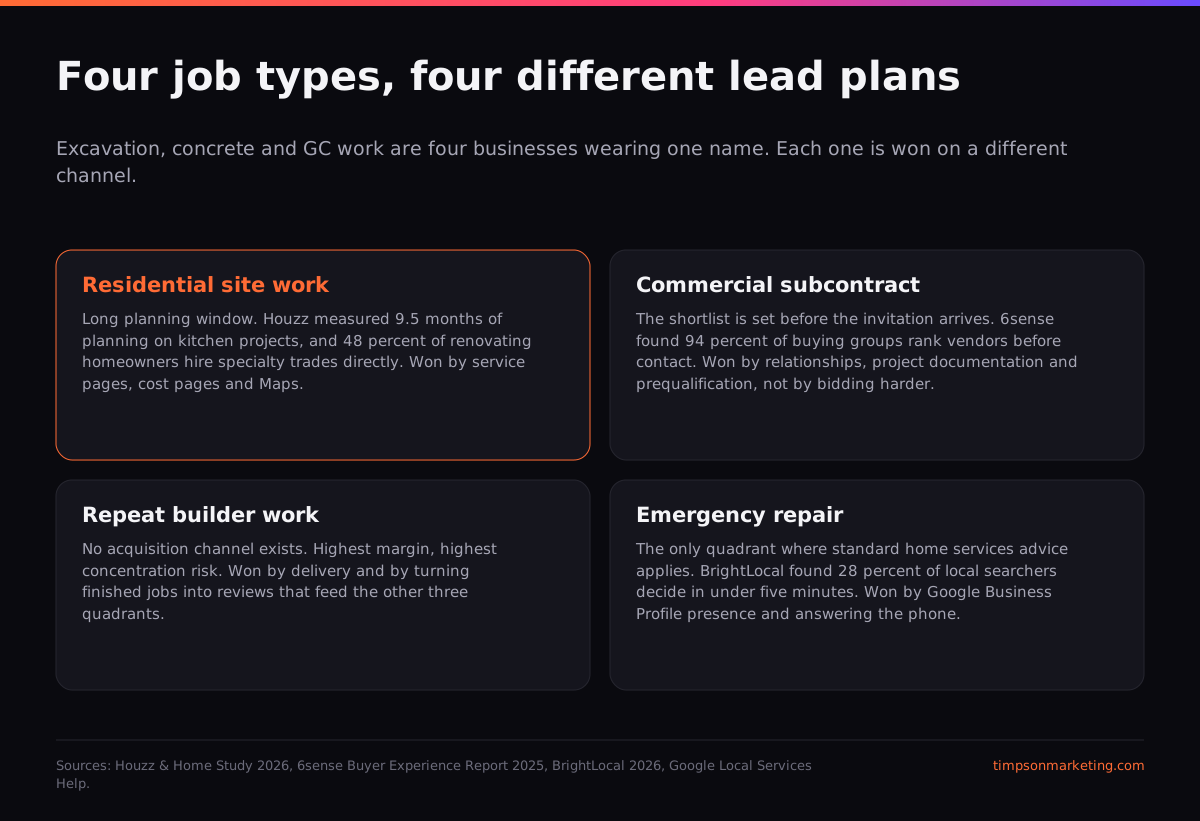
Residential site work. A homeowner with a project and a long planning window. Price sensitive, found through Google Search and Google Maps, and the quadrant the bid cycle framing was built for. Houzz found 91 percent of renovating homeowners hire professionals, 29 percent hire a general contractor, and 48 percent hire specialty providers directly with no construction manager in between. That last figure matters enormously to you: half of these customers are hiring the trade directly, so being findable by name of trade is not optional.
Commercial subcontract. A GC or developer with a project list. The shortlist exists before the invitation goes out. Dodge Construction Network states it sends 99 million bid invitations a year across 677,000 firms, which is a vendor claim about its own platform rather than an independent measurement. Treat bid networks as distribution, not demand. The relationship decides who gets invited, and winning commercial contractor work is a different discipline from ranking.
Repeat builder work. The three builders who keep you busy. No acquisition channel at all, just delivery and relationship. Highest margin quadrant, and the most dangerous, because it can disappear without anyone ever typing a search query.
Emergency repair. Broken water line, collapsed retaining wall, storm washout. The only quadrant where standard home services advice applies unchanged, and for most dirt contractors it is a small line. If it is real revenue for you, how to capture emergency service calls covers it properly.
One channel detail that almost nobody writes down. Google's Local Services Ads accepts General contractor, Foundations services and Landscaping services as categories, and there is no excavation, grading or site preparation category at all. If you are an excavator, the paid channel that home services companies treat as the default simply does not exist for you. That one fact reorders the whole plan, and it is missing from every excavation marketing listicle we read while researching this.
Consumers are not hanging around. It's clear from the data that most consumers want to make quick decisions on the businesses they use.
Ranking the assets that actually win bid cycle work
Whitespark's 2026 report scored 187 ranking factors using a panel of 47 local search experts and put a dedicated page for each service at the top of local organic with a score of 210, ahead of geographic relevance and link authority. That maps cleanly onto a bid cycle, because a researcher searches by service, not by company. Our order:
- A page per service. Not one page called Services. Excavation, grading, site prep, foundation digs, trenching, land clearing, demolition, hauling, each on its own URL with the equipment and conditions named. Six real pages beat one long one.
- A cost page per service. BrightLocal found clear pricing or a stated offer was a top deciding factor for 29 percent of local searchers, effectively tied with reviews. A published range with the variables named beats call for a quote, and it filters out the jobs you do not want.
- Project pages with real photos and real numbers. Cubic yards moved, days on site, the rock you hit and what it changed. This is the asset that survives being read by a general contractor.
- Google Business Profile category and reviews. Primary category is the single highest scoring local pack factor in the Whitespark data at 227, just ahead of proximity. Set Excavating contractor or Concrete contractor before you touch anything else, then read how categories actually work and what moves Maps rankings.
- Service area pages, carefully. Google's own guidelines cap a service area at about two hours of driving time from where the business is based. Thin duplicated city pages hurt more than they help, so build location pages that hold up or build none.
What we would cut: Google Business Profile posts. In the same Whitespark data, posting frequency ranks 148th and post quantity ranks 168th out of 187. If an agency is billing you for weekly posts on an excavation profile, that budget belongs in service pages.
One trap specific to your trade. Most excavators hide their address because they run out of a yard rather than a storefront. Sterling Sky analyzed 8,186 businesses across 200 cities and found being configured as a service area business correlated negatively with local pack rankings. If you have a real yard with a sign and a mailbox, show the address.
The number of reviews you've gotten this month matters more than your total number of reviews.
Review velocity is harder in construction than in HVAC, because you finish six jobs a month rather than sixty. That makes a systematic ask non negotiable rather than nice to have. How to get more Google reviews has the process we use.
Paid channels, aggregators and bid networks, priced honestly
LocaliQ's 2026 benchmarks put the Home and Home Improvement category at an average $8.33 cost per click and $90.92 cost per lead, roughly eleven paid clicks per lead. Those are vendor benchmarks with no published account count or data window, so treat them as directional. Even so, the arithmetic is decisive: $91 a lead is defensible against a $40,000 excavation contract and indefensible against a $900 driveway patch. Run the numbers before the campaign, which is what are Google Ads worth it for contractors walks through.
Aggregators are the channel most contractors default to and the one with the best documented downside. Angi's audited annual report shows $587.1 million in US lead revenue on 20.195 million leads in 2025, about $29 a lead, and its own definition confirms pros pay for consumer matches regardless of whether the pro ultimately provides the requested service. The Federal Trade Commission ordered HomeAdvisor to pay up to $7.2 million over deceptive lead marketing and later mailed 110,372 refund checks to affected providers. That is a federal enforcement record, not a forum complaint.
Today's order requires HomeAdvisor to refund home service providers millions of dollars and stop misleading them about the quality of its leads.
Public work is the channel nobody in this niche mentions. A SAM.gov registration is what allows you to bid on government contracts and apply for federal assistance, and most state transportation departments and counties maintain their own prequalification lists on top of it. For a site prep, paving or highway contractor, prequalification is a moat rather than a marketing cost. It takes weeks of paperwork, which means a competitor cannot spin it up the month your private market goes quiet.
## The seasonality mistake that only hits the dirt trades Site preparation employment swung 13.2 percent peak to trough during 2025 and poured concrete swung 11.7 percent, calculated from Bureau of Labor Statistics monthly payroll counts for site preparation contractors and the matching series for the other trades. Plumbing and HVAC swung 3.2 percent. Electrical swung 2.1 percent. Every flat monthly budget recommendation you have ever read was written for a trade with a 3 percent swing. Apply it to excavation or concrete and you are spending evenly across a year in which your own demand varies by more than an eighth. Here is the part that gets missed even by people who know about seasonality. Because your work runs on a bid cycle, the correction is not spend more in summer. It is spend ahead of the season by the length of your planning window. If a residential customer plans for months, your February visibility produces June dirt. Spending in June buys you October, by which point your crews are already committed and your competitors have taken the work.
See how we build this→The three builder problem, and what fixing it is actually worth
Your work comes from three builders and a word of mouth chain. That is not a marketing failure. It is the most profitable arrangement in construction, right up until one builder slows down and a third of your year vanishes with no warning and no pipeline behind it.
Housecall Pro surveyed 1,040 US homeowners and found 73 percent would refer a pro after an excellent experience. Referral is real and it converts better than anything you can buy. It just cannot be scheduled, and it cannot be scaled on demand.
The useful framing is that referral and search are not competitors, they are correlated, and reviews are the bridge between them. BrightLocal found 47 percent of consumers will not use a business with fewer than 20 reviews. Every completed builder job is a review you did not ask for and a search result you did not earn.
Set a concentration target rather than a lead target: no single source above 40 percent of revenue. Judged that way, a search channel that produces two jobs a quarter is not a disappointment, it is insurance with a positive return. One client of ours reached 2,718 organic visits and 472 Google Business Profile calls a month, and we published the working in our local SEO case study. That is one business in one market and it is not what we expect anyone to replicate, so treat it as an example of the method rather than a forecast. Also expect it to take time, which how long local SEO takes sets out honestly.
One more thing worth knowing before you plan around AI. Consumer adoption of AI tools for finding local businesses is real and growing fast, but it is a discovery surface rather than a closing one. We covered the actual numbers in whether customers use ChatGPT to find local businesses. Do not reorganize your plan around it while your service pages are still one bullet list.
What we would do in the first 90 days
- Set the Google Business Profile primary category to your actual trade, add the real yard address if you have one, and fill the Services section completely.
- Build one page per service you genuinely sell, naming the equipment, the sequence and the conditions that move the price.
- Publish a cost page for the three services that carry the most revenue, with ranges and the variables behind them.
- Photograph three finished jobs properly and write them up with the numbers rather than the adjectives.
- Build the review ask into job closeout so it happens every time instead of when someone remembers.
- Register in SAM.gov and on your state transportation department and county prequalification lists if you touch public work at all.
- Get onto the bid networks your local general contractors actually use, then call those general contractors directly.
- Measure by source of first contact, not by form fills, and review it quarterly against the 40 percent concentration target.
Do them in that order. Items four through eight will underperform if item one is wrong, because your Google Business Profile is what the search result is largely made of. If you would rather not build it yourself, this is what we do, and the rest of the playbooks are here.
Frequently asked questions
How long does it take to get construction leads from search?
Longer than a service trade, because the customer's own planning window is long. Houzz measured 9.5 months of planning on kitchen projects. Expect assets published in winter to produce summer work, and judge the channel on two full seasons rather than on the first quarter.
Do excavation contractors need a website, or is a Google Business Profile enough?
You need both, and they do different jobs. The profile wins the map result. The site wins the research phase, where a buyer is comparing grading against excavation and looking for a price range. Whitespark's panel scored a dedicated page per service as the top local organic factor.
Are Angi and HomeAdvisor worth it for excavation and concrete work?
Angi's own filings show about $29 per lead in 2025, charged whether or not you get the job. The FTC ordered HomeAdvisor to pay up to $7.2 million over deceptive lead marketing. They can work as a stopgap, but they are rented demand, not an owned channel.
How many Google reviews does a construction company need?
Twenty is the practical floor, because BrightLocal found 47 percent of consumers will not use a business below that. After that, pace matters more than total. Sterling Sky's 8,186 business study found current month review count correlates with rankings more strongly than lifetime count.
Should a general contractor run Google Ads?
It depends entirely on your average contract value. LocaliQ's benchmarks put home improvement cost per lead near $91. Against a $40,000 project that is cheap. Against small repair work it is not. Calculate leads to bids to wins before you fund a month of clicks.
What is the best Google Business Profile category for an excavation company?
Excavating contractor, if that is what you actually are. Google's guidelines say to choose categories completing the sentence this business is a, and to use as few as possible. Primary category scored as the strongest local pack factor in Whitespark's 2026 report.
Can excavation contractors run Google Local Services Ads?
No. Google's eligible category list includes General contractor, Foundations services and Landscaping services, but no excavation, grading or site preparation category. General contractors and some foundation specialists can use it. Pure site work contractors need to plan around its absence.
How do I get onto a general contractor's bid list?
Be on the shortlist before the invitation goes out. 6sense found 94 percent of buying groups rank vendors before contacting anyone. Bid networks distribute invitations, they do not create preference. Direct relationships, completed project documentation and prequalification paperwork create it.
How much should a construction company spend on marketing?
Start from where your trade actually sits. The 2022 Economic Census shows site prep contractors spent 0.18 percent of revenue on purchased advertising and roofers spent 0.73 percent. Moving from 0.2 percent to 1 percent is a large strategic change and still a small line item.
Sources
- Houzz. Renovation Nation: 9 Home Remodeling Trends for 2026 (2026-07)
- Houzz. 2026 U.S. Houzz & Home Study: Renovation Trends (2026)
- 6sense. Buyer Experience Report 2025 (2025-11)
- 6sense. The Timeline for Influencing B2B Buyers Is Shrinking (2025-11)
- BrightLocal. Consumer Search Behavior: Speed of Decision (2026-06)
- BrightLocal. Consumer Search Behavior: How Consumers Decide (2026-07)
- BrightLocal. Local Consumer Review Survey 2026 (2026-02)
- U.S. Census Bureau. 2022 Economic Census, Construction Sector Basic File (EC2223BASIC) (2022)
- U.S. Census Bureau. Monthly Construction Spending, May 2026 (C30) (2026-07)
- U.S. Bureau of Labor Statistics. All employees, site preparation contractors, not seasonally adjusted (CEU2023891001) (2026-06)
- Whitespark. Local Search Ranking Factors 2026 (2025-11)
- Sterling Sky. What Gets You Ranking for Near Me in 2025 (2025-11)
- Angi Inc.. Form 10-K for fiscal year ended December 31, 2025 (2026-02)
- U.S. Federal Trade Commission. FTC Order Requires HomeAdvisor to Pay $7.2 Million (2023-01)
- U.S. Federal Trade Commission. FTC Returns More Than $3 Million to Businesses That Paid for HomeAdvisor Memberships (2023-11)
- LocaliQ / WordStream. Search Advertising Benchmarks (2026-06)
- Google. Getting started with Local Services Ads (United States) (2026)
- Google. Guidelines for representing your business on Google (2026)
- Construction Business Owner (George Hedley). Aid Your Construction Bid-Hit Ratio with Focused Strategies (2026)
- Dodge Construction Network. Subcontractors: Commercial Construction Bid Opportunities (2026)
- SAM.gov (U.S. General Services Administration). Entity Registration (2026)
- Harvard Joint Center for Housing Studies. Remodeling Spending Poised for Further Slowdown (LIRA) (2026-07)
- Housecall Pro. Home Service Customer Service Report (2025-12)
Joseph Timpson has worked in search since 2010 and runs Timpson Marketing out of St. George, Utah. He built The Cited Method, a five stage framework for earning and proving real citations in AI answers, and publishes what does not work alongside what does.
Want this done for you, with the receipts to prove it worked?
One call, no pitch deck. We look at what is actually blocking you and tell you the truth about whether we can help.
Book a free consultation →