How to Get Commercial and B2B Clients as a Contractor
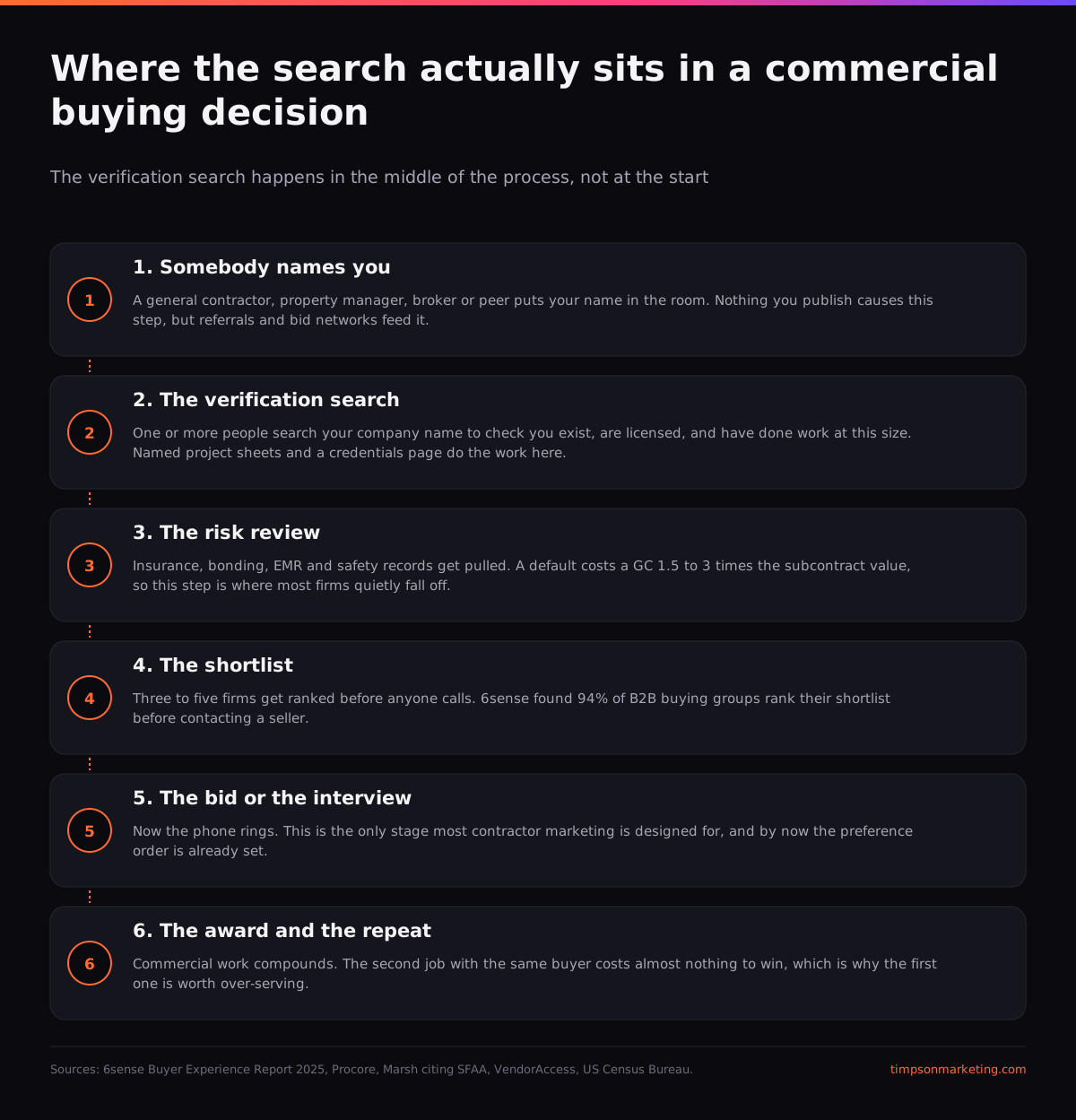
Your commercial buyer will search you, but not to find you. He searches to check you after somebody names you, and that single fact changes which pages have to exist on your site.

- In commercial work, search does not generate the lead. It decides whether you survive the verification step after a referral, a bid invitation or a prequalification search puts your name in the room.
- 6sense found that 94% of B2B buying groups rank their shortlist before ever contacting a seller, and the pre-contact favorite wins roughly 80% of deals.
- Commercial buyers dig hard because picking wrong is expensive: Marsh, citing the Surety and Fidelity Association of America, says a subcontractor default usually costs 1.5 to 3 times the subcontract value.
- Five of the six doors into commercial work open before anybody types your service into Google, which is why lead-form marketing feels broken to contractors chasing B2B work.
- The assets that matter are named project sheets, a credentials page, a capacity page, named humans, and a record that matches everywhere else it appears.
Your commercial buyer searches you second, not first
Roughly 58 cents of every US construction dollar sits outside private housing. Total construction spending ran at a $2,210.2 billion annual rate in May 2026, with private residential at $930.2 billion. The remainder is commercial, industrial, institutional and public work. That subtraction is ours, not the Census Bureau's, but it holds.
That is the money most contractors tell us they want. It is also the money almost every piece of local marketing advice is useless for, because that advice assumes one person, in one moment of need, typing one query and calling the first three results.
Commercial does not work that way. A property manager, a general contractor or a developer does not discover you in a moment of need. Somebody names you. Then he searches you to check whether the name was worth passing along.
In commercial and B2B work, search does not create the lead. It survives the check. Somebody names you first, usually a general contractor, a property manager, a broker or a peer. Then one or more people search your company name to verify you before you reach the shortlist. Your job is to make sure that search returns proof instead of a thin homepage.
The cleanest evidence for this does not come from construction at all. 6sense surveyed nearly 4,000 B2B buyers and found that 94% of buying groups rank their shortlist in order of preference before engaging with sellers, that the pre-contact favorite wins about 80% of deals, and that buyers fill 3.6 of their shortlist spots on day one.
Read those three findings together and the conclusion is uncomfortable. By the time your phone rings, the ranking has already happened. The lever is not showing up for "commercial concrete contractor near me." The lever is surviving a search on your own company name.
The real urgency for revenue teams is to influence those early journeys before buyers reach out.
The reason he digs so hard: a bad pick costs him 1.5 to 3 times the contract
A homeowner who hires the wrong plumber loses a Saturday. A general contractor who hires the wrong subcontractor loses the schedule, the retainage and sometimes the whole job. Marsh puts a number on it, citing the Surety and Fidelity Association of America: defaults usually cost 1.5 to 3 times the subcontract value.
That one number explains every frustrating thing about commercial buying. The prequalification portal. The three references. The Experience Modification Rate worksheet. The certificate of insurance that has to name the owner as additional insured. None of it is paperwork for its own sake. It is a buyer pricing his own downside.
So the usual advice to "build relationships and network more" is only half right, and the half it gets wrong is the expensive half. Relationships get your name into the room. Relationships do not survive a risk review. The firm that gets awarded is the one whose public record holds up after the relationship put it on the list.
Where commercial work actually comes from
There are six doors. Only one of them looks anything like the funnel your marketing was built for.
1. A general contractor's invited bid list. Procore's own documentation on subcontractor prequalification is blunt about how this works: general contractors typically only allow prequalified subcontractors to bid on their projects. The packet they ask for includes financial statements, surety and bonding capacity, OSHA incident rates, EMR ratings, trade licenses, W-9s and certificates of insurance.
2. Bid networks and plan rooms. Dodge Construction Network states that more than 99 million bid invitations and project notifications move through its network annually across more than 677,000 firms. Those are vendor-published figures, so treat them as scale rather than gospel, but the mechanism is real: GCs search a directory by trade and region and send private invitations.
3. Third-party prequalification platforms. ISNetworld says hiring clients can search and source from a network of more than 90,000 companies, with a review team that checks submitted documents against client requirements. If you work anywhere near energy, utilities, manufacturing or telecom, this is a gate, not a marketing channel.
4. Property manager and facility approved vendor lists. A property management vendor compliance guide from VendorAccess lists what actually gets a contractor onto the list: a current W-9, general liability at minimum $1M per occurrence and $2M aggregate, workers compensation, both the management company and the owner named as additional insured, and financial statements or bonding capacity for projects above $50,000.
5. Public procurement. Federal work has a hard front gate. FAR 52.204-7 states that an offeror is required to be registered in SAM when submitting an offer and at time of award. State and municipal work usually has its own prequalification registry. You cannot bid your way past registration.
6. Direct search. Somebody genuinely does type "structural drafting services" or "commercial excavation contractor St George" and starts cold. This is the smallest of the six doors by volume and the only one most agencies sell against.
Rank those doors honestly and the strategy inverts. Five of six open before anyone searches your service. That is the real reason contractors who buy commercial construction lead generation packages built on form fills feel ripped off. The package was priced against door six.
The five assets a verification search has to find
Once you accept that the search is a check and not a discovery, the site brief writes itself. These five assets are what a skeptical property manager or estimator is looking for, in the order he looks.
- Named project sheets: scope, square footage or linear footage, the GC or owner, the year, and what went wrong and how you handled it
- A credentials page: license numbers by state, bonding capacity and surety, insurance limits, EMR, and a named safety program
- A capacity page: crew count, owned equipment, service radius, largest job completed, and current backlog posture
- Named humans: the estimator, the project manager and the superintendent, with real bios and real photographs
- A record that matches: the same legal name, address and phone on your Google profile, LinkedIn, state license lookup and every bid network profile
The fifth one is the one contractors skip and the one that quietly kills deals. A buyer who finds three different phone numbers and two different legal entity names does not call to ask which is right. He moves to the next firm on the list.
Minimizing brand drift to ensure accuracy and consistency across every digital touchpoint is now the starting point for securing visibility.
Two notes on the Google profile, because commercial contractors get this wrong in both directions. Google's own guidelines say a business that rents a physical mailing address but does not operate from it is not eligible for a profile, and that service-area businesses should run one profile for the central office with a designated service area. So no virtual office in the city you want work in. But do not skip the profile either: it is the card that renders next to your name when a property manager searches you, and getting the primary category and service list right is what makes that card look like a real company. If you want the city coverage, build it with genuine location pages, not fake addresses.
The off-site half matters more here than in residential. Aleyda Solis measured 84% to 93% of AI citation weight sitting on third-party sites rather than the brand's own domain across 15 B2B brands, and Semrush found Google's AI Mode citing LinkedIn in close to 15% of its responses. For a commercial contractor that translates directly: your LinkedIn company page, your Dodge or Blue Book profile and your state license record are part of the verification surface whether you maintain them or not.
Worked example one: the excavation sub who wants on GC bid lists
Start here because the numbers are the friendliest. Site preparation contractors spend just 0.18% of revenue on purchased advertising, per the 2022 Economic Census, against 0.73% for roofing. Almost nobody in excavation is competing for the verification search. The bar is on the floor.
The sequence we run:
Build the prequal packet first
Financials, bonding letter, EMR history, OSHA 300A summaries, sample COI, safety manual, three GC references. This is the product. The website is the brochure for it.
Publish six named project sheets
Not a photo gallery. Six pages, each naming the GC, the owner, the site, the cubic yards, the schedule and one problem you solved. These are what the estimator reads.
Register where the invitations are
The bid networks your local GCs actually use, plus any state DOT or municipal prequalification registry that applies to your work.
Fix the record
One legal name, one address, one phone, matched across the Google profile, LinkedIn, the license lookup and every bid network profile.
Ask for the packet, not the job
The outreach to a GC's chief estimator is "here is our prequalification packet," not "do you have any work." One asks to be evaluated. The other asks for a favor.
The honest constraint: this does not produce a lead next Tuesday. It produces bid invitations over one to three quarters, and the first ones will be the jobs nobody else wanted. That is normal. Read our piece on how long local SEO actually takes before you set a budget against it, and our construction lead generation breakdown if you also need residential volume in the meantime.
Worked example two: commercial real estate leasing
Commercial leasing is a two-sided market and most leasing companies market to only one side. You need owners to give you listings and you need tenants or tenant reps to fill them. The verification search runs on both sides, for different things.
On the owner side, the buyer is an asset manager or a small landlord deciding who gets the listing. What he checks: your current and recently leased inventory, your days-on-market record, your submarket knowledge, and whether you are a real firm or one broker with a logo. The asset that wins it is not a services page. It is a submarket report you publish quarterly with actual asking rents, actual vacancy and actual absorption for the three or four submarkets you cover. That single asset does the credential work, the expertise work and the search work at once.
On the tenant side, the buyer is a business owner or a tenant rep and the listing itself is the discovery surface. Listings syndicate. Your website does not have to win the "office space for lease" query, and it usually cannot. What your website has to win is the search that happens after a tenant rep sees your name on a listing and wants to know whether you will be a problem to transact with.
Repeat business is the whole economics here. The National Association of Realtors reported that its members earned 20% of business from repeat clients and 21% from referrals, and that among members with 16 or more years of experience, 40% said repeat clients made up more than half their business. That is residential-weighted data and we will not pretend otherwise, but the shape is the same in commercial and the shape is the point: the second deal with the same owner costs almost nothing to win.
## Worked example three: drafting and design services Drafting is the hardest of the three because the buyer is technical, the work is invisible, and the competitive set is global. Your buyer is an architect, a structural engineer, a general contractor or a builder, and he is not comparing you to the drafter across town. He is comparing you to an offshore team at a third of your rate. Which means the verification search is doing something specific: it is checking whether you are worth the premium. Five things answer that on a page, and almost no drafting firm publishes any of them. - The exact software and versions you deliver in, including whether you can work to the client's title block, layer standard and template rather than your own - Real deliverable samples, redacted, showing a permit set and a shop drawing set, not renders - A stated turnaround commitment by deliverable type, with what happens when you miss it - Your NDA position, stated plainly, before anybody has to ask - The named drafter or engineer who will actually touch the file, with credentials and years The pilot project is the close. Offer a small paid pilot at a defined scope and price, and say so on the page. A GC who is nervous about handing you a permit set will hand you an as-built. The pilot converts a risk decision into a small purchase, which is exactly what a buyer who has been burned wants. One more thing for drafting specifically. Because the buyer is technical and time-poor, he is likely to ask a chatbot before he asks a peer. Semrush's survey of 643 US B2B professionals found 92% said AI tools had shaped their vendor shortlist, and 66% regularly use AI to research vendors. If the model has nothing to read about you, you are not in that answer. We wrote about that failure mode in detail in why AI does not recommend your business.
See what we actually build→By the time a user sees an answer, the model has already decided which sources matter.
What does not work, and what we will not sell you
Publishing the failures is part of the job, so here they are.
llms.txt does not do anything. Google's own documentation states there are no additional requirements to appear in AI Overviews or AI Mode, and no special files or markup needed. Ahrefs analyzed 137,000 sites and found 97% of llms.txt files are never read by AI crawlers. Anyone selling you one for commercial visibility is selling you nothing.
Schema markup will not get you cited. It helps machines parse a page and it is worth doing correctly. There is no evidence it causally lifts AI citations. Our full position on schema has the receipts.
Buying leads does not build a bid list. Pay-per-lead marketplaces sell the same commercial inquiry to several contractors and disappear the moment you stop paying. A prequalification packet at three general contractors is a durable asset. A month of purchased leads is not.
Ranking first is table stakes, not the win. BrightLocal found only 6% of consumers simply click the top result when choosing a local business. In a committee purchase with a risk review attached, position one buys you a look and nothing else.
How to tell it is working when nobody fills in a form
This is the measurement problem that makes commercial marketing feel unaccountable. The fix is to stop counting form fills and start counting the four things that actually move first.
| Signal | Where you read it | What it means |
|---|---|---|
| Branded search volume | Search Console, queries containing your company name | More people are being told your name and are checking you |
| Prequalification packets requested | Your own log | The verification step is being reached |
| Bid invitations received | Your own log, by GC | You are on somebody's list, which is the actual goal |
| Direct and LinkedIn referral traffic | Analytics | Name-first traffic, the signature of a verification search |
Branded search is the leading indicator and almost nobody tracks it. Ahrefs found that 45.7% of all Google searches are branded across roughly 150 million US keywords. In a referral-driven trade, that share runs higher, and a rising branded line with flat generic rankings is exactly what a working commercial program looks like.
The labor market gives you one more reason to move now. AGC's 2025 workforce survey found 92% of construction firms struggling to fill open positions, with shortages the leading cause of project delays.
Construction workforce shortages aren't just a problem for the construction industry. Construction projects of all types are being delayed because there aren't enough qualified workers available for firms to hire.
When owners and GCs are short on capable trade partners, the firm that is easy to verify gets called first. That is the whole argument. If you want a second opinion on whoever is running your marketing now, read how to tell if your SEO agency is working, and see what a real local program produced before you commit a budget. Everything we publish sits in the blog, and what we build is on our services page.
Frequently asked questions
How do contractors get commercial clients?
Through six doors: a general contractor's invited bid list, bid networks and plan rooms, third-party prequalification platforms, property manager approved vendor lists, public procurement registries, and direct search. Five of the six open before anyone searches your service, so the work is getting named and then surviving the check.
Does SEO work for commercial contractors?
Yes, but not the way it works for residential. Commercial search volume is small and the query that matters most is your own company name. SEO in a commercial context means making the verification search return proof: named projects, credentials, capacity and consistent records everywhere your name appears.
What is contractor prequalification?
It is the risk review a general contractor or owner runs before letting you bid. Procore's documentation lists financial statements, bonding capacity, OSHA incident rates, EMR ratings, licenses, W-9s and certificates of insurance. Most large GCs only allow prequalified subcontractors to bid on their projects at all.
How do I get on a general contractor's bid list?
Build the prequalification packet before you make contact, then approach the chief estimator asking to be evaluated rather than asking for work. Register on the bid networks your local GCs use, publish named project sheets at the size range you want, and keep your public records consistent.
Do I need a Google Business Profile if my customers are property managers?
Yes, but for a different reason. It is the card that renders beside your company name during a verification search, not a discovery channel. Google's guidelines prohibit a virtual office you do not operate from, and service-area businesses should run one profile for the central office.
How long does it take to win commercial work?
Plan in quarters, not weeks. Prequalification approval alone can take weeks, and the first invitations you receive tend to be the jobs other subs declined. A realistic sequence is packet and site assets in month one, registrations in month two, and invitation flow building across the following two quarters.
Are Google Ads worth it for commercial construction leads?
Sometimes, for a narrow set of queries where a real buyer searches cold, such as emergency commercial repair or a specific technical service. For committee purchases with a prequalification step, ads buy a click into a process you have not prepared for. Fix the verification assets first.
What should a commercial contractor's website have that a residential one does not?
Five things: named project sheets with the GC or owner and job size, a credentials page with license numbers and bonding and EMR, a capacity page with crew and equipment and largest job, named humans with real bios, and identical company records across every profile that mentions you.
Sources
- US Census Bureau. Monthly Construction Spending, May 2026 (C30) (2026-07)
- US Census Bureau. 2022 Economic Census, Construction Sector (EC2223BASIC) (2022)
- 6sense. Buyer Experience Report 2025 (2025-11)
- 6sense. The timeline for influencing B2B buyers is shrinking (2025-11)
- Marsh, citing the Surety and Fidelity Association of America. The rise of subcontractor defaults (2023-05)
- Procore. Subcontractor Prequalification: The Keys to Selecting Quality Subs (2026-07)
- Dodge Construction Network. Subcontractors: Commercial Construction Bid Opportunities (2026-07)
- ISNetworld. Contractor Prequalification and Ongoing Monitoring (2026-07)
- VendorAccess. The Essential Checklist for Property Management Vendor Compliance (2026-04)
- Acquisition.gov, US Federal Acquisition Regulation. FAR 52.204-7 System for Award Management (2024-11)
- Google Business Profile Help. Guidelines for representing your business on Google (2026-07)
- Google Search Central. AI features and your website (2026-07)
- Semrush. How AI shapes B2B buying (2026-07)
- Semrush. Most cited domains in AI search (2025-11)
- Semrush. Semrush releases expanded 2026 AI Visibility Index (2026-06)
- Aleyda Solis. SaaS AI search optimization study (2026-07)
- Ahrefs. AI search trends (2026-07)
- Ahrefs. Almost half of Google searches are branded (2025-05)
- BrightLocal. Consumer search behavior: how people decide (2026-07)
- National Association of Realtors. Income steady, even as market slows: 2025 member trends (2025-08)
- Associated General Contractors of America. Workforce shortages are leading cause of project delays (2025-08)
- Clearscope. The search engine wars are back with AI (2026-03)
Joseph Timpson has worked in search since 2010 and runs Timpson Marketing out of St. George, Utah. He built The Cited Method, a five stage framework for earning and proving real citations in AI answers, and publishes what does not work alongside what does.
Want this done for you, with the receipts to prove it worked?
One call, no pitch deck. We look at what is actually blocking you and tell you the truth about whether we can help.
Book a free consultation →