What a Real Local SEO Engagement Looked Like, Month by Month
Four of the top ranking local SEO case studies publish a percentage and a logo. None of them publish the work. This one publishes the work first, the numbers second, and a plain list of what the numbers cannot prove.

- The best ranking local SEO case studies publish outcomes with no method. Searchbloom shows a 2,500% keyword increase, Local Dominator shows 480% traffic, Miromind shows no numbers at all, and none of the three describes what was done in what order.
- An outcome number you cannot reproduce is not evidence. Under 16 CFR 255.2, an advertiser using a client's endorsement of a result should either hold substantiation that the result is representative or disclose what clients generally achieve.
- The five figures this post stands behind are 2,718 organic visits a month, 472 Google Business Profile calls a month, a 100/100/100/100 PageSpeed result, about $16.7K in added Ahrefs traffic value, and a 113 to 659 visit lift. Every one is published as a dated tool screenshot at josephtimpson.com/#proof. They come from client work, they are not all from one engagement, and none of them is a promise.
- The single biggest structural move in the engagement below was deleting pages, not adding them. Thirty five near duplicate city pages were consolidated into a smaller set and redirected.
- Ahrefs traffic value is a PPC equivalent estimate, not revenue. Google Business Profile calls counts taps on a call button, not conversations. Knowing what a metric measures is more useful than the metric.
Five numbers, and why they are the least useful thing on this page
Here are the five figures this page stands behind. 2,718 organic visits a month. 472 Google Business Profile calls a month. A 100/100/100/100 PageSpeed result. Roughly $16.7K in added Ahrefs traffic value. One page group that went from 113 visits to 659.
All five are published as dated tool screenshots on Joseph Timpson's proof page, where the SEMrush, Ahrefs, PageSpeed Insights and Business Profile panels behind them sit. Go and look at them before you read another word of this.
Do not hire us because of them.
Also do not hire the other agency because of its numbers. We read the pages currently ranking for this exact search before writing this one. Searchbloom's local SEO case study page names six clients and reports a 2,500% increase in top three keyword rankings, a 633% increase in page one rankings, and $4,445 returned for every $100 invested. It does not say what was done, or in what order. Local Dominator publishes a 480% traffic increase for an unnamed Austin cleaning company, evidenced by screenshots of its own software. Miromind's page titled four local SEO case studies contains no performance figures at all. SnowdriftCO's senior living study is the most honest of the four: it reports a 10% revenue increase and says plainly that timelines vary by competition, location and starting condition.
Not one of them publishes a work sequence. That is the whole problem.
A local SEO case study is only useful if it publishes the work in order. An outcome number on its own cannot be verified by you, cannot be reproduced by anyone, and tells you nothing about whether the agency would do anything sensible on your account. Read every case study you are handed with one question: what did they do, in what sequence, and what happened after each thing. If the page cannot answer that, it is a scoreboard, not evidence. Below is our sequence, month by month, including the parts that produced nothing.
The reading standard a regulator already uses
There is a formal version of this test, and it is worth borrowing even though it was not written for you.
16 CFR 255.2, the federal rule on consumer endorsements, says that an advertisement containing an endorsement about a key attribute of a product "will likely be interpreted as representing that the endorser's experience is representative of what consumers will generally achieve." The rule then says the advertiser "should possess and rely upon adequate substantiation for this representation," and that if it does not, the ad "should clearly and conspicuously disclose the generally expected performance in the depicted circumstances."
That is the part almost nobody in this industry has read. A line of small print saying results are not typical does not satisfy it. The rule requires the ad to state what clients generally get, and to have evidence for that number too.
This matters the moment a client's own words appear next to a result, which is exactly how agency case study pages are built. Searchbloom's page, for example, carries client testimonials referencing improvements ranging from 30% to 700% alongside the headline figures.
We are not accusing anyone of anything, and this is not legal advice. The useful part is the standard itself. If an agency cannot tell you what its clients generally achieve, then the one number it is showing you is decoration. And here is the honest admission that follows: neither can we. We do not have a large enough sample of comparable engagements to publish a median outcome, so we are not going to invent one.
That admission has to reach our own marketing too. Our case studies page is a wall of client outcome figures with no method attached to any of them. By the standard this post is arguing for, that page is a scoreboard, and pointing you at it as proof would be the exact move we just criticized. So we are not going to. What we can publish is the work, and this is it.
There's a lot in Local SEO you can't control. Don't build your process around those things.
That is the correct organizing principle for a case study as well as for a process. Rankings, revenue and market conditions are outputs you influence and do not control. The work sequence is the only thing an agency fully controls, so it is the only thing worth publishing as proof of competence.
What each of our five numbers actually measures
Before the log, the numbers, with their limits attached. This section exists because the definitions are more useful than the figures, and because we would rather you distrust these than take them at face value.
| Figure | What it measures | What it does not mean |
|---|---|---|
| 2,718 organic visits per month | SEMrush estimated monthly organic traffic on one client site, grown from near zero across six months | Not a measured session count from Analytics. Not leads, not jobs, not revenue |
| 472 Google Business Profile calls per month | Taps on the call button on one Business Profile in one month | Not 472 conversations. Not deduplicated by person |
| 100/100/100/100 PageSpeed | A single Lighthouse lab run scoring Performance, Accessibility, Best Practices and SEO | Not a ranking. Not field data from real users |
| About $16.7K added Ahrefs traffic value | A modeled PPC equivalent cost of the organic keywords a site ranks for | Not money earned. Not money saved |
| 113 to 659 visits | SEMrush estimated monthly traffic on one page group, before and after structural work | Not attributable to a single change with certainty |
Take the traffic value figure. Ahrefs defines traffic value as "the equivalent monthly cost of traffic from all keywords that the target website/URL ranks for organically, if that traffic was paid via PPC instead," calculated by multiplying each keyword's estimated organic traffic by its CPC and adding the results. Every input in that chain is an estimate: the traffic estimate, the CPC estimate, and the assumption you would have bought those clicks. Agencies present it as dollars because it has a dollar sign in front of it. It is a modeled proxy for keyword portfolio value, and it is useful as a trend line and close to meaningless as a single figure.
The calls number has a sharper problem. Google's own documentation defines the metric as "the number of times a customer clicked on the call button on your Business Profile." A tap is not a conversation.
A click to call also doesn't mean the person actually initiated the call.
Hawkins runs the most rigorous public testing operation in local search, and her guide to reading Business Profile performance metrics is the correction most agency dashboards need. Our own view, and this is a judgment rather than a published finding, is that any profile reporting call taps without a tracked line behind them is reporting an intent signal, not a lead count. If the number is going to appear in a contract, put call tracking on the receiving line first.
The PageSpeed score is the one clients love most and we defend least. Google's page experience documentation states that "there is no single signal" for page experience, that Core Web Vitals "are used by our ranking systems," and that Search "always seeks to show the most relevant content, even if the page experience is sub-par." A perfect Lighthouse score is a lab result on one device profile at one moment. It is worth pursuing because slow sites lose people, not because 100 outranks 89.
Month 1: access, a frozen baseline, and the audit nobody wants to pay for
Month one produced no rankings and no calls. It produced permission and a number to be judged against later.
Access capture
Google Search Console, Google Analytics 4, Google Business Profile ownership at manager level, WordPress admin, DNS and host. Every one of these was a separate request and two of them took three weeks.
Baseline freeze
Organic sessions, Business Profile calls and website clicks, tracked keyword positions, and a full crawl, all recorded and dated before a single change went live.
Crawl and index audit
Which pages exist, which are indexed, which are duplicates of each other, which return errors. This is where the thirty five page problem surfaced.
Conversion tracking check
Do forms actually deliver email. Does the phone number on the site match the phone number on the profile. Twice in the last two years the answer to the first question was no.
Spam and competitor snapshot
Screenshots of the local pack for the money queries, dated, so later movement can be argued from evidence rather than memory.
The baseline freeze is the step clients most want to skip and the one that decides whether month six is an argument or a report. Without a dated before, every later claim is the agency's word.
The access problem is not administrative trivia either. An agency that cannot see Search Console is guessing, and an agency that has manager access to a Business Profile it did not create can be removed from it without warning. If you are evaluating a proposal, our guide to what a local SEO retainer actually buys in hours is worth reading alongside this, because month one consumes a lot of them and produces nothing you can see.
Month 2: the 35 page problem, and why deleting pages was the growth move
The site had thirty five city pages. Each one targeted the same service in a different town. Each one was, structurally, the same page with the place name swapped.
This is the single most common thing we find on local service websites, and it is almost always the largest available win, because the fix is subtraction.
Google's spam policies define doorway abuse as "when sites or pages are created to rank for specific, similar search queries" that "lead users to intermediate pages that are not as useful as the final destination," and scaled content abuse as "when many pages are generated for the primary purpose of manipulating search rankings and not helping users." Thirty five swapped nouns sits close enough to both definitions to be a liability rather than an asset.
The mechanical damage is separate from the policy risk. Google's guidance on consolidating duplicate URLs says consolidation "helps search engines to be able to consolidate the signals they have for the individual URLs (such as links to them) into a single, preferred URL," and warns that crawl budget spent on duplicates is crawl budget not spent on your real pages. Thirty five pages competing for one query means thirty five weak candidates instead of one strong one.
Map demand
Which of the thirty five towns had real search volume and a real service history. Most did not.
Pick survivors
A small set of pages kept, each rewritten with content that only applies to that town: crews, jobs, permits, drive times, local landmarks.
Redirect the rest
Every retired URL 301 redirected to the nearest surviving page. Google's documentation ranks redirects first among canonicalization signals, calling them "a strong signal that the target of the redirect should become canonical."
Geo route carefully
Where a visitor's location was used to send them to the right regional page, we made sure crawlers were treated exactly like any other visitor from that location.
Re-crawl and verify
Submit the updated sitemap, confirm the redirects resolve in one hop, and watch the index count fall on purpose.
The geo routing step deserves a warning, because it is where this move goes wrong. Google's guidance on locale adaptive pages states that when content changes based on the visitor's perceived location, "Google might not crawl, index, or rank all your content for different locales," and instructs site owners to treat Googlebot "like you would treat any other user from that country." Location based redirects that send crawlers somewhere different from users are not clever. They are cloaking with a friendly name.
The honest result: this was the change that preceded the 113 to 659 lift on the surviving page group. We are not going to claim it caused it, because a consolidation, a content rewrite and a set of redirects all shipped inside the same window and no control group exists. What we will say is that removing thirty pages was followed by more traffic, not less, which is the outcome the theory predicts and the opposite of what most owners fear.
If you are staring at a folder of near identical city pages right now, our piece on building location pages that are not thin duplicates covers the survivors, and the one on ranking in a city you are not physically in covers why some of those towns were never winnable.
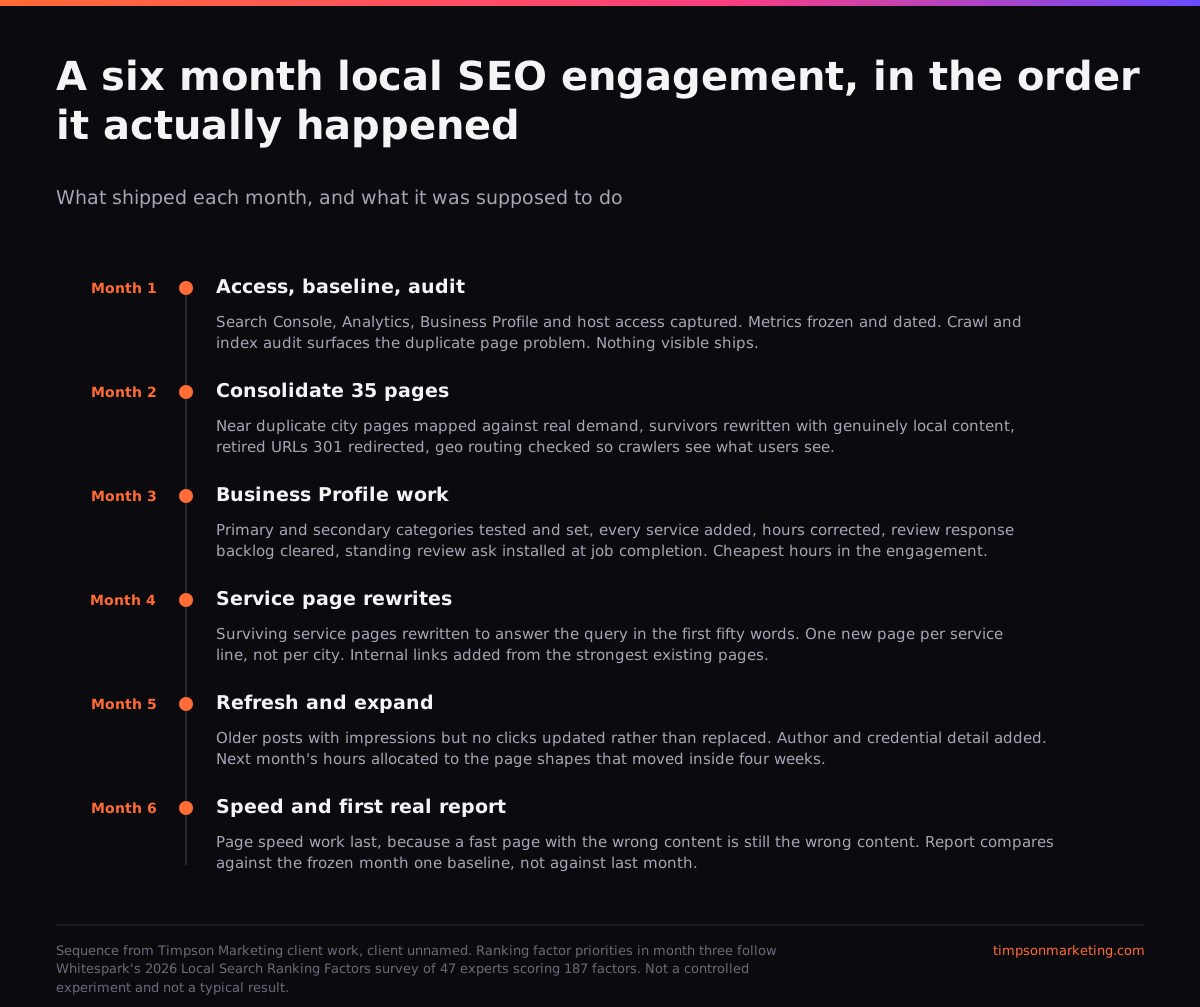
Month 3: the profile work that is boring, cheap, and works
Month three is the least impressive month to describe and the best return on hours in the entire log.
Whitespark's 2026 Local Search Ranking Factors report, built from 47 local search experts scoring 187 factors, puts the primary Business Profile category at the top of the local pack list with a score of 227, ahead of proximity of the business address to the searcher at 225. That is the finding worth internalizing: the single strongest controllable factor outranks the uncontrollable one. Google's own tips for improving local ranking name the same tension without the scores, listing relevance, distance and prominence as the three inputs and stating flatly that "There's no way to request or pay for a better local ranking on Google." Distance is the input you can neither edit nor buy. Relevance is the category and services fields, and those are free and take an afternoon. Meanwhile posting frequency sits at #148 and post quantity at #168, while predefined services sit at #22.
Most retainers are inverted relative to that data. They bill for weekly posts, which rank near the bottom of 187 factors, and leave the category and services fields half filled.
What shipped in month three:
- Primary category changed after testing what the top three competitors used for the money query, plus secondary categories filled from the available ten slots
- Every predefined service added, then custom services for the ones Google does not offer
- Hours corrected, including the fact that "business is open at time of search" ranks #5 in Whitespark's data at a score of 189
- Review response backlog cleared, then a standing ask process installed at the point of job completion
- Business name, address and phone standardized across the site, the profile and the top tier directories
The review work is the piece with the strongest evidence behind it. Sterling Sky's study of 8,186 businesses across 200 cities found that reviews received in the current month correlate with local pack ranking more strongly than lifetime review count. On the demand side, BrightLocal's 2026 survey of 1,002 US consumers found 74% look for reviews written in the last three months, and that 83% of people who were asked to leave a review went ahead and left one. Ranking evidence and buyer evidence pointing the same way is rare. When it happens, act on it.
The practical translation is that the bottleneck is the ask, not the customer. Our review generation guide has the process, and the piece on category selection covers the testing method we used here.
Months 4 and 5: content that answers a question instead of targeting a keyword
This is the slow part, and the part where an honest log has to admit uncertainty.
Ahrefs tracked one million newly published URLs for a year and found only 1.74% reached Google's top ten, down from 5.7% in a comparable 2017 study, with the average number one result five years old. But among the pages that did reach the top ten, 40.82% got there within the first month. Ranking is closer to bimodal than gradual. A page that does nothing for eight weeks usually does nothing for eight months.
That finding changed how we sequence content. We publish in small batches, watch which pieces move inside four weeks, and put the next month's hours behind the shapes that moved rather than behind the calendar.
What shipped across months four and five:
- Rewrites of the surviving service pages, each answering the question the query actually asks in the first fifty words
- One genuinely new page per service line rather than one per city
- Refreshes of older posts that already had impressions in Search Console but no clicks
- Author and credential detail attached to the pages where expertise is the product
- Internal links added from the strongest existing pages to the new ones, which is the cheapest ranking lever nobody schedules
The refresh work is more defensible than the new publishing. Seer Interactive's study of 7,683 cited pages carrying 47,097 citations found that 75% of pages cited in AI answers had been updated within the last year, and that 72% looked fresh by update date against only 42% by original publish date. Updating an existing page that already has impressions beats publishing a new one that has none, and it is faster.
Every step in this log maps to a line item in a real scope of work. Our service pages spell out what is included at each tier, in hours and deliverables rather than adjectives.
See the scope behind this sequence→Month 6: speed, the first honest report, and the thing we got wrong
Speed came last on purpose. A fast page with the wrong content on it is a fast page nobody wants.
The 100/100/100/100 PageSpeed result belongs to this phase, and it belongs in perspective. It is a lab score. The number that matters is field data from real visitors, and the honest framing is that speed work removes a friction cost rather than buying a ranking. Google's own page experience documentation, quoted earlier, is explicit that no single signal exists and that relevance wins over experience.
Month six also produced the first report worth reading, which compared everything against the frozen month one baseline rather than against the previous month. Month over month reporting is where agencies hide, because seasonality does most of the work.
And here is the thing we got wrong, which belongs in any case study that expects to be believed. We spent time in months two and three on structured data markup on the assumption it would lift visibility. It did not measurably do so. It is hygiene, it helps machines parse a page correctly, and it is not a growth lever. We have written that up separately in our honest assessment of whether schema markup is worth it, and we now sequence it as maintenance rather than as strategy.
None of the experts have special access to the internal workings of Google's local search algorithm.
Shaw wrote that as the methodology caveat on the most cited study in local search, the one whose scores we used in month three. The author of the industry's best ranking factors research opens by saying nobody involved knows the algorithm. Anyone selling you certainty is selling something they do not have, and Google's own documentation on hiring an SEO tells businesses plainly that no one can guarantee a number one ranking.
What this does not prove
This section is the reason to trust the rest of the page.
There is also a moving floor underneath all of this. Sterling Sky's State of Local SEO in 2026 reports that across 322 markets, AI local packs surfaced 5,943 unique businesses against 18,330 in traditional three packs, roughly a third as many winners, and that 88% of those markets had fewer unique businesses in the AI pack. A profile that holds its position can still get quieter. Rankings and calls are drifting apart, which is why we write review dates around calls and booked jobs rather than positions. Our piece on how local businesses show up in AI Overviews covers what that shift means for the same site.
Rather than investing in deeper customer insights, most marketers focus on developing stronger performance tracking as the primary way to demonstrate value.
Moorman said that on the back of the 2026 CMO Survey, which polled 308 US marketing leaders, 97% of them at vice president level or above. It describes the failure mode this whole post is arguing against: a dashboard substituted for understanding. A case study that is only a dashboard is the same substitution, sold to a buyer instead of to a board.
Run this log against the agency you are considering
You do not need our case study. You need theirs, in this format. Ask for it.
- What did you do in month one, before anything was visible, and how long did access take to obtain?
- Show me a dated baseline from a real engagement and the same metrics six months later, from the same source.
- What did you remove or consolidate, and what happened to traffic afterward?
- Which of your standard deliverables produced nothing on that account, and how did you find out?
- What is the median result across your comparable clients, not the best one?
- What exactly does each number in this report measure, and what does it exclude?
- What would you have done differently if you started that engagement again today?
Question five is the one that ends most sales conversations, and question four is the one that identifies a real practitioner. An agency that has never found a deliverable that failed has either never measured one or is not telling you.
If you want the shorter version of how to audit a live engagement you are already paying for, our guide to telling whether your SEO agency is working is built around the same principle, and the timeline piece covers what a realistic month six looks like before you set expectations. If a Business Profile has already slipped, start instead with the diagnostic for a ranking drop and the fundamentals of Maps ranking.
The five numbers at the top of this page are still there. They are real, the tool screenshots behind them are public, the clients are unnamed, and none of it is a promise. If you want the same sequence run against your own site, with a dated baseline and a review date written around calls instead of positions, tell us what you are working with, or work through the rest of the hiring and proof series.
Frequently asked questions
What should a local SEO case study include?
A work sequence, not just an outcome. It should state what was done in each month, in what order, what the baseline was before any change, what each metric measures, and which deliverables produced nothing. An outcome number with no method cannot be verified or reproduced.
Are local SEO case study results typical?
Almost never, and honest ones say so. Federal endorsement rules at 16 CFR 255.2 say an advertiser should either hold substantiation that a result is representative or disclose what clients generally achieve. Most agency case studies publish neither, so treat every headline percentage as a best case.
How long did the engagement in this case study take to show results?
Structural changes shipped in months one and two and movement followed over the next several months. Ahrefs found only 1.74% of new pages reach Google's top ten within a year, but 40.82% of those that do get there within the first month. Ranking tends to be fast or never.
Why would deleting pages increase traffic?
Thirty five near duplicate city pages compete with each other for the same query, split their signals, and waste crawl budget. Google's documentation says consolidating duplicates lets search engines combine signals into a single preferred URL. Fewer, stronger pages usually beat many weak ones.
Do Google Business Profile calls mean actual phone conversations?
No. Google defines the metric as the number of times someone clicked the call button on your profile. Joy Hawkins of Sterling Sky notes that a click to call does not mean the person actually initiated the call. Put call tracking on the receiving line if the number will appear in a contract.
What is Ahrefs traffic value and is it real money?
It is not money. Ahrefs defines it as the equivalent monthly cost of your organic traffic if you had bought it through PPC instead, calculated from estimated traffic multiplied by estimated cost per click. It is a useful trend line for keyword portfolio value and a poor proxy for revenue.
Does a 100 PageSpeed score improve rankings?
Not directly. Google states there is no single page experience signal, that Core Web Vitals are used by its ranking systems, and that Search shows the most relevant content even when page experience is sub par. Speed removes friction for visitors. Treat a perfect lab score as hygiene.
What should I ask an agency before hiring them?
Ask what they did in month one before anything was visible, for a dated baseline with the same metrics six months later, which of their standard deliverables produced nothing on that account, and what the median result is across comparable clients rather than the best one.
Why do you not name the client in this case study?
Client work is confidential unless the client asks to be named. Naming adds credibility for the agency and nothing for the reader, since you still cannot audit the account. The method, the sequence and the honest limits are the parts you can actually use.
Can you guarantee I will get the same results?
No, and neither can anyone else. Google's own hiring documentation states plainly that no one can guarantee a number one ranking. Your market, competition, starting position, budget and close rate will produce a different outcome from any published example.
Sources
- Legal Information Institute, Cornell Law School. 16 CFR 255.2, Consumer endorsements (2023)
- Searchbloom. Local SEO Case Studies (2026)
- Local Dominator. Local SEO Case Study: How We Increased Traffic by 480% (2024)
- Miromind. 4 Local SEO Case Studies (2026)
- SnowdriftCO. Senior Living Local SEO Case Study: Less Traffic, More Revenue (2026)
- Ahrefs Help Center. What is Traffic value and Paid traffic cost in Site Explorer? (2026)
- Google Business Profile Help. Understand your Business Profile performance and insights (2026)
- Sterling Sky. How to Interpret Google Business Profile Performance Metrics (2026)
- Google Search Central. Understanding page experience in Google Search results (2026)
- Google Search Central. Spam policies for Google web search (2026)
- Google Search Central. How to specify a canonical URL with rel canonical and other methods (2026)
- Google Search Central. Locale-adaptive pages (2026)
- Google Search Central. Do you need an SEO? Tips for hiring an SEO (2026-06)
- Whitespark. Local Search Ranking Factors 2026 (2025-11)
- Sterling Sky. What Gets You Ranking for Near Me Searches in 2025 (2025-11)
- Sterling Sky. The State of Local SEO in 2026 (2026-06)
- BrightLocal. Local Consumer Review Survey 2026 (2026-02)
- Ahrefs. How Long Does It Take to Rank in Google? (2025-05)
- Seer Interactive. Study: Content Recency's Impact on AI Visibility in 2026 (2026-07)
- GatherUp. The Theory and Praxis of Local SEO: What Mike Blumenthal Wants Every Agency to Know (2026)
- Duke University Fuqua School of Business, The CMO Survey. CMOs Face Headwinds Even as Marketing Value and AI Impact Grow (2026-03)
- Google Business Profile Help. Tips to improve your local ranking on Google (2026)
Joseph Timpson has worked in search since 2010 and runs Timpson Marketing out of St. George, Utah. He built The Cited Method, a five stage framework for earning and proving real citations in AI answers, and publishes what does not work alongside what does.
Want this done for you, with the receipts to prove it worked?
One call, no pitch deck. We look at what is actually blocking you and tell you the truth about whether we can help.
Book a free consultation →